- 01When to start preparing for school entry
- 02What I wrote after reading only the application guide
- 03I read the national administrative notice after being corrected
- 04What the administrative notice says
- 05National and municipal documents play different roles
- 06The municipality makes the final call
- 07Steps for cross-checking primary sources
- 08How to ask when checking with your municipality
- 09How the older child’s gakudo relates to leave for the younger child
- 10How it differs from continuing daycare during childcare leave
- 11Common mistakes and pitfalls
- 12Things to check before you start
- 13FAQ
- 14Official references
- 15Summary
Good morning, this is まさきん.
With our younger child starting elementary school, I began looking into gakudo, Japan’s after-school childcare clubs. Along the way, I actually wrote something wrong at one point. This post is my correction, along with how to compare primary sources side by side.
*This information is current as of publication. Please check the official sites for the latest details.
- Reading only my municipality’s application guide, I wrote that “parents on childcare leave do not meet the eligibility requirements for gakudo”
- In an administrative notice dated June 29, 2026, the Children and Families Agency says use is “possible at the discretion of the municipality”
- The national government is only saying “it may be used”; whether you can actually use it depends on your municipality’s requirements
- Some municipalities treat continuing use and new applications for the next school year differently
- For daycare, continuing use during childcare leave is listed as a reason in a national ministerial ordinance, so the mechanism is slightly different
When to start preparing for school entry
The first thing I checked was when to start preparing for school entry and thinking about gakudo. From what I found, municipal procedures seem to be concentrated in the autumn of the year before the child enters school.
If the application goes in during autumn, you need to know the requirements before then. So I decided to start comparing gakudo options and checking the application requirements from early summer of the year before entry. With summer vacation in between, moving a little early is probably just right.
I manage school-related paperwork with a system that OCRs school printouts and adds them to our calendar. I plan to run the gakudo application deadline through the same flow.
What I wrote after reading only the application guide
When I researched the requirements, what I read was our municipality’s application guide for gakudo for “Reiwa 8” (fiscal 2026).
It listed the conditions for households that can use it. Based on the wording, I wrote in my notes that “parents on childcare leave do not meet the eligibility requirements.” Since it was in the application guide, I assumed that was the answer.
Later, however, someone pointed out that this was wrong. They said an administrative notice from the Children and Families Agency (こども家庭庁) states that families on childcare leave can use gakudo at the municipality’s discretion.
I read the national administrative notice after being corrected
So I looked for the actual document on the Children and Families Agency’s website. It was posted on the “Laws and notices” page for after-school children’s clubs (放課後児童クラブ).
It is dated June 29 of Reiwa 8 (2026). The subject is “On the handling of cases where a guardian is on childcare leave in the After-School Healthy Child Development Program.” It is addressed to the relevant departments of prefectures and municipalities.
After reading it, I realized my note had gone too far. So I corrected that part of my notes. At the same time, I felt it would also be wrong to write “anyone on childcare leave can use it.” I explain why below.
What the administrative notice says
The notice first cites the scope defined in the Child Welfare Act. Gakudo is for “children attending elementary school whose guardians are not at home during the day due to work, etc.”
It then states that this “work, etc.” can include being on childcare leave. And it says that making use of this is possible “at the discretion of the municipality, which is the implementing body.”
It also notes that the agency had already been answering municipalities that asked in the same way. So it may be less a new rule and more a document re-circulating an existing interpretation.
A request to municipalities that exclude it across the board
The notice includes one more request. It concerns cases where, because of limited capacity or waiting lists, a municipality excludes all families on childcare leave.
In such cases, it asks municipalities to consider individual circumstances. The things to take into account are the situation of the guardian, the younger sibling who is the reason for the leave, and the elementary schooler who had been using gakudo. Where there are risks such as postpartum depression, developmental concerns, or disabilities, it also encourages coordination with related departments.
Guidance for children who have to leave
As a result of placement decisions, some children will have to leave gakudo when a parent goes on childcare leave. The notice also asks municipalities to make efforts to introduce those children to other places to spend their time, such as children’s centers (jidokan).
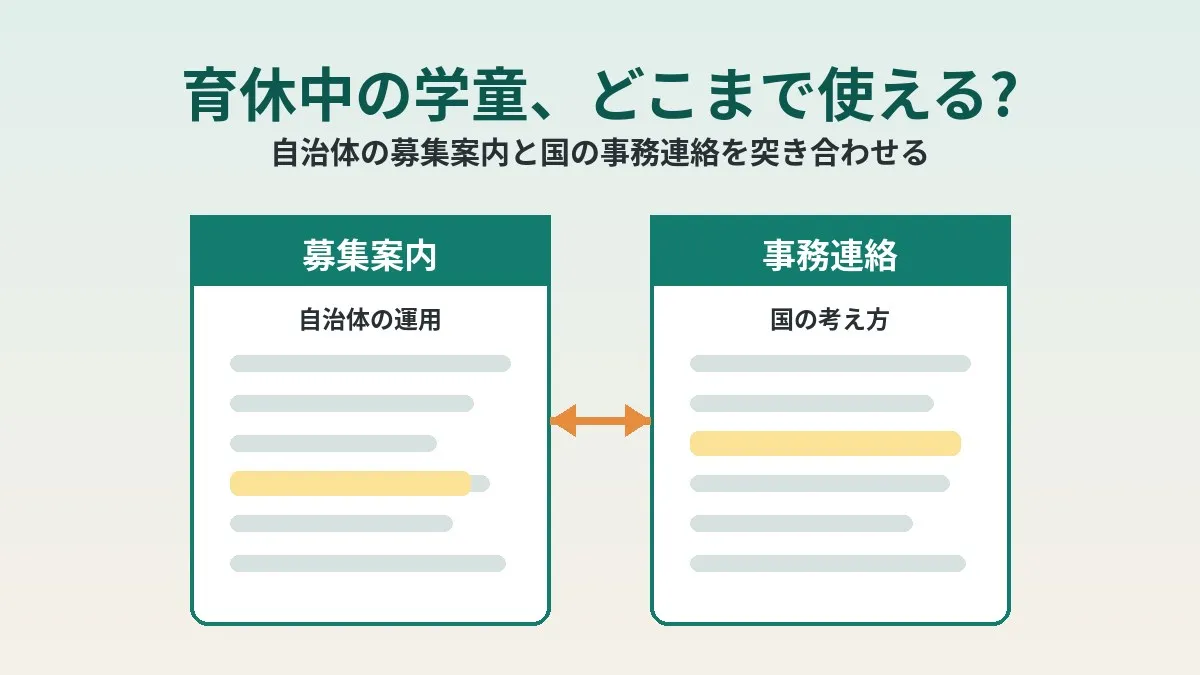
National and municipal documents play different roles
Looking back at why I stumbled, I think it came down to the different roles these documents play.
| Document | Issued by | What it says | How to position it when reading |
|---|---|---|---|
| Child Welfare Act | National government (law) | Definition of children eligible for gakudo | The root definition |
| Administrative notice | Children and Families Agency | Interpretation that use during childcare leave is possible at the municipality’s discretion | Interpretation and requests |
| Operating guidelines and commentary | Children and Families Agency | Operating standards and explanation of “work, etc.” | Operating fundamentals |
| Application guide and implementation rules | Municipality | Application requirements and procedures for that fiscal year | Actual operation |
National documents show a range: “it is fine to think of it this way.” Municipal documents decide, within that range, “this is how we do it here.”
So it may not be unusual for the two to say different things. This time in particular, the administrative notice came out at the end of June. The fiscal year’s application guide must have been written before that.
The municipality makes the final call
The important point is that the national government does not flatly say “you can use it.” The wording is that it is possible “at the discretion of the municipality.”
In fact, some municipalities have changed how they handle it after the notice. For example, Hanyu City in Saitama Prefecture has published that it previously asked children to leave when a parent took childcare leave. After receiving the notice, it reportedly changed this so children can continue to use gakudo for the rest of the fiscal year.
However, Hanyu City’s notice goes on. For those wishing to enroll in the following fiscal year, eligibility was limited to parents scheduled to return to work as of April 1. So continuing use and new enrollment are handled differently.
Mitsuke City in Niigata Prefecture also states that, in principle, it now covers cases where a working household was already using gakudo and plans to return to work. On the other hand, those who want to start using it newly during childcare leave are told to consult the responsible department.
Even from these two examples, the lines are drawn differently. I think the only way to know how your own municipality handles it is to check its documents.
Steps for cross-checking primary sources
Reflecting on this, I redefined my checking process.
- Read the municipality’s latest application guide, plus its implementation rules if there are any
- On the Children and Families Agency’s “Laws and notices” page, check the dates of relevant administrative notices
- Compare when the application guide was written with the date of the administrative notice
- Look for any “change in handling” announcement on the municipality’s website
- For anything still not written down, contact the responsible department
The key is step 3. If the application guide was written before the administrative notice, the handling may have changed since then.
In my case, I drew a conclusion from step 1 alone. At work, I check two sources for any number, but for family matters I made do with one.
How to ask when checking with your municipality
When you contact them, I think how you ask changes how precise the answer is. Just asking “Can we use it during childcare leave?” tends to get a rough answer.
- Is the handling during childcare leave the same for continuing use and new applications?
- If I am on childcare leave at the time of application, do I need proof of my planned return-to-work date?
- If I go on childcare leave partway through the fiscal year, will my child have to leave?
- Up to what age of the child the leave is for do you assume?
- Has the handling changed following the Children and Families Agency’s administrative notice dated June 29?
The last question may be a slightly pointed way to ask. But the staff should be aware of the notice. It might even speed things up.
It seems wise to note the date and the name of the department for whatever you hear. Staff can change by the time applications open, so having a record is reassuring.
How the older child’s gakudo relates to leave for the younger child
The situation the notice mainly has in mind is this: the older child uses gakudo, and a parent goes on childcare leave after a younger sibling is born.
In that case, the older child ends up leaving gakudo because of the leave. The notice says that media reports of such cases were what prompted it.
Caring for a baby while also watching an elementary schooler all afternoon is hard. That may be why the notice mentions “the situation of the elementary schooler who had been using it.”
That said, some municipalities do not have enough spaces. In areas with waiting lists, families on childcare leave may be given lower priority. This is another thing worth asking your municipality.
By the way, I have summarized birth-related benefits in my post on benefits available for childbirth and childcare.
Your income changes shape during childcare leave, so it is also a good opportunity to review your household budget. Among fixed costs, the phone bill may be one of the easiest to tackle.
Clicking this opens the Rakuten login page. Once you log in, you’ll see the campaign details.
How it differs from continuing daycare during childcare leave
By comparison, daycare works a little differently. Using daycare requires certification of “need for childcare,” and the qualifying reasons are listed in a national ministerial ordinance.
Article 1-5 of the Ordinance for Enforcement of the Child and Child Care Support Act includes an item about childcare leave. It covers cases where a preschool child other than the one the leave is for is using daycare, and continued use is recognized as necessary.
| Item | Daycare (older preschool child) | Gakudo (older elementary school child) |
|---|---|---|
| National basis | The enforcement ordinance lists continuing use during childcare leave as a reason | The administrative notice clarifies it can be included in “work, etc.” |
| Who it covers | Continuation for a child already enrolled | Use is possible at the municipality’s discretion |
| Final decision | The municipality recognizes the need | The municipality sets the requirements |
For daycare, I think the big difference is that it is written into the regulation as a reason. On the other hand, the wording is “recognized as necessary,” so the municipality’s judgment comes in here too.
Specifics such as up to what age continuing use is allowed seem to be set by each municipality. What I could confirm in the national documents was only that the reason exists.
Common mistakes and pitfalls
Including my own lessons, here are the easy places to trip up.
- Drawing a conclusion from the municipality’s application guide alone
- Reading the national notice as “anyone can use it”
- Mixing up continuing use with new applications for the next school year
- Not comparing the notice’s date with when the application guide was written
- Not keeping a record of what you were told on the phone
The first one applied to me. The second one, I almost did in the opposite direction when correcting myself.
The national administrative notice is a document addressed to municipalities. It is probably more natural to read it as not being grounds for a family to directly demand “let us use it.” Start by checking your municipality’s requirements and consultation contact.
Things to check before you start
- Have the municipality’s latest application guide and implementation rules on hand
- Checked the date and wording of the Children and Families Agency notice
- Sorted out whether your case is about continuing use or a new application
- Looked for any change-in-handling announcement on the municipality website
- Written down the questions to ask when you contact them
FAQ
Q. Can we use gakudo during childcare leave?
The national government’s position is that it can be used at the municipality’s discretion. But whether you can actually use it depends on your municipality’s requirements. Please check your local municipality’s guidance.
Q. Which national document is the basis?
The Children and Families Agency’s administrative notice dated June 29 of Reiwa 8 (2026). Its subject is “On the handling of cases where a guardian is on childcare leave in the After-School Healthy Child Development Program.” You can read it from the agency’s “Laws and notices” page.
Q. The application guide says families on childcare leave are not eligible.
The guide may have been written before the administrative notice. It would be good to check with the municipality’s announcements or the responsible department whether the handling has changed. Even if it has not, it may be worth consulting them about your individual circumstances.
Q. Is the handling the same for children already enrolled and for new applicants?
It seems to differ by municipality. There was an example where continuing within the fiscal year was allowed, but new enrollment for the next year required a planned return to work. I think it is best to ask about each case separately.
Q. Is this the same mechanism as continuing daycare during childcare leave?
Slightly different. For daycare, continuing use during childcare leave is written as a reason in a national ministerial ordinance. For gakudo, the administrative notice clarifies that it can be included in “work, etc.”
Q. Can we use it in areas with long waiting lists?
Depending on capacity, some municipalities apparently exclude families on childcare leave. The notice asks that individual circumstances be considered even in those cases. Start by asking the responsible department about the situation.
Q. What if we cannot get into gakudo?
The notice asks municipalities to introduce children who leave to other places such as children’s centers. It is also worth checking whether your area has a local children’s center or programs like after-school children’s classes (放課後子供教室).
Official references
- On the handling of cases where a guardian is on childcare leave in the After-School Healthy Child Development Program (Children and Families Agency administrative notice, June 29, 2026, PDF, in Japanese)
- Laws and notices on the After-School Healthy Child Development Program (after-school children’s clubs) (Children and Families Agency, in Japanese)
- Commentary on the Operating Guidelines for After-School Children’s Clubs (Children and Families Agency, March 28, 2025, PDF, in Japanese)
- Ordinance for Enforcement of the Child and Child Care Support Act (e-Gov Law Search, in Japanese)
- Change in handling when guardians of after-school club children take childcare leave (Hanyu City, in Japanese)
- Using after-school children’s clubs during childcare leave (Mitsuke City, in Japanese)
Summary
What I learned from this is that documents play different roles. The national administrative notice sets out the interpretation, while the municipal application guide determines how things work that year.
I read only the operational document and treated it as the final word on the interpretation. That said, reading only the national document and concluding “we can use it” is just as risky, I think.
If you start in early summer of the year before school entry, there is plenty of time to ask questions before the autumn application. When documents contradict each other, line up the dates and ask your municipality. That level of approach may be enough.
I also wrote about how we handle weekday evenings in my post on blocking out weekday nights for a dual-income family. I hope it helps once your gakudo is decided.
Clicking this opens the Rakuten login page. Once you log in, you’ll see the campaign details.
This article contains affiliate advertising. If you sign up for a product or service through a link on this site, we may receive compensation from the partner company. The site operator is also an employee of Rakuten Group and may receive compensation through an employee referral program. The content and opinions here are based on the operator’s own experience and research regardless of any advertising relationship, but please read with the above in mind. See the Disclaimer & Affiliate Disclosure for details. Disclaimer & Affiliate Disclosure
This article includes machine-translated content. Please check the official Rakuten Mobile multilingual page for exact terms.
If you have concerns about Rakuten Mobile coverage or signal quality, you can consult through the official signal improvement request form .