- 01How we ended up paying the full amount
- 02Getting it back is a two-step process
- 03This is separate from the lump-sum childbirth allowance
- 04Handle the newborn’s insurance enrollment and medical certificate in parallel
- 05What is “ryoyohi” in health insurance?
- 06Typical situations where you end up paying in full
- 07For preschoolers, 80% comes back
- 08Step 1: Apply to your insurer for ryoyohi
- 09Step 2: Apply for your local child medical subsidy
- 10Copy your receipts before sending them to your insurer
- 11Deadlines: 2 years and 5 years
- 12How high-cost medical care benefits and extra benefits fit in
- 13Common mistakes and pitfalls
- 14Check before you start applying
- 15FAQ
- 16Official sources I referred to
- 17Summary
Good morning, this is まさきん.
This summer, our fourth child was born. Right after the birth, the baby was admitted to the neonatal unit, and we ended up paying the full medical bill up front.
Getting that money back means applying to two different offices in a specific order. I stumbled a bit on that order, so I’m laying it all out here.
This reflects information at the time of publishing. Please check the official sites for the latest terms.
- A newborn’s insurance card often isn’t ready in time, so a hospital stay can mean paying the full amount up front
- For medical costs you paid in full, first apply to your health insurance for “ryoyohi” (reimbursement of medical expenses)
- For a preschool child, the math works out to 80% of the insured treatment coming back as ryoyohi
- For the remaining out-of-pocket share, apply to your local government’s child medical subsidy as a “reimbursement” (shokan-barai)
- Local government applications often require your insurer’s payment decision notice and the receipts
- Original receipts sent to your insurer won’t come back, so always make copies before mailing them
- The lump-sum childbirth allowance is for the mother’s delivery costs; the baby’s treatment is a separate matter
How we ended up paying the full amount
It started with the birth of our fourth child. From the day the baby was born, they had to stay in the neonatal unit for about a week. I’ll leave out the medical details here.
The problem was the insurance card. The baby was admitted on the very day of birth, so naturally the health insurance enrollment hadn’t been done yet. The eligibility certificate (shikaku kakuninsho) arrived about four weeks after the birth.
So we had to pay the full hospitalization cost for the time being. With no insurance card and no medical certificate, it was “100% out of pocket.”
Normally, if you show your insurance card and medical certificate (iryosho), you pay almost nothing at the counter, especially for kids, since their medical costs are subsidized. So seeing a bill for the full amount gave me a bit of a jolt.
But there’s a system for getting back what you’ve paid up front. That’s health insurance “ryoyohi” and the “reimbursement” (shokan-barai) through your local government’s child medical subsidy.
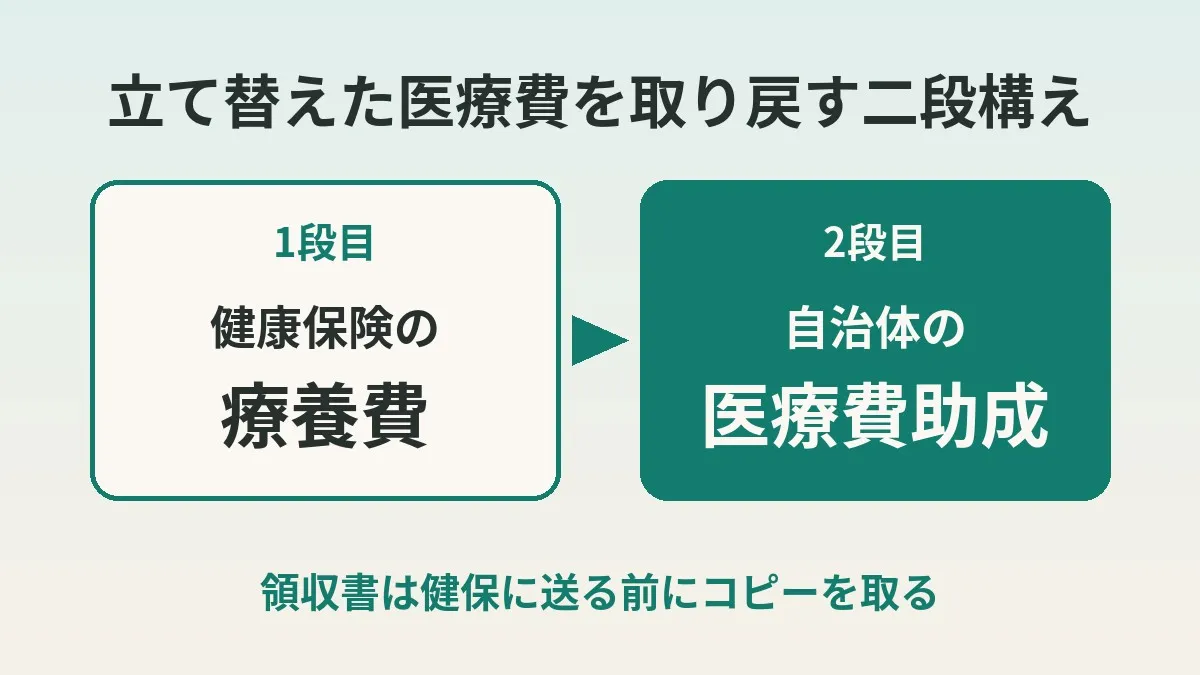
Getting it back is a two-step process
In a nutshell, two programs fill in the gap, one after the other.
| Step | Where to apply | What comes back |
|---|---|---|
| Step 1 | Your health insurance | The insured portion, minus your out-of-pocket share |
| Step 2 | Your local government | The out-of-pocket share left after step 1 (within the subsidy scope) |
| Not covered | Neither | Costs insurance doesn’t cover (such as private room fees) |
Step 1 is the amount health insurance would normally have paid. Step 2 is what your medical certificate would normally have wiped out at the counter. In other words, you’re working your way back, after the fact, to the state you’d be in “if you’d been able to show the medical certificate at the counter.”
Order matters. In many municipalities, you apply for the subsidy only after your insurer has made its payment decision.
This is separate from the lump-sum childbirth allowance
When it comes to money and childbirth, the first thing that comes to mind may be the lump-sum childbirth allowance. According to the Japan Health Insurance Association (Kyokai Kenpo), for a birth at a hospital enrolled in the Japan Obstetric Compensation System, it’s 500,000 yen per child.
But this money is meant for the mother’s delivery costs. If you use the direct payment system, it goes straight to the hospital. It doesn’t cover a baby’s hospital stay for treating an illness.
The baby’s treatment is a medical cost handled by the baby’s own health insurance. So until the baby is enrolled, there’s no insurance card. That’s exactly where paying the full amount up front comes from.
| Cost | Whose cost | Main source of funds |
|---|---|---|
| Delivery and hospital stay (mother) | Mother | Lump-sum childbirth allowance |
| Routine newborn care for a healthy baby | Often included in the delivery costs | Lump-sum childbirth allowance, etc. |
| Baby’s treatment and hospital stay | The baby | Baby’s health insurance + child medical subsidy |
It’s easy to assume that the lump-sum allowance takes care of all the money around childbirth. Keeping these separate in your head should help you stay calm if you do end up paying up front.
Handle the newborn’s insurance enrollment and medical certificate in parallel
Once the baby is born, the first step is adding them as a dependent on a parent’s health insurance. It takes a little while for the eligibility certificate or similar to arrive.
The child medical subsidy’s medical certificate is also hard to move forward without that health insurance information. So it seems best to start the dependent enrollment right after submitting the birth registration. Things get hectic after a birth, but I found that the sooner you get this done, the easier everything else becomes.
Some hospitals will apparently hold off on settling the bill until the insurance card arrives. Why not ask the billing counter once the hospital stay is decided? In our case, we paid the full amount for the time being.
What is “ryoyohi” in health insurance?
As a rule, health insurance works by showing your insurance card at the counter and receiving treatment. The Japan Health Insurance Association calls this “benefits in kind.”
Sometimes, though, circumstances make that impossible. In those cases, you pay the full amount yourself and then claim a refund later. That refund is “ryoyohi.”
The refund is calculated based on what the treatment would have cost under insurance. From that amount, your normal out-of-pocket share is deducted, and the rest is paid to you. If what you actually paid is lower than the standard amount, what you paid is used as the basis instead.
Typical situations where you end up paying in full
Here are typical examples I found on the Japan Health Insurance Association’s pages.
- You went to the doctor without your My Number insurance card or eligibility certificate and had no choice but to pay in full
- After changing jobs or similar, you used your old insurance card
- You had a therapeutic device, such as a corset, made on a doctor’s orders
- You fell suddenly ill abroad and got treatment there
For families with kids, the most likely case might be a newborn. That was exactly our situation. Sometimes a baby needs treatment before the health insurance enrollment is finished.
Nishinomiya City’s FAQ says that in this case you pay the full amount at the counter. Later, you apply to both your health insurance and the municipality’s medical subsidy.
Ryoyohi is meant for cases with “unavoidable circumstances.” If you simply forgot your insurance card, I think the safest bet is to ask your own health insurer how they handle it.
For preschoolers, 80% comes back
The share of medical costs you pay yourself for children depends on age. According to the Ministry of Health, Labour and Welfare, children who haven’t started compulsory education pay 20%.
So if you paid up front for insured treatment for a preschooler, 80% should come back as ryoyohi. From elementary school on, the share is 30%, so 70% comes back.
A newborn baby, of course, also pays 20%. The remaining 20% or 30% is what step 2, the child medical subsidy, fills in. What the subsidy covers varies by municipality, so please be sure to check your own local government’s page.
Step 1: Apply to your insurer for ryoyohi
In our case, I first applied to the health insurance society at my workplace for ryoyohi. The flow was roughly as follows.
- Get the receipt and an itemized statement of the treatment from the hospital
- Get your insurer’s ryoyohi application form
- Fill in the form, attach the receipts and other documents, and send it in
- The insurer reviews it and sends you a payment decision notice
- The ryoyohi is deposited into the bank account you specified
The Japan Health Insurance Association says that for payments you made up front, you need a “certificate describing the treatment” and the receipt. If you were treated using an old insurance card, you also need the medical fee statement (known as a “receipt” or rezepto).
Document names and forms may differ a little depending on your insurer. It’s a good idea to read the application instructions carefully first.
For us, the “reason you couldn’t use your insurance card” on the form was simply that the card was still being issued. That’s a common reason for newborns, so I don’t think you’ll get stuck here.
A stay that spans two months gets split into monthly statements
The baby’s hospital stay happened to span the end of one month and the start of the next. That meant the itemized statement was split into two, one per month. I requested the statements at the hospital’s document counter and picked them up.
Medical costs are basically calculated per month. The same goes for high-cost medical care benefits and a health insurance society’s extra benefits. So when a stay spans two months, how much falls in which month can change how much comes back. It’s reassuring to have your statements organized by month.
When the payment decision notice arrives
Once the review is done, a payment decision notice arrives. Ours came too, and the insured portion minus our out-of-pocket share was set to be refunded.
You’ll use this notice when you apply to your local government in step 2. So when it arrives, don’t throw it away. Personally, I found it reassuring to scan it as soon as it arrived.
Sudden expenses like family medical bills make you think about your monthly fixed costs, too. Starting with something like your phone bill, where a single review keeps paying off, might be one way to go.
Clicking this opens the Rakuten login page. Once you log in, you’ll see the campaign details.
Check the numbers on the notice against the deposit
Actually, there was something on our payment decision notice that bothered me. The sum of the line items didn’t match the number in the total field. The total was slightly higher.
At first I thought it was a typo. But thinking it over, I had a hunch. Some health insurance societies add their own top-up on top of the statutory benefits, called “extra benefits” (fuka kyufu).
For family medical costs, it goes by a name like “family medical expense supplement.” In many cases, it refunds your monthly out-of-pocket amount minus a set threshold. When I plugged our numbers into our insurer’s formula, it matched the difference exactly.
The extra benefit wasn’t printed as a line item. It had simply been added into the total without comment. And it only applied to one of the two months the stay spanned. Because it’s calculated per month, it may not kick in for a month where your out-of-pocket amount is small.
Because the notice is an official document, it’s tempting to take it at face value. But when the numbers don’t add up, working backward from how the system works can reveal the reason. Just like handling numbers at work, when you have two sources, you reconcile them.
If your insurer offers extra benefits, the municipality’s application form may have a field asking whether you received them. Amounts refunded as extra benefits are generally excluded from the child medical subsidy. Don’t overlook any gap between the total field and the line items on the notice.
Step 2: Apply for your local child medical subsidy
Once your insurer has decided on the payment, next comes your local government’s child medical subsidy. These are the programs known as “Maru-nyu” and “Maru-ko.”
Tokyo’s infant medical subsidy page explains that it covers your out-of-pocket share under medical insurance. If you visited a hospital where you couldn’t use the medical certificate, you first pay your share. Then you take that receipt to your city or ward’s department in charge and apply.
Getting reimbursed later for what the medical certificate couldn’t cover at the counter is what’s called “reimbursement” (shokan-barai). We sent our application by mail.
Documents needed for the local government application
Comparing several municipalities’ pages, the required documents were broadly similar. Many municipalities ask for the following.
| Document | Details | Notes |
|---|---|---|
| Application form | Municipality’s own form | Many municipalities let you download it from their website |
| Receipts | Issued by the hospital | Some accept copies if you submitted the originals to your insurer |
| Insurer’s payment decision notice | When ryoyohi or high-cost medical care benefits were paid | Many municipalities require it when you paid in full |
| Medical certificate / proof of insurance | For the child | My Number insurance card, eligibility certificate, etc. |
| Bank account details | Account in the parent’s name | Not required in some municipalities |
For example, Nerima Ward says receipts should in principle be originals. But if you have to submit the originals to your insurer, copies are fine. Chuo Ward says that if you paid the full amount, you should apply to your insurer first and then to the ward.
In our case, too, we needed the insurer’s payment decision notice and copies of the receipts. That said, the fine print differs by municipality, so please be sure to check your own local government’s page.
Copy your receipts before sending them to your insurer
This is the lesson I most want to share. Once you send the original receipts to your insurer, they basically don’t come back.
The Japan Health Insurance Association’s application form page states that attached documents won’t be returned. It also clearly says that if you’ll need them for city procedures, you should keep copies in advance.
If you don’t know the order and send only the originals, you’ll have nothing left for step 2. You might end up having to go back to the hospital for help. This is one to really watch out for.
- Before sending receipts to your insurer, copy or scan every page
- Copy the payment decision notice as soon as it arrives, too
- Keep a note of which documents you sent to your insurer
Deadlines: 2 years and 5 years
Watch the deadlines, too. The right to receive health insurance benefits expires after 2 years.
According to the Japan Health Insurance Association, for ryoyohi, the clock starts the day after you paid the medical bill. For high-cost medical care benefits, it’s 2 years from the 1st of the month after the month of treatment.
Local subsidy deadlines vary by municipality. Nerima Ward and Chuo Ward both allow up to 5 years. But if your insurer application is delayed, the subsidy application gets harder to move forward too. So in practice, I think it’s best to keep the 2-year limit in mind.
| Where to apply | Approximate deadline | Clock starts |
|---|---|---|
| Insurer (ryoyohi) | 2 years | The day after you paid the medical bill |
| Insurer (high-cost medical care benefits) | 2 years | The 1st of the month after the month of treatment |
| Local government (reimbursement) | Varies (5 years in some cases) | The day after the receipt or payment date, etc. |
How high-cost medical care benefits and extra benefits fit in
A hospital stay can get expensive. In that case, your insurer’s high-cost medical care benefits and any extra benefits offered by your health insurance society come into play.
Tokyo’s page says medical costs covered by the insurer’s high-cost medical care benefits or extra benefits aren’t eligible for the subsidy. Hachioji City’s page also says it won’t subsidize the portion covered by other programs. Nerima Ward, too, says the subsidy covers your out-of-pocket share excluding high-cost medical care benefits.
In short, you first collect whatever your insurer will pay back. Then the local government fills in what’s left. That’s another reason the two-step order matters.
Hospital meal costs are handled differently by municipality
Meal costs during a hospital stay need attention, too. Under Tokyo’s program, the standard meal charge during hospitalization is excluded from the subsidy.
On the other hand, some municipalities, like Nerima Ward, list meal costs as covered by the ward’s reimbursement. It may be that the ward adds its own coverage on top of the Tokyo program. This varies a lot from place to place, so checking it should help you avoid leaving money on the table.
Common mistakes and pitfalls
Putting together our experience and the cautions I saw on official pages, here’s the list.
- Assuming the lump-sum childbirth allowance will also cover the baby’s hospital stay
- Putting off adding the baby as a dependent, which delays the ryoyohi application too
- Sending original receipts to your insurer without keeping a copy for the local government
- Trying to apply to the local government before your insurer, and coming up short on documents
- Throwing away the payment decision notice
- Missing the gap between the line items and the total on the notice, and not noticing the extra benefits
- Putting off the application without thinking about the 2-year deadline
- Assuming costs insurance doesn’t cover, like private room fees, will also come back
The one I almost tripped on was copying the receipts. It’s preventable if you know the order, so I’d be glad if you remember this post right after paying a bill up front.
Check before you start applying
- I finished adding the baby as a dependent on our health insurance
- I have both the original receipts and copies (or scans) of them
- I checked the ryoyohi application form and attachment instructions from our health insurer
- I confirmed the hospital can give me an itemized statement of the treatment for each month
- I checked the required reimbursement documents on my local child medical subsidy page
- I put the insurer deadline (2 years from the day after payment) on my calendar
- I decided where to keep the payment decision notice when it arrives
FAQ
Q. How long does it take for ryoyohi to be deposited?
It depends on the insurer, so check your own insurer’s guidance. The Japan Health Insurance Association says that if you apply online, you can check the processing status.
Q. Can I apply for the child medical subsidy before applying to my insurer?
It seems many municipalities ask you to apply after your insurer if you paid the full amount. Chuo Ward’s page also says to apply to the ward after applying to your insurance association. That’s because the insurer’s payment decision notice is required.
Q. Where do the original receipts go?
Your insurer requires the original receipts when you apply for a refund of costs you paid up front. Some municipalities accept copies if you submitted the originals to your insurer. But handling differs by municipality, so I think it’s safest to check in advance.
Q. Is it the same when a newborn’s insurance card wasn’t ready in time?
It often ends up being the same two-step process. That was our case, too. Nishinomiya City’s FAQ describes paying the full amount first and then applying to both your insurer and the subsidy. It’s a good idea to add the baby as a dependent and apply for the medical certificate as early as possible.
Q. Does the lump-sum childbirth allowance cover the baby’s hospital stay too?
The lump-sum childbirth allowance is meant for the costs of the delivery itself. A hospital stay for the baby’s treatment is a medical cost handled by the baby’s own health insurance. So it’s best to think of it as something you get back through ryoyohi and the child medical subsidy, separately from the allowance.
Q. What’s the deadline for applying?
Insurer ryoyohi expires 2 years from the day after you paid the medical bill. Local subsidies vary, and some allow up to 5 years. Still, since the insurer comes first, it may be wise to aim for the 2-year mark.
Q. Do private room fees come back too?
Ryoyohi covers insured treatment only, so costs insurance doesn’t cover aren’t included. The child medical subsidy also covers your out-of-pocket share under medical insurance. It’s safest to assume private room fees and the like won’t come back from either.
Q. Can I apply by mail?
We sent our local government application by mail. Nerima Ward’s and Hachioji City’s pages also accept applications by mail. Chuo Ward, on the other hand, says applications are in principle made in person, so check your own municipality’s guidance.
Official sources I referred to
- Lump-sum childbirth allowance (Japan Health Insurance Association)
- Ryoyohi (Japan Health Insurance Association)
- Paying medical costs up front: ryoyohi (Japan Health Insurance Association)
- When you paid the full medical bill up front (Japan Health Insurance Association FAQ)
- Ryoyohi application form for up-front payments and therapeutic devices (Japan Health Insurance Association)
- About health insurance benefits (Japan Health Insurance Association FAQ)
- Patient cost-sharing rates and high-cost medical care limits (Ministry of Health, Labour and Welfare)
- Infant medical subsidy program, Maru-nyu (Tokyo Metropolitan Government Bureau of Social Welfare)
- Applying for reimbursement of child medical subsidy (Nerima Ward)
- Child medical subsidy (Chuo Ward)
- Infant medical subsidy program, Maru-nyu medical certificate (Hachioji City)
- When your child saw a doctor before their health insurance information arrived (Nishinomiya City FAQ)
Summary
When you pay your newborn’s medical bill up front right after birth, you can get it back in two steps: ryoyohi from your insurer and the subsidy from your local government. For a baby, 80% should come back from the insurer first. This is separate from the lump-sum childbirth allowance, so keeping the two apart in your head will help you stay calm. The rest of your out-of-pocket share may also be covered by the local subsidy.
But I found that if you don’t know the order and how to handle the documents, it’s easy to get stuck at step 2. Above all, make copies of your receipts before sending them to your insurer. And if the numbers on the notice don’t add up, suspect extra benefits.
I’ve covered benefits around childbirth in my post on benefits for childbirth and childcare. For reviewing your household budget as a whole, how to get started reviewing fixed costs may also help.
If you have a baby on the way, it may be reassuring to check the steps for adding them as a dependent ahead of time. If you have receipts for a bill you paid up front, start by making one copy.
Clicking this opens the Rakuten login page. Once you log in, you’ll see the campaign details.
This article contains affiliate advertising. If you sign up for a product or service through a link on this site, we may receive compensation from the partner company. The site operator is also an employee of Rakuten Group and may receive compensation through an employee referral program. The content and opinions here are based on the operator’s own experience and research regardless of any advertising relationship, but please read with the above in mind. See the Disclaimer & Affiliate Disclosure for details. Disclaimer & Affiliate Disclosure
This article includes machine-translated content. Please check the official Rakuten Mobile multilingual page for exact terms.
If you have concerns about Rakuten Mobile coverage or signal quality, you can consult through the official signal improvement request form .