- 01Why I put eating out on a weekly budget
- 02The two-week actuals: 82% and 204%
- 03I left the cap unchanged
- 04The remaining question: what counts toward the bucket
- 05The average eating-out spend is 16,563 yen a month (Family Income and Expenditure Survey)
- 06Set the weekly budget starting from your average actuals
- 07Three things to look at in a review
- 08Steps for a two-week review
- 09A way of looking that prevents overspending at convenience stores
- 10Common mistakes and pitfalls
- 11Who it suits and who it doesn’t
- 12Things to confirm before you start
- 13Frequently asked questions
- 14Official sources I referred to
- 15Summary
Good morning, まさきん here.
Two weeks have passed since I put a weekly budget on eating out. Week 1 came in at about 80% of the cap, and week 2 at about double. I spent a little time thinking about how to read that gap, so I am noting down the review procedure.
Note: this information is current as of publication. Please check the official sites for the latest conditions.
- Group eating out, cafes, and convenience stores together, and manage them with a weekly cap rather than a monthly one
- Don’t just set a weekly budget and leave it; review the level against two weeks of actuals
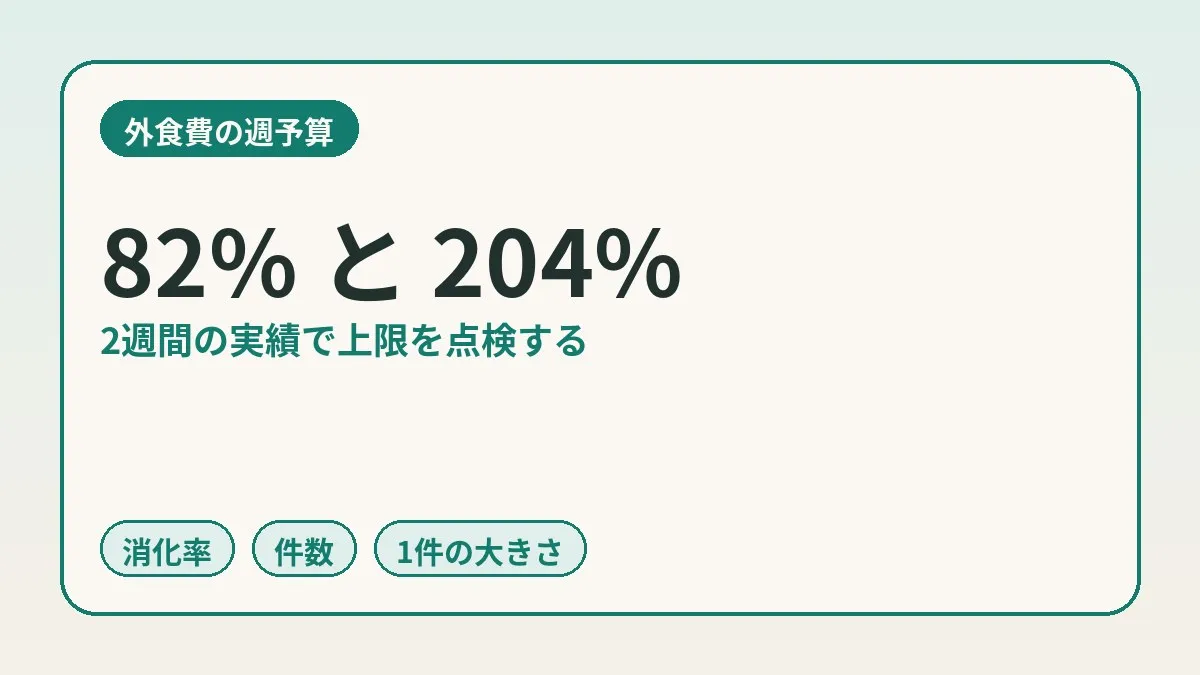
- My actuals were 82% of the cap in week 1 and 204% in week 2
- The week 2 overrun was mainly due to three family meals out over a long weekend, and I left the cap unchanged
- Whether you count occasion meals in the same bucket changes what an overrun means
Why I put eating out on a weekly budget
The scope is three things: eating out, cafes, and convenience stores. I grouped these three and set a single cap per week. The amount itself differs by household, so in this post I write in ratios.
I chose weekly rather than monthly because I wanted a shorter interval between reviews. With a monthly budget, you notice at the end of the month. Even if you notice you overspent, that month can no longer be fixed.
With weekly, you get about four chances a month to notice a drift. Each review has fewer transactions too, so looking back is easy. Within food costs, I think eating out and the like suit the weekly unit well.
The two-week actuals: 82% and 204%
Let me put the results of the two weeks in a table first. I tallied them from the card transactions imported into my accounting software.
| Week | Burn rate against the cap | What was in it |
|---|---|---|
| Week 1 | About 82% | Everyday eating out, cafes, and convenience stores |
| Week 2 | About 204% | Includes three family meals out over a long weekend |
| Of week 2: the three family meals | About 160% | These three alone were about 1.6 times the cap |
| Rest of week 2 | Just under 50% | Everyday spending excluding the three |
| Week 3 | Not yet final | Transactions are slow to post |
Week 1 stayed within about 80% of the cap. Week 2 was roughly double the cap. Lined up as numbers alone, week 2 looks like a big failure.
But what was inside week 2 was a little different. The main cause of the overrun was three meals out with the family over a long weekend. These three alone came to about 1.6 times the cap.
Put the other way, week 2 excluding those three was just under half the cap. Looking only at everyday spending, it was if anything lower than week 1.
I left the cap unchanged
The conclusion: I have not moved the cap. I neither raised nor lowered it; it stays as is.
The reason is simple: everyday spending was inside the cap in both weeks. Week 1 was about 80%, and the everyday portion of week 2 was just under half. As a level, I read it as neither too tight nor too loose.
If I raised the cap to match the week 2 overrun, ordinary weeks would become slack. So I judged it better not to touch the amount.
The remaining question: what counts toward the bucket
I left the amount alone, but one question remains. Whether to keep counting family meals out on long weekends and occasions in the same weekly bucket.
If I keep counting them, weeks with a long weekend will structurally overrun. Eat out three times as a family and that alone exceeds the cap. A bucket that reads “over” every time may gradually stop getting looked at.
On the other hand, a separate bucket can also become an escape hatch. I haven’t yet decided which is better. In this post I will go only as far as laying out both options as material for the decision.
Same bucket vs. separate bucket
Here are the pros and cons of the two options in a table.
| Point of comparison | Option A: count in the same weekly bucket | Option B: put occasion meals in a separate bucket |
|---|---|---|
| How it works | All eating out goes into one weekly budget | Everyday spending in the weekly budget, occasions in a separate monthly or yearly bucket |
| Pro | Total eating-out spend is visible as one number | Everyday overspending shows up directly in the burn rate |
| Pro 2 | No moments of doubt about where to draw the line | Numbers stay steadier even in long-weekend weeks |
| Con | Weeks with a long weekend structurally overrun | If “occasion” is loosely defined, the bucket becomes a formality |
| Con 2 | Easy to get used to overruns and stop looking at the numbers | One more bucket to manage |
| Likely a good fit for | Households with few occasion meals out | Households where family meals out cluster around long weekends and occasions |
If you stay with Option A, one approach is to change how you read it. Treat long-weekend weeks as overruns by design, and check whether it balances out in the monthly total.
If you go with Option B, you need to write the definition of the separate bucket first. For example, make it countable conditions such as “a long weekend that includes a public holiday” or “occasions such as birthdays.” If you can add “this is an occasion too” after the fact, wouldn’t the everyday bucket lose its meaning?
This thinking is close to what I wrote earlier in my post reviewing Rakuten Super Sale against a bulk-buying budget. That one, too, was about splitting by content rather than looking at the total.
The average eating-out spend is 16,563 yen a month (Family Income and Expenditure Survey)
When reviewing the level, you also wonder about the general average. I checked the Family Income and Expenditure Survey from the Statistics Bureau of Japan.
In the 2025 average for households of two or more people, eating out averages 16,563 yen a month. Food as a whole is 94,895 yen a month, so eating out is about 17% of food. Consumption expenditure was 314,001 yen a month, and the Engel coefficient was 28.6%.
| Item (two-or-more-person households, 2025 average) | Monthly average | Share of food |
|---|---|---|
| Consumption expenditure | 314,001 yen | — |
| Food | 94,895 yen | 100% |
| Of which eating out | 16,563 yen | About 17% |
| Of which prepared foods | 13,580 yen | About 14% |
| Of which beverages | 5,859 yen | About 6% |
| Of which confectionery | 9,211 yen | About 10% |
I calculated the shares from the published monthly averages. Adding eating out and prepared foods gives 30,143 yen a month, about 30% of food.
Converting to weekly makes the benchmark easier to grasp. Dividing the 16,563 yen for eating out by about 4.3 weeks in a month gives roughly 3,800 yen a week. With prepared foods added, 30,143 yen comes to roughly 7,000 yen a week.
However, this is the average across all households of two or more. I think the reality varies considerably with household size, age, and whether both partners work. It seems best to see it less as a standard for setting your own cap and more as material for checking where you stand.
What the survey’s “eating out” includes and excludes
When comparing against the average, the scope of the term needs care. “Eating out” in the survey is a bit narrower than everyday usage.
In the list of income and expenditure classifications, eating out is divided into general eating out and school lunches. The items listed under general eating out are as follows.
- Japanese soba and udon, Chinese noodles, other noodle meals out
- Sushi (eating out), Japanese food, Chinese food, Western food
- Hamburgers, other staple-type meals out
- Coffee shop charges, drinking charges
Cafe spending falls under eating out as “coffee shop charges.” School lunches are also on the eating-out side. On the other hand, boxed meals and rice balls were items under “prepared foods.” Filled breads and frozen prepared foods are also listed under prepared foods.
In other words, a boxed meal bought at a convenience store does not count as eating out. Coffee drinks are “beverages,” and sweets are “confectionery.” The survey classifies by item, not by the store where you bought it.
My grouping of “eating out, cafes, and convenience stores” does not match this classification. On top of eating out and coffee shop charges, it straddles parts of prepared foods, beverages, and confectionery. So it cannot be compared directly with the 16,563 yen figure.
Set the weekly budget starting from your average actuals
From here, I will lay out how to set a weekly budget in general terms.
The starting point is past actuals. Using card statements or a budgeting app, pull one to two months of spending around eating out. Divide that by the number of weeks and you have your current weekly average.
I think setting the cap at that average or slightly below is the sustainable way. Cut it in half all at once and you tend to blow through it in week 1 and give up. Making your current level the bucket first, then adjusting as you review, may be easier to keep up.
Materials from J-FLEC (Japan Financial Literacy and Education Corporation) also describe the first stage of household management as “grasping income and expenditure.” Next comes “reviewing expenditure.” I think the order of grasp first, review second, is the same for a weekly budget.
Eating out is spending that moves with each week’s decisions. Looking as well at spending that continues once decided, like phone costs, makes it easier to get the whole household budget in order.
Clicking this opens the Rakuten login page. Once you log in, you’ll see the campaign details.
Three things to look at in a review
When reviewing a weekly budget, I think it is better not to look at the burn rate alone. What I looked at this time were the following three.
| What to look at | What it tells you | Example of how to read it |
|---|---|---|
| Burn rate | How much of the cap you used | Around 80% suggests the level is about right |
| Number of transactions | How many times you spent | A high count points to everyday frequency |
| Size per transaction | How heavy each one is | Going over on few transactions points to big meals out |
Even at the same 200% burn rate, the remedy changes with what is inside. Are there 30 small payments, or 3 big meals out? The former is about frequency; the latter is about how the bucket is defined.
My week 2 was the latter. Three transactions made up about 1.6 times the cap, so the cause was size per transaction, not count. If you skip this and sum it up as “I overspent,” the remedy ends up off target.
Steps for a two-week review
Here is the review flow, numbered.
- Decide up front what goes in the bucket, such as eating out, cafes, and convenience stores
- Set a weekly cap from past actuals
- Run it for two weeks without moving the amount
- Once the transactions are all in, calculate the burn rate for each week
- Check the number of transactions and the large individual payments
- For a week that went over, also calculate the burn rate excluding the few large items
- Decide whether to raise, lower, or keep the cap
- If doubts arise about the bucket’s definition, note them down as an open question
Step 6 was the most useful this time. If the figure after exclusion is inside the cap, you can read the everyday level as about right. If it is over even after exclusion, it is time to fix either the cap or how you spend.
For step 8, I don’t think you need to settle it on the spot. I too have put how to count occasion meals on hold. What matters is writing down that it is on hold.
Week 3 is not final while transactions are still posting
The tally for week 3 is not yet final. Transactions are slow to post to my accounting software.
This time lag comes with any tally based on card transactions. The number of days from use to posting differs by store. So figures right after a week ends can come out on the low side.
In my post on automatically checking each night’s card spending, I also wrote that a posting delay of a few days is the norm for these integrations. I think it is safer to review the weekly budget a few days later rather than right after the week ends. Judge on interim numbers and the result may change afterward.
A way of looking that prevents overspending at convenience stores
At convenience stores, each purchase is small, so it is the count that adds up. So what to watch is the number of visits rather than the amount.
In general, approaches like these come to mind.
- Decide the number of visits per week up front and don’t track the amounts closely
- Shift drinks and snacks toward bulk buying
- Use a single payment method so transactions are easy to count on the statement
The third ties directly to how easy the review is. When cash and multiple payment methods are mixed, you lose track of the weekly count. I also wrote about the idea of consolidating payments in my post on consolidating household cards into one.
Common mistakes and pitfalls
Here are the points where it is easy to stumble with a weekly budget.
- Moving the cap right away based on one week’s result
- Regretting the total without looking at what was inside an overrun week
- Judging on numbers before the transactions are all in
- Conveniently adding more “it was an occasion, so it’s separate” after the fact
- Comparing the statistical average directly with your own bucket of a different scope
- Starting with the scope of the bucket left vague
If you count long-weekend weeks in the same bucket, overruns may keep coming. Once you get used to overruns, you may stop looking at the numbers at all. Even if you continue with the same bucket, I think it is best to decide in advance at least how you will read long-weekend weeks.
Who it suits and who it doesn’t
A weekly budget seems likely to suit cases like these.
- You eat out or use convenience stores several times a week
- You feel you can’t act on a look back done all at once at month-end
- You mainly pay by card or QR code payment, so tallying from transactions is easy
Conversely, there are cases where it seems unlikely to fit.
- You eat out once or twice a month, almost only on occasions
- You mainly pay in cash, so weekly tallying takes effort
- You have many business trips or long outings, so the week-to-week swings are large to begin with
For households where eating out centers on occasions, a monthly or yearly bucket may suit better than a weekly one.
Things to confirm before you start
- Wrote out what goes in the bucket (eating out, cafes, convenience stores, etc.)
- Worked out the weekly average from the past one to two months of actuals
- Decided where the week starts and ends (which day to which day)
- Decided which transactions to tally from and how many days to wait for posting
- Put the review date in the calendar for two weeks out
- Wrote down at least a tentative plan for handling occasion and long-weekend meals
Frequently asked questions
Q. How much should I set my weekly eating-out budget at?
I don’t think there is a fixed right answer. A sustainable way is to first divide the past one to two months of actuals by the number of weeks and set it around that average. Then run it for two weeks and review the level.
Q. What is the average eating-out spend per household?
In the 2025 average of the Family Income and Expenditure Survey, eating out for households of two or more is 16,563 yen a month. That is about 17% of food overall. But the reality changes with household size and age. It seems best to treat it as a rough guide.
Q. Can you also tell me the average for a family of four?
The summary of results I checked this time gave figures for all households of two or more. I have not been able to confirm eating-out spend for four-person households alone from this material. For tabulations by household size, try looking in the survey’s detailed statistical tables.
Q. Does a convenience store boxed meal count as eating out?
Under the survey’s classification, it does not. Boxed meals and rice balls are items under “prepared foods.” Which side you put them on in your own budget is up to you, but when comparing with statistics the difference in scope needs care.
Q. Should I separate cafe spending from eating out?
In the survey, coffee shop charges are one item within eating out. I group eating out, cafes, and convenience stores into one bucket. Separating them gives a finer view, but I think more buckets also mean more review effort.
Q. If I go over the weekly budget, should I make it up the next week?
I think it depends on why you went over. If everyday frequency is the cause, holding back a little the next week is natural. If a big occasion meal is the cause, thinking about how the bucket counts things may fit better than cutting the next week.
Q. Why review after two weeks rather than one?
Because with just one week, you end up judging on a week that happened to be unusual. In my case too, the results for week 1 and week 2 differed greatly. With two weeks, it is easier to tell an ordinary week from a special one.
Q. Should long-weekend and occasion meals go in a separate bucket?
Both have pros and cons. With the same bucket you see the total as one number; with a separate bucket the everyday level is easier to see. I myself haven’t decided which to go with yet.
Official sources I referred to
- Family Income and Expenditure Survey report, income and expenditure, summary of 2025 (Reiwa 7) average results (Statistics Bureau of Japan)
- Family Income and Expenditure Survey, list of income and expenditure classifications (Statistics Bureau of Japan)
- Money matters every working adult should know, for younger workers (J-FLEC, Japan Financial Literacy and Education Corporation)
Summary
I think a weekly budget gets its meaning from the review after you set it. Look not only at the burn rate but also at the count and the size per transaction. For a week that went over, also calculate the figure excluding the few large items. That alone makes it easier to see whether the cap should move.
In my case, I left the cap unchanged. I haven’t yet decided how to count occasion meals. Once the week 3 numbers are final, I intend to think it over again.
The approach of going through fixed costs in order is summarized in my post on reviewing one contract per week. Eating out is spending that moves every week, and phone costs are fixed spending. Wouldn’t it be good to look at both together?
Clicking this opens the Rakuten login page. Once you log in, you’ll see the campaign details.
This article contains affiliate advertising. If you sign up for a product or service through a link on this site, we may receive compensation from the partner company. The site operator is also an employee of Rakuten Group and may receive compensation through an employee referral program. The content and opinions here are based on the operator’s own experience and research regardless of any advertising relationship, but please read with the above in mind. See the Disclaimer & Affiliate Disclosure for details. Disclaimer & Affiliate Disclosure
This article includes machine-translated content. Please check the official Rakuten Mobile multilingual page for exact terms.
If you have concerns about Rakuten Mobile coverage or signal quality, you can consult through the official signal improvement request form .