- 01What a no money day is
- 02Why three days a week: Tuesday, Wednesday, Thursday
- 03The weekly timetable
- 0410 minutes of prep at 21:00 the night before
- 05Last week’s result: 0 transactions on all 3 days in the alerts
- 06Small purchases as seen in the Family Income and Expenditure Survey
- 07Cashless payments feel less like spending
- 08The pitfall is shopping for events
- 09Your own rules for what not to count
- 10How to check the answer
- 11No forcing yourself
- 12Common mistakes and pitfalls
- 13Frequently asked questions
- 14Official sources I referred to
- 15Summary
Good morning, まさきん here.
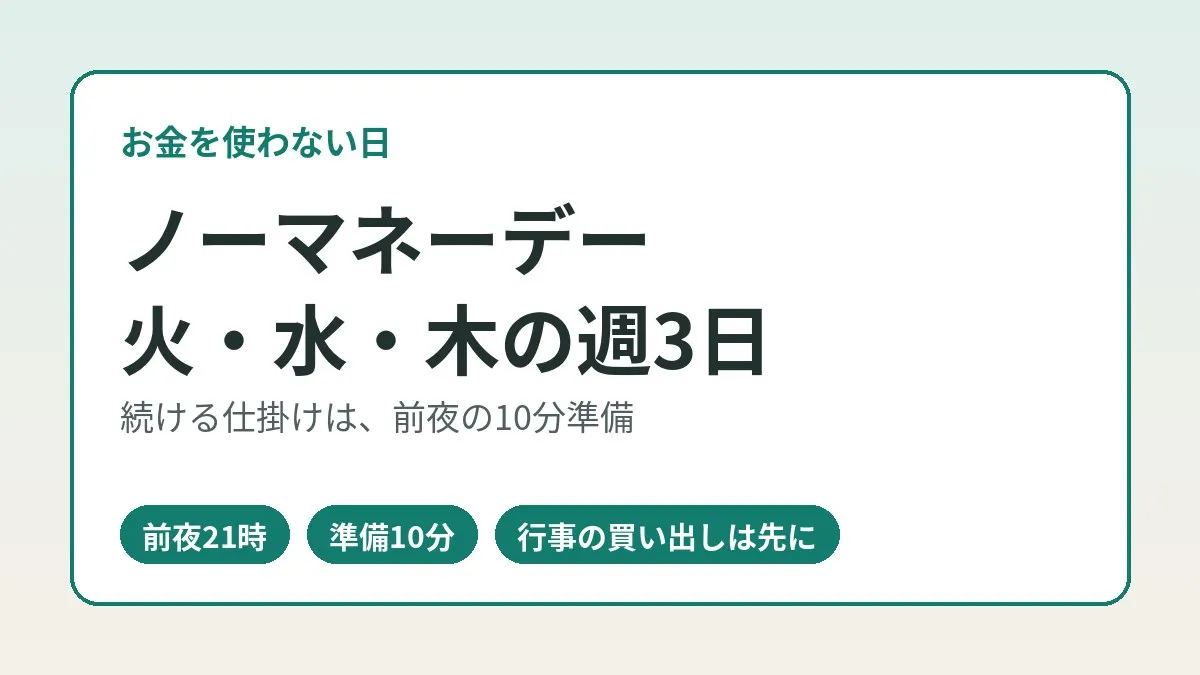
I am writing down how to build no money days (days without spending) into three days a week. In our house, Tuesday, Wednesday and Thursday became days when the wallet stays shut. I got through those 3 days last week, so here is a summary of the night-before prep and the point where I nearly tripped.
Note: this information is current as of the publication date. Please check the official sites for the latest conditions.
- No money days are my office days, Tuesday, Wednesday and Thursday, three days a week. Neither wallet nor card comes out on those days
- What keeps it going is a 10-minute slot at 21:00 the night before. I get the next day’s drink and snack ready and take them with me
- Last week the card usage alerts showed 0 transactions on all 3 days. I plan to check again after the statement is posted
- The pitfall is shopping for events. The ingredients for the packed lunch for a Friday school trip nearly ended up with “no day to buy them”
- I could not find an official definition of “no money day”. What you leave out of the count is for you to decide
What a no money day is
A no money day is a day when you spend no money. In English it is often called a No Spend Day.
It does not seem to be a term with an official definition, though. In my background research, I could not find an explanation on any government page. I have not been able to confirm any public data showing a savings effect either.
So this post does not talk about effects. I only write about how our household set it up and how the prep is arranged.
Why three days a week: Tuesday, Wednesday, Thursday
In our house, Tuesday, Wednesday and Thursday, which are my office days, became no money days. Neither wallet nor card comes out.
There is one purpose. I put a “weekly cap” on variable costs such as eating out and convenience stores. I want to hold that cap in reserve instead of using it up in the first half of the week. This is the mechanism for that. The cap itself is covered in my post looking back on two weeks of a weekly eating-out budget.
I chose office days because my movements are easy to predict. The time I leave home and the time I get back are more or less fixed. I figured that as long as I prepare what to bring, I can cut down the moments where I buy something.
Putting it in the shared family calendar
Just deciding is not enough; I would forget. So I put it in our shared family calendar as all-day events. That covers the 3 days, Tuesday, Wednesday and Thursday.
I made them all-day events because they show at the very top of the day. The family can see them too. It helps that I do not have to explain out loud the premise that “today is a no-spend day”.
The weekly timetable
Laid out as a table, the week looks like this.
| Day | Spend or not | What to do the night before |
|---|---|---|
| Mon | Spending day | At 21:00, prepare the drink and snack for Tuesday |
| Tue | No-spend day | At 21:00, prepare for Wednesday |
| Wed | No-spend day | At 21:00, prepare for Thursday |
| Thu | No-spend day | No prep needed |
| Fri | Spending day | No prep needed |
| Sat and Sun | Spending days | On Sunday, look over the coming week |
Prep is only needed on Monday, Tuesday and Wednesday nights. At 10 minutes three times a week, it comes to about 30 minutes in total.
“Look over the coming week” on Sunday is a line I want to add because of the pitfall I describe later.
10 minutes of prep at 21:00 the night before
The mechanism for keeping it going is the night-before prep. I set a 10-minute slot at 21:00 the evening before. I get the drink and snack for the next day at the office ready and take them with me.
If I try to do it on the morning itself, I mostly do not make it in time. When I do not make it, I end up buying while out. So I moved it to the night before.
| What to prepare | What to do | Aim |
|---|---|---|
| Drink | Prepare the next day’s and put it near my bag | Fewer moments of buying a drink while out |
| Snack | Prepare something for a small hunger and put it alongside | Fewer evening stops at the convenience store |
| Next day’s schedule | Check the calendar for plans that need payment | Notice unexpected spending the night before |
As steps, it goes like this.
- At 21:00, check the next day’s schedule in the calendar
- Prepare the drink
- Prepare the snack
- Put both near my bag
- If there is a plan that needs payment, decide how to treat that day
I keep the slot on the short side at 10 minutes. I think long prep does not last.
Last week’s result: 0 transactions on all 3 days in the alerts
Last week I got through Tuesday, Wednesday and Thursday without opening my wallet. The card usage alerts showed 0 transactions on all 3 days.
I cannot call it final yet, though. Statements reach the accounting software a few days late. There is also still a chance that payments not shown in the alerts turn up later.
So after posting, I plan to check once more whether all 3 days are at 0. All I can say right now is “it was 0 in the alerts”. I am keeping those two apart.
Small purchases as seen in the Family Income and Expenditure Survey
What I want to reduce with no money days is the little bits of spending while out. How big is that in published statistics?
I looked at the Family Income and Expenditure Survey from the Ministry of Internal Affairs and Communications. These are the 2025 averages, for households of two or more people, as monthly averages.
| Item | Monthly average |
|---|---|
| Consumption expenditure (total) | 314,001 yen |
| Food | 94,895 yen |
| Of which, eating out | 16,563 yen |
| Of which, prepared food | 13,580 yen |
| Of which, sweets and snacks | 9,211 yen |
| Of which, beverages | 5,859 yen |
The source is Table I-1-1 in the “Family Income and Expenditure Survey Report (Income and Expenditure), Summary of 2025 Average Results”.
When I added up eating out, prepared food, sweets and snacks, and beverages, the four came to 45,213 yen. That is a little under half of food. This is not a published figure; I added the numbers in the table myself.
Of course, not all of it is purchases made while out. Ready-made dishes and tea consumed at home are in there too. And since it is about the average household, it is separate from our own numbers. I am not saying to cut all of this. I look at it as a rough guide that “small purchases add up to more than you would think”.
I could not confirm per-day or per-weekday amounts from the materials I opened this time. So I am not writing any daily breakdown.
Cashless payments feel less like spending
There is a reason I made it a day when not only the wallet but also the card stays shut.
Teaching materials published by the Financial Services Agency list points to watch with cashless payments. One sentence says “it is hard to feel that you have spent, so it is easy to overspend”. On the other hand, it also noted the benefit of being able to check your usage history in an app.
For me, a no money day is a mechanism that uses both sides of this. Decide the no-spend days, and fence off that faint sense of spending by day of the week. Then use the 0 in the usage alerts to check my answer. I think it is easy to verify precisely because a history remains.
The same materials also bring up the idea of dividing things into “needs” and “wants”. No money days may suit small spending on the wants side.
If you only ever look at fixed costs, small variable spending tends to get put off. The reverse is true as well. Money that goes out every month like clockwork, such as a phone bill, does not move by a single yen on a no money day. It seems better to review that in one go on a separate occasion.
Clicking this opens the Rakuten login page. Once you log in, you’ll see the campaign details.
The pitfall is shopping for events
This may be the real subject of the post. Last week, I nearly tripped over one thing.
On the Friday of that week, my child had a school trip. A packed lunch was needed. I wanted the ingredients bought by the day before. But the day before was Thursday, a no money day. So were Wednesday and Tuesday.
In other words, it was a “no day left to buy” problem. With three no-spend days in a row, the last day to buy something needed on Friday morning goes all the way back to Monday. It could easily turn into grabbing things at a convenience store that very morning.
As a countermeasure, I changed the arrangement. Ingredients for events are bought in one trip before the no money days begin. Convenience store runs on the morning itself are to be avoided. My wife handles the shopping.
- When no-spend days run in a row, shopping for whatever comes right after has to move earlier
- Assume that anything needed on Friday morning gets bought by Monday
- Look at event plans in the calendar before the week starts
Plans that tend to clash, and getting ahead of them
Besides school trips, other plans look likely to clash in the same way. I put the ones I could think of in a table. These did not happen in our house; they are assumptions for getting ahead.
| Plan that tends to clash | What happens | How to get ahead |
|---|---|---|
| Packed lunch for an event | Cannot buy ingredients the day before | Buy in one go before the no-spend days begin |
| Money collected by school or preschool | Cash is needed on the day | Have it ready during the previous week |
| Running out of daily goods | They run out on a no-spend day | Check stock on the weekend |
| Clinic visits and medicine | A necessary payment comes up | Treat it separately as necessary spending |
| Socializing at work | An expense that is hard to refuse comes up | Decide ahead that the day is an exception |
What they share is looking at plans before the week starts. That is why one line was added to Sunday in the timetable.
Your own rules for what not to count
With no official definition, what counts as “spent” is yours to decide. I think it is fine for this to differ from person to person. Here are some examples of how to decide.
| Type of spending | Example decision | Thinking |
|---|---|---|
| Regular automatic debits | Do not count | Not spending you chose that day |
| Commuter pass | Do not count | Already paid for |
| Subscription renewal dates | Do not count | Review them on a separate occasion |
| Pay-per-ride transport fares | Decide beforehand | If unavoidable for commuting, not counting is an option |
| Vending machines and convenience stores | Count | The very spending you want to cut |
| Online shopping orders | Count | It is spending even without taking out your wallet |
What matters, I would say, is deciding before you start. If you waver on the day, you tend to interpret things in whichever way suits you.
Once you decide not to count automatic debits, fixed costs drop out of view. It seems better to look at those in a separate frame. For example, deciding before cancelling an unused subscription is something I wrote up as a task separate from no money days.
How to check the answer
Whether I spent or not is confirmed by records, not memory.
- Look at the card usage alerts from that day into the next
- A few days later, look at the statement posted to the accounting software
- Count the transactions dated on the no-spend days
- If it is not 0, check whether it is spending your own rules leave out
I separate the alerts from the final figures because there is a time lag before posting. I still have the second step left to do myself.
Sometimes the shop name on the statement alone does not tell you what it was. I wrote about that in my post on sorting card statements from a shopping complex.
No forcing yourself
A word of caution as well. A no money day is not an endurance contest.
Not drinking fluids. Skipping meals. Putting off a clinic visit even though you feel unwell. At that point the whole thing has lost its purpose. I do not think there is any need to cling to 0 at the cost of your health.
Necessary spending is different. Medical costs and medicine get paid even on a no-spend day. The same goes for money needed for work or school. It is enough to record that day as “a day with an exception”.
One more thing: I want to be careful about how much gets bought in bulk. If you stock up too much before the no-spend days, you end up with leftover ingredients instead. According to an announcement by the Ministry of the Environment, food loss in Reiwa 6 is estimated at about 4.61 million tons. Of that, about 2.24 million tons comes from households and about 2.37 million tons from businesses.
The amount coming from households is by no means small. Even if you shop less often, there is little point if the amount you buy goes up. For event shopping too, I want to aim for “only what gets used that day”.
Common mistakes and pitfalls
Trying to prepare on the morning itself. There is no time in the morning. If you do not make it, you end up buying while out. I think moving prep to the night before is less of a strain.
Not looking at the plans right after the no-spend days. This is where our house nearly tripped. With 3 days in a row, shopping for Friday goes back to Monday.
Starting without deciding what not to count. A single automatic debit is enough to make it look like a “failure”. Spending you will not count is best decided in advance.
Calling it 0 based on the alerts alone. Statements can be posted late. I too still have the post-posting check left.
Spending in a lump before and after the no-spend days. If spending merely shifts to Monday and Friday, the weekly cap will not hold. What you look at is the weekly total, not the day.
Stopping even necessary spending. Spending that concerns your health or safety is in a separate category.
- Have you decided which days of the week are no-spend days and shared them with your family?
- Have you set the time and length of the night-before prep (for example, 10 minutes at 21:00)?
- Have you decided in advance what not to count, such as regular automatic debits and commuter passes?
- Have you checked, before the week starts, for events or money collections right after the no-spend days?
- Have you arranged to finish event shopping before the no-spend days begin?
- Have you decided which records (card usage alerts or statements) to check your answer against?
- Have you decided that necessary spending such as medical costs gets paid as an exception?
Frequently asked questions
Q. Is there a fixed definition of a no money day?
I could not find an official one. I searched government pages but have not been able to confirm any explanation. So what counts as “spent” is something you decide yourself.
Q. Is three days a week too many?
I think it depends on the person. My office days are Tuesday, Wednesday and Thursday, so we matched it to those. Starting with just one day, on a day when your movements are easy to predict, could be a good way to go.
Q. Is a day with an automatic debit a failure?
I think it is better to decide not to count it as a failure. It is not spending you chose yourself that day. Still, this is your own rule, so what matters is deciding beforehand.
Q. What do you do for the night-before prep?
I prepare the drink and snack for the next day at the office. I set a 10-minute slot at 21:00 the evening before. Looking at the next day’s schedule at the same time adds peace of mind.
Q. How much did you save?
I have not worked out an amount yet. The 3 days last week showed 0 in the usage alerts, but I am still waiting for the statement to be posted. The purpose is to hold the weekly cap in reserve, so what I look at is the weekly total.
Q. What if the day before an event falls on a no-spend day?
In our house, we arranged to buy everything in one go before the no-spend days begin. For a Friday school trip, the ingredients are gathered by Monday. If something will not keep, I think making that one day an exception is also an option.
Q. Do you ask your family to follow the same rule?
In our house, it is set as a rule for my office days. It is shared in the calendar, but my wife handles the shopping. If everyone were asked to keep the same days, you might easily run out of days to buy, as happened this time.
Q. Should I keep to it on days when I feel unwell?
I do not think you need to. Drinks, meals and clinic visits are necessary spending. Record that day as an exception and carry on again the following week; that should be plenty.
Official sources I referred to
- Family Income and Expenditure Survey Report (Income and Expenditure), Summary of 2025 Average Results (Statistics Bureau, Ministry of Internal Affairs and Communications, PDF)
- Family Income and Expenditure Survey, Income and Expenditure, survey results (Statistics Bureau, Ministry of Internal Affairs and Communications)
- Release of estimated food loss in Japan (Reiwa 6) (Ministry of the Environment)
- Financial literacy teaching materials (Financial Services Agency, PDF)
- Glossary: “Household budget management” (J-FLEC, Japan Financial Literacy and Education Corporation)
Summary
I set no money days on Tuesday, Wednesday and Thursday, three days a week. What keeps it going is 10 minutes of prep at 21:00 the night before. Last week the usage alerts showed 0 on all 3 days. I will call it final after the statement is posted.
What I learned from trying it is that the arrangements before and after matter more than the no-spend days themselves. Look at event shopping before the week starts. Decide in advance what not to count. With that much prep, I feel it becomes a lot easier to keep running.
Small variable spending goes to no money days, and fixed costs such as the phone bill go to another occasion. Thinking of them separately may make them easier to tackle. If you like, look over next week’s plans and try setting just one no-spend day.
Clicking this opens the Rakuten login page. Once you log in, you’ll see the campaign details.
This article contains affiliate advertising. If you sign up for a product or service through a link on this site, we may receive compensation from the partner company. The site operator is also an employee of Rakuten Group and may receive compensation through an employee referral program. The content and opinions here are based on the operator’s own experience and research regardless of any advertising relationship, but please read with the above in mind. See the Disclaimer & Affiliate Disclosure for details. Disclaimer & Affiliate Disclosure
This article includes machine-translated content. Please check the official Rakuten Mobile multilingual page for exact terms.
If you have concerns about Rakuten Mobile coverage or signal quality, you can consult through the official signal improvement request form .