- 01A high-rewards card caught my eye
- 02I totaled up a full year of card statements
- 03”Quit Costco and shop elsewhere” crossed my mind
- 04The numbers said the opposite
- 05I double-checked which cards Costco accepts
- 06I also reviewed the annual fee and membership tiers
- 07Rewards by payment method, side by side
- 08What I decided
- 09How to think about recouping the annual fee
- 10How to avoid losing money on bulk buying
- 11Who it suits and who it does not
- 12Common mistakes
- 13What to check before you start
- 14Frequently asked questions
- 15Official sources consulted
- 16Summary
Good morning, this is まさきん.
The other day I seriously considered switching my main credit card. The trigger was the high rewards rate on the Marriott Bonvoy American Express card. One thought led to another, and I ended up asking myself whether we should quit Costco and move our shopping to a different supermarket. The short version: once I ran the numbers, staying put came out ahead. Here is how I got there.
This reflects the information available at the time of publication. Please check the official websites for the latest terms.
- When I totaled up a full year of card statements, Costco was just under 20% of our card spending
- The extra you gain from a higher rewards rate is on the order of 30,000 yen a year
- A mere 5% difference in unit prices flips that result
- So I decided to leave Costco on the Rakuten Card and not touch it
- Costco Japan only accepts Mastercard credit cards, and a Rakuten Card on the Mastercard network works fine
A high-rewards card caught my eye
It all started with the Marriott Bonvoy American Express Premium card. Our family does a lot of long-distance road trips and stays at hotels along the way, so a hotel-affiliated card looked like a natural fit.
From what I found at the time, the base rate is 3 points per 100 yen. The annual fee is 82,500 yen, and spending 4 million yen a year earns a free-night award. The Rakuten Card’s base rate is 1 point per 100 yen, so on the surface the gap is 2%.
That “2%” figure stuck in my head. If I funneled our household spending onto this card, wouldn’t the difference add up to something meaningful? Starting that calculation is where this article begins.
I totaled up a full year of card statements
First, I exported a year’s worth of card transactions from the accounting software I use. Two cards: the Rakuten Card and the Costco Global Card I carry as a backup.
What struck me when I added it all up was how big Costco was. Costco accounted for just under 20% of all our card spending. In money terms, that is roughly 1.5 million yen a year. We buy in bulk for a family of six, but the share was still higher than I expected.
That also matters for the 4-million-yen threshold, because whether Costco spending counts toward it makes a real difference. The problem is that Costco Japan does not accept American Express. That is where I got stuck.
”Quit Costco and shop elsewhere” crossed my mind
So at first I thought about it the straightforward way. If I am going to consolidate on Amex, I could just move the Costco shopping to a supermarket near home. That spending would then go on the card too, and the 3% rate would apply to everything.
Written out like that, the logic seems to hold. But something nagged at me. The reason we go to Costco was never the card rewards.
The numbers said the opposite
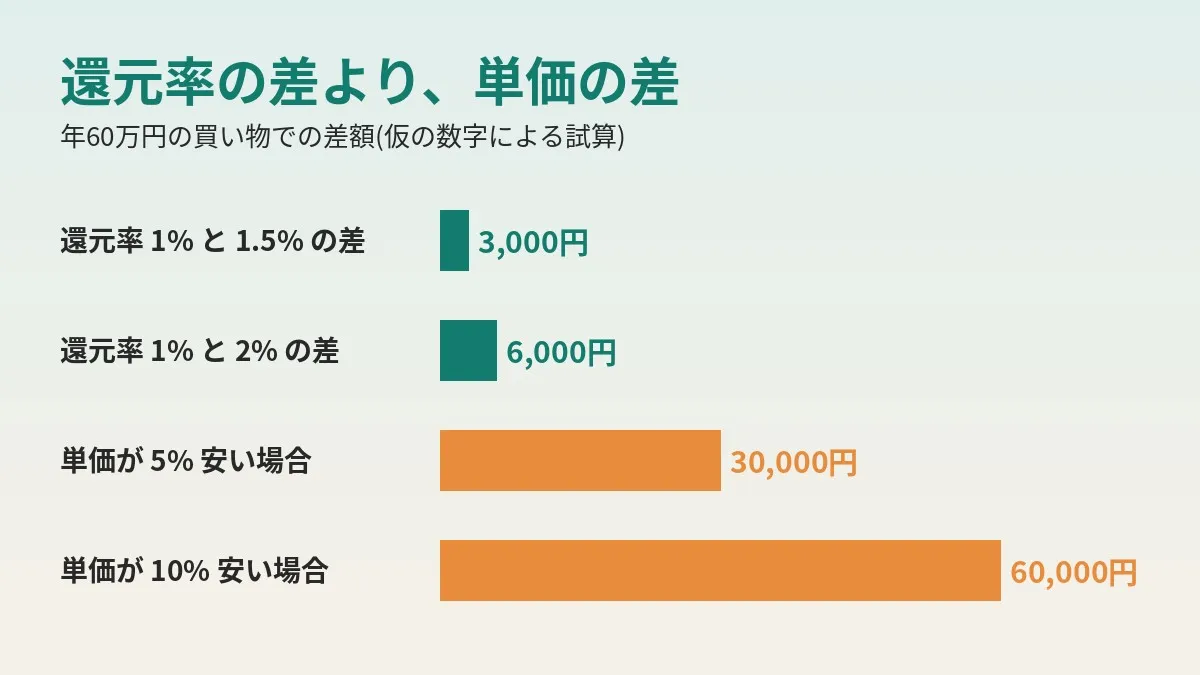
To resolve that nagging feeling, I lined up the figures. Taking our annual Costco spending as 1.5 million yen, I compared the rewards-rate difference against the unit-price difference.
| What is being compared | Difference on 1.5 million yen a year |
|---|---|
| 1% vs. 3% rewards rate | 30,000 yen |
| 1% vs. 2% rewards rate | 15,000 yen |
| Unit prices 5% higher than the local store | 75,000 yen |
| Unit prices 10% higher than the local store | 150,000 yen |
Raising the rewards rate by 2% only adds 30,000 yen a year. Meanwhile, buying the same things at prices just 5% higher wipes out 75,000 yen. It is fair to say these are a full order of magnitude apart.
Of course, Costco is not always cheaper. Some items cost about the same as at the local store. But our staples are mostly bulk groceries and household goods, and those are exactly the categories where the unit-price gap tends to show up.
That settled it for me. Quitting Costco for the sake of card rewards is almost certainly a losing move.
I double-checked which cards Costco accepts
While I was at it, I went back to the official pages to re-check Costco Japan’s payment rules. I had a vague memory that it was “Mastercard only,” so I wanted to be sure.
The payment methods listed in the membership terms were as follows: cash and Costco Shop Cards, plus the Costco Global Card and Mastercard-branded credit cards.
| Payment method | Warehouse | Online |
|---|---|---|
| Cash | Accepted | Not available |
| Mastercard credit cards | Accepted | Accepted |
| Costco Global Card (Mastercard) | Accepted | Accepted |
| Costco Shop Card (prepaid) | Accepted | Not available |
| Visa, JCB, Amex and other brands | Not listed in the terms | Not available |
| Debit cards, e-money, QR code payments | Not confirmed officially | Not available |
Online is even narrower: Mastercard credit cards only. The instructions for renewing your membership online also tell you to have a Mastercard ready.
My Rakuten Card is on the Mastercard network. It falls under “all Mastercard-branded credit cards” in the terms, so I can keep using it as is. Even if I consolidated on Amex, I would still need to keep one card for Costco.
I could not find any mention of debit cards or e-money on the official pages I checked this time. The surest way to know whether they work is to ask at the warehouse before you shop.
I also reviewed the annual fee and membership tiers
I also put Costco’s annual fees and rewards into a table. These are the amounts confirmed on the official membership page.
| Membership type | Annual fee (tax included) | Main features |
|---|---|---|
| Gold Star (individual) | 5,280 yen | One free household card |
| Business (corporate) | 5,280 yen | One household card plus additional business cards |
| Executive Gold Star | 10,560 yen | Up to 2% reward on purchases |
| Executive Business | 10,560 yen | Up to 2% reward on purchases |
One family member aged 18 or older living at the same address can become a household member for free. The membership card is valid from the month you join through the end of the same month the following year.
Costco Global Card
The Global Card I carry as a backup is a Mastercard co-branded card issued by Orico. It earns a 1.5% reward rate at Costco and 1.0% everywhere else. Rewards are credited the following February and can be used at warehouses at 1 yen per reward point.
The annual fee is waived in the first year. From the second year it is 2,375 yen (tax included) for the primary cardholder, but using the card at least once a year keeps it free the following year as well. The household card fee was revised to 550 yen (tax included) starting with the December 2025 billing cycle.
There is a catch with the rewards, though: they expire on December 31 of the year they are credited. They also cannot be used at the food court, the pharmacy, or online. If you do not decide in advance when to spend them, you may find yourself scrambling at year-end.
Executive membership
Executive membership is not a card; it is the upper tier of membership itself. You earn a 2% reward on your Costco purchases. It is calculated on the pre-tax amount and capped at 110,000 yen a year.
The upgrade costs an extra 5,280 yen a year for individual members. The official page says you recoup the difference with 22,000 yen of purchases per month. Dividing 5,280 yen by 2% gives 264,000 yen a year, so the math checks out.
It also says that combined with the Global Card, the total comes to 3.5%. Note, however, that if you downgrade to a regular membership instead of renewing, you cannot receive the reward.
Rewards by payment method, side by side
Here is everything so far in a single table, limited to what I could confirm officially.
| Combination | Approximate reward at Costco | Additional annual fee |
|---|---|---|
| Cash | None | None |
| Rakuten Card (Mastercard) | 1% (Rakuten Points) | None |
| Costco Global Card | 1.5% (reward) | Free if conditions are met |
| Executive membership + Rakuten Card | 2% + 1% | 5,280 yen upgrade difference |
| Executive membership + Global Card | 3.5% | 5,280 yen upgrade difference |
Looking purely at the rewards rate, the Global Card is higher. I will concede that point honestly.
What differs is how you receive the rewards. Rakuten Points can be spent at all sorts of stores, and our family shops on Rakuten Ichiba a lot. The Global Card’s rewards are meant to be spent inside Costco. Which one suits you probably depends on how your household spending flows.
What I decided
After finishing the estimates, I settled on these three things:
- I will not quit Costco because of card rewards
- I will pay at Costco with the Rakuten Card
- Whether to consolidate on the Marriott Amex is a decision I will revisit once our household finances settle down
On paper, consolidating on Amex came out about 50,000 yen a year ahead. But that assumes we use the free-night award every single year. If we do not, the difference nearly vanishes, so I saw no reason to rush the decision.
The decision to keep Costco on the Rakuten Card, on the other hand, was easy. The unit-price gap from buying in bulk matters more than switching stores to chase a rewards rate.
More cards also means more statements to check. I wrote up my thinking on narrowing down to a single main card in Why I run our household on a single main credit card.
I have come to feel that looking at unit prices and fixed costs pays off more than picking stores. The monthly phone bill is the same story: review it once and the savings keep coming.
Clicking this opens the Rakuten login page. Once you log in, you’ll see the campaign details.
How to think about recouping the annual fee
Let me apply this calculation to recouping the 5,280 yen annual fee. It is easiest to think in terms of the unit-price gap.
| Unit-price gap | Annual purchases needed to recoup the 5,280 yen fee |
|---|---|
| 3% | About 176,000 yen |
| 5% | About 105,600 yen |
| 10% | About 52,800 yen |
The formula is “annual fee divided by unit-price gap.” The smaller the gap, the more you have to buy to break even. Our family spends around 1.5 million yen a year, so even a 1% gap would cover the fee.
That said, there is also the travel time and the gas. Factor those in and the break-even line may sit a bit higher.
How to avoid losing money on bulk buying
A low unit price means nothing if you cannot use it all up. These are the three things our family watches out for.
Not finishing the food
Large packs of fresh food sometimes go bad before we can finish them. The smaller the household, the more easily the unit-price advantage evaporates here.
Not enough storage space
If your freezer or pantry is full, what you bought has nowhere to go. Buying an extra appliance just to store things changes the whole equation.
Impulse buys
In a warehouse that size, unplanned items have a way of ending up in the cart. My wife and I share a shopping list and shop against it. A simple house rule like “anything not on the list goes back” can make this a lot easier.
We also set a monthly cap on bulk purchases. I described how that cap works in Reviewing Rakuten Super Sale shop-around purchases against a bulk-buying budget.
Who it suits and who it does not
| Good fit | Poor fit |
|---|---|
| Households that use the same items in steady amounts every week | Households that often end up throwing food away |
| People with spare freezer and storage space | People with almost no room to store things |
| People who compare unit prices before buying | People who tend to buy unplanned items in the store |
| People who already hold a Mastercard | People who only hold Visa, JCB or Amex cards |
| People who can get to a warehouse without much trouble | People for whom the round trip costs a lot of time or money |
Larger families do have an easier time making the most of the unit-price gap. Still, “can you use it all up” probably matters more than headcount.
Common mistakes
- Quitting a store with low unit prices in order to consolidate on a high-rewards card
- Showing up with only a Visa or Amex card and getting stuck at the register
- Assuming Visa or JCB works online too
- Adding cards to raise your rewards rate and making your statements a chore to manage
- Forgetting to use Global Card rewards and letting them expire at year-end
- Buying items with no unit-price advantage “because it is Costco”
The first one is exactly the mistake I nearly made. Rewards rates are easy to see, so they are tempting to chase. But what actually moved the needle was the unit price.
What to check before you start
- Is the credit card in your wallet on the Mastercard network?
- Will you also shop online?
- Can you recoup the 5,280 yen annual fee through the unit-price gap?
- Do you have room in your freezer and storage?
- Have you estimated how much your family can actually finish?
- Have you set a monthly cap on bulk purchases?
- Can you use your Global Card rewards before the end of the year?
Frequently asked questions
Q. Does Costco Japan accept Visa or Amex cards?
The only credit cards listed in the membership terms are Mastercard-branded ones. There was no mention of Visa or American Express. Online, it is explicitly stated to be Mastercard only.
Q. Can I use a debit card or PayPay?
I could not find any mention of debit cards or QR code payments on the official pages I checked. The membership terms list cash, Shop Cards, the co-branded card and Mastercard credit cards. If you are unsure, check at the warehouse.
Q. Do I earn points when I pay with a Rakuten Card at Costco?
The Rakuten Card’s base rate is 1 point per 100 yen, or 1%. That said, Rakuten notes that some purchases may be excluded or earn at a different rate. I make a habit of confirming the points on my statement.
Q. What is the rewards rate on the Costco Global Card?
According to the official page, it is a 1.5% reward on purchases at Costco and 1.0% elsewhere. Rewards can be used at Costco warehouses and similar locations at 1 yen per reward point. They are valid until December 31 of the year they are credited.
Q. How much is the Costco annual fee?
According to the official membership page, Gold Star (individual) and Business (corporate) are 5,280 yen. Executive membership is 10,560 yen. All amounts include tax.
Q. Does Executive membership pay for itself?
The upgrade costs an extra 5,280 yen a year. Dividing that by the 2% reward, you break even at 264,000 yen of annual purchases. The official page also says 22,000 yen of purchases per month covers it.
Q. Is it worth quitting Costco to consolidate on a high-rewards card?
Based on my estimates, I would not recommend it. A 2% difference in rewards rate adds 30,000 yen on 1.5 million yen of annual spending. Buying the same things at prices just 5% higher increases your spending by 75,000 yen. If you are buying items with a real unit-price gap, you come out ahead by staying.
Q. Do I get the annual fee back if I cancel mid-year?
The membership terms include a fee guarantee: cancel within the validity period and the annual fee is refunded in full. However, you cannot rejoin for 12 months from the month you cancel.
Official sources consulted
- Join or renew a Costco membership (Costco Japan official)
- Membership terms and conditions (Costco Japan official)
- Costco Global Card (Costco Japan official)
- About Executive membership (Costco Japan official)
- Membership renewal (Costco Japan official)
- Costco Global Card (Orico official)
- Notice of annual fee revision for the Costco Global Card from the second year (Orico official)
- Earn points with the Rakuten Card (Rakuten PointClub)
- Marriott Bonvoy American Express Premium Card (Amex official)
Summary
A high-rewards card caught my eye, and I came close to quitting Costco. But when I ran the numbers on a year of statements, the result was the opposite. The rewards-rate gap is on the order of 30,000 yen a year, while the unit-price gap is on the order of 70,000 yen or more.
At Costco Japan, both in the warehouse and online, Mastercard is the backbone of payment. If you hold a Rakuten Card on the Mastercard network, you can use it as is. Before you decide on a card, first look at which stores and which items actually give you a unit-price gap.
Clicking this opens the Rakuten login page. Once you log in, you’ll see the campaign details.
This article contains affiliate advertising. If you sign up for a product or service through a link on this site, we may receive compensation from the partner company. The site operator is also an employee of Rakuten Group and may receive compensation through an employee referral program. The content and opinions here are based on the operator’s own experience and research regardless of any advertising relationship, but please read with the above in mind. See the Disclaimer & Affiliate Disclosure for details. Disclaimer & Affiliate Disclosure
This article includes machine-translated content. Please check the official Rakuten Mobile multilingual page for exact terms.
If you have concerns about Rakuten Mobile coverage or signal quality, you can consult through the official signal improvement request form .