- 01Conclusion: Do not touch the plan until the grant decision notice arrives
- 02What the 100% renewable electricity plan bonus is
- 03The bonus requirements in a table
- 04How the review stopped once over the summer
- 05What happens if you change it before the grant decision
- 06Rules after the grant decision: change notification and partial refund
- 07Rough time until the grant decision
- 08Official information on the EV plan and the 100% renewable plan
- 09Criteria for deciding after the notice arrives
- 10Common mistakes and pitfalls
- 11What to check before you start
- 12How this relates to the national CEV subsidy
- 13Frequently asked questions
- 14Official sources I referred to
- 15Summary
Good morning, this is まさきん.
I applied for the Tokyo ZEV subsidy and am now waiting for the result of the review. I also applied for the bonus for a 100% renewable electricity plan at the same time. I was unsure whether I could change my electricity plan in the meantime, so I am writing down the reasoning behind my decision.
Note: This information is current as of the time of publication. Please check the official sites for the latest conditions.
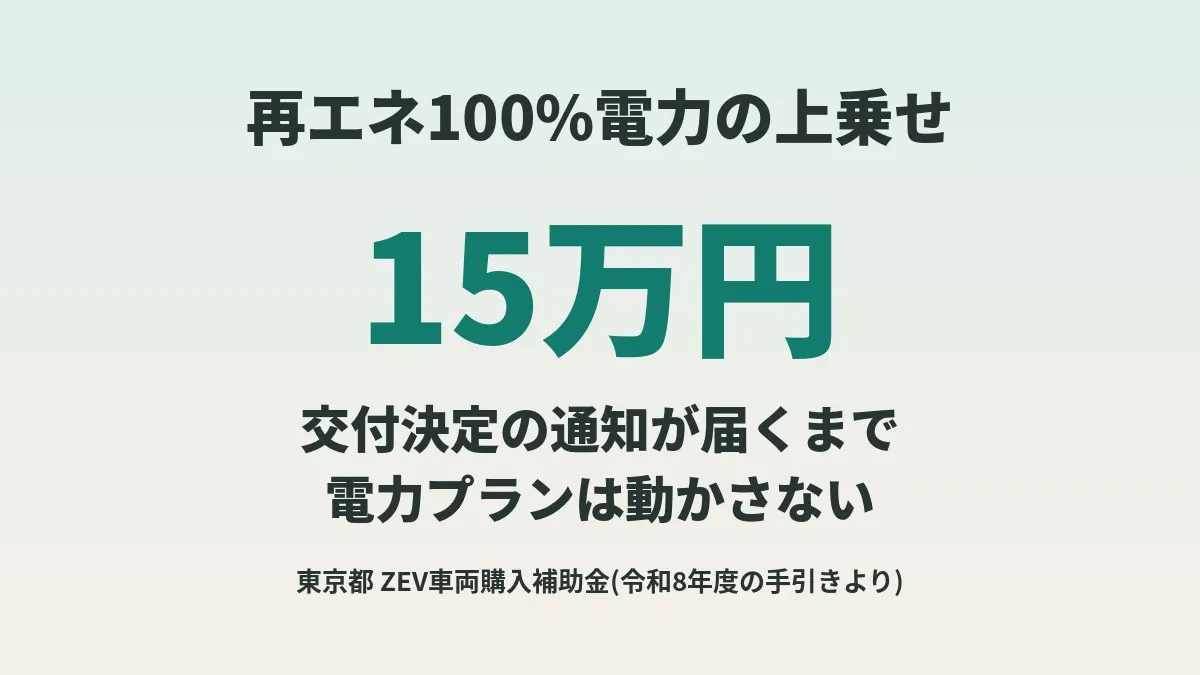
- The Tokyo ZEV subsidy adds a bonus of 150,000 yen for an EV if you have a contract for a 100% renewable electricity plan
- The bonus must be requested together with the grant application and cannot be added after the grant decision
- Switching between eligible plans is said to be possible, and after the grant decision you submit a change notification form
- If you fall out of eligibility, the handbook says a partial refund of the bonus is required
- I decided not to touch my current EV plan until the grant decision notice arrives
Conclusion: Do not touch the plan until the grant decision notice arrives
Let me state the conclusion first. I decided not to lay a hand on my electricity contract until I receive the grant decision notice.
The reason is simple. I believe what the review looks at is the contract documents I submitted when I applied. I figured that if the contract changed partway through, things would get complicated.
In my case, the amount I expect to save by reviewing my electricity bill is somewhere in the 10,000 yen range per year. The bonus, on the other hand, is 150,000 yen. All I lose by waiting is a few months of that difference. Weighing the two, I judged that waiting costs less.
What the 100% renewable electricity plan bonus is
The Tokyo ZEV vehicle purchase subsidy is a grant handled by Cool Net Tokyo. In the fiscal 2026 (Reiwa 8) handbook, the grant amount is the sum of several components.
A bonus by manufacturer is added to the base amount. On top of that comes the bonus for introducing renewable energy electricity. If you have a contract for a 100% renewable electricity plan, the bonus for an EV is stated as 150,000 yen .
If you have a solar power system installed, it is 300,000 yen for an EV. Even if you meet both, however, you can apparently apply for only one of them.
| Type of bonus | EV | PHEV |
|---|---|---|
| Contract for a 100% renewable electricity plan | 150,000 yen | 150,000 yen |
| Solar power system installed | 300,000 yen | 150,000 yen |
| When both are met | Only one of the two | Only one of the two |
The handbook also notes that vehicles with a base price of 8.4 million yen or more are multiplied by 0.8. I think the surest way to find your actual amount is the official simulator.
The bonus requirements in a table
The requirements are gathered in the handbook chapter on applying for an increase through the introduction of renewable energy electricity. I put what I picked up from reading it into a table.
| Item | What the handbook says (fiscal 2026) |
|---|---|
| Eligible plans | Plans whose planned renewable energy usage rate is 100% in the list under the Tokyo Energy and Environment Plan system |
| Point of judgment | The plan must be on the list as of the application date |
| Contract status | The contract must already be concluded (not allowed while the sign-up is still in progress) |
| Supply address | Must match the “principal place of use” on the vehicle inspection certificate, and so on |
| Timing of the application | Apply together with the basic grant amount (the bonus alone cannot be added later) |
| Application deadline | Within one year of first registration and by 17:00 on March 31, 2027 |
For vehicles first registered on or before March 31, 2026, plans that were on the Ministry of the Environment list are apparently also eligible. The handbook says, however, that this list is no longer public. People signing a contract from now on are directed to look at the Tokyo list.
What struck me personally as important is that the judgment turns on whether the plan is on the list. Even if an electricity company advertises “effectively 100% renewable,” that alone may not be enough. Checking the plan name on the list comes first.
The documents must show four items
The documents are required to show at least the following four things.
- The name of the contracted plan
- The company providing the contracted plan
- The name of the contract holder
- The address to which electricity is supplied
The handbook gives a copy of the contract or a copy of the meter reading slip as examples. A customer page on the web or the email confirming the contract apparently also works. I think the point is that all four can be read together.
In my article on the subsidy application experience, I wrote about saving a screenshot of my account page and submitting it. That one is a record of gathering documents overall. This time I am focusing on how to handle the electricity contract after applying.
How the review stopped once over the summer
The review was in fact suspended once over the summer. The cause was the contract documents for the renewable energy bonus.
The handbook says that if there are deficiencies, corrections will be requested by email or phone. The applicant is required to make the correction within 30 days. If it is not fully corrected within 180 days from the day after the first contact, the application is apparently treated as withdrawn.
This experience made me realize that the electricity contract documents really are examined in the review. That is why I decided not to move the contract while the review is under way.
What happens if you change it before the grant decision
Let me be honest here. I could not find in the handbook how a change of electricity plan before the grant decision is handled.
What the handbook does contain is the following three points. Eligible plans are judged against the list as of the application date. You cannot apply for the bonus additionally after the grant decision. During the disposal restriction period, continuation of the contract may be checked.
In other words, it does not say that a change during review is an automatic failure. At the same time, it does not say it is fine either. If the documents I submitted and the actual contract diverge, I might get contacted about a deficiency again.
- I could not confirm in the handbook how a change of electricity plan before the grant decision is handled
- If you have a reason to change, contacting Cool Net Tokyo is the sure way
- “It would put things at risk” is my own judgment and is not stated that way officially
My thinking was that when something is not written down, not moving is the cheapest option. Asking and confirming is one way, but this is also a matter that resolves itself if I wait.
Rules after the grant decision: change notification and partial refund
How things are handled after the grant decision was written clearly in the handbook. I think this was the biggest thing I gained this time.
First, changes within the eligible plans are said to be possible even during the disposal restriction period. If you change after the grant decision, you submit a change notification form. “A change between 100% renewable electricity plans” was also listed as an example of a minor change.
On the other hand, if you can no longer meet the conditions, you need to report it. In that case, the handbook says a partial refund of the grant is required. In the list of dispositions, the reference date is the cancellation date of the electricity contract. Only the increased portion is said to be subject to it.
| Action after the grant decision | How the handbook treats it |
|---|---|
| Switching between eligible plans | Possible. Submit a change notification form |
| Switching to an ineligible plan or cancelling | Must be reported. Partial refund of the bonus |
| Checking that the contract continues | Cool Net Tokyo or the Tokyo Metropolitan Government may check |
| Disposal restriction period for private vehicles | 4 years |
So you are not set free once the notice arrives. For a private car, the constraint of “choose among eligible plans” stays for four years. When thinking about where to switch, this condition comes first.
Rough time until the grant decision
The handbook says it takes “roughly 3 to 5 months” from receipt of the application to payment. The Q&A also says the money is transferred in roughly 3 to 5 months if there are no deficiencies.
This is a guide to the time until payment, not the number of days until the grant decision notice arrives. The wording is that the transfer is made “after a certain period” from when the notice is sent.
Since mine stopped once along the way, I expect it to run later than the guide. My estimate is that the grant decision will come sometime between the end of October and the end of December. That is purely a personal guess.
The progress of the review can apparently be seen on the Cool Net Tokyo application status site. Updates are announced as being around 3 p.m. every Tuesday and Friday.
I cannot move the electricity plan, but phone and internet costs can be reviewed regardless of the subsidy. As a way to use the waiting time, it may not be a bad one.
Clicking this opens the Rakuten login page. Once you log in, you’ll see the campaign details.
Official information on the EV plan and the 100% renewable plan
My contract is with Octopus Energy. I am currently on its EV plan. I will list only the facts from the official pages.
EV Octopus requires that you own an EV or a PHEV. It has two cheaper time bands a day. They are 1 to 5 a.m. and 11 a.m. to 1 p.m.
| Unit prices in the TEPCO area (EV Octopus) | Per 1kWh |
|---|---|
| EV Night Time (1 to 5 a.m.) | 15.1 yen |
| EV Day Time (11 a.m. to 1 p.m.) | 13.1 yen |
| EV Standard | 26.27 yen |
Green Octopus is introduced on the official blog as an “effectively 100% renewable energy” plan. It works by combining non-fossil certificates. The pricing was explained as a basic charge plus a three-tier usage charge.
The power source mix page lists the plans that count as effectively 100% renewable. Both Green Octopus and EV Octopus were on it. Simple Octopus and others, meanwhile, are separated out as a different power source mix.
There is one thing to be careful about here, though. What is used for the subsidy judgment is the Tokyo list. Being listed on the electricity company page and being on the Tokyo list may be two separate matters. Before deciding what to switch to, I plan to look up the plan name on the list.
Criteria for deciding after the notice arrives
Once I had decided to wait, the next question was what to do when it arrives. Deciding this in advance made the wait easier.
- Pull the monthly kWh from my recent meter reading slips
- Recalculate the actual cost under my current plan and the candidate plans
- Compare a change within the same electricity company as the first candidate
- If the difference from another company is 10,000 yen or more a year, consider switching too
- Check whether the candidate is an eligible plan on the Tokyo list
- If I do change, confirm how to submit the change notification form
In an earlier estimate, a plan change within the same company produced a difference in the 10,000 yen range per year. My usage may have changed between then and now, though. So I intend to redo it with recent numbers.
If you do not charge at home, time-of-use pricing may not help much. I wrote about our charging situation in my post on driving a Tesla without home charging. Whether an EV plan fits probably also depends on where you charge.
For usage by time of day, the steps in my article on reading electricity usage in 30-minute intervals can be used as they are. Once you know how much you use late at night and at midday, I think the estimate gets more accurate.
Why I set the bar at “10,000 yen or more”
I set the switching threshold at 10,000 yen a year because it felt like the line where the savings balance the effort.
Moving to another company means checking whether the plan is eligible. I would also submit a change notification form. I might have to obtain documents showing the contract holder name and supply address all over again. For a difference of a few thousand yen, staying put is easier.
The other reason is the risk of a refund. Moving to an ineligible plan means giving back part of the bonus. Undoing that for savings in the 10,000 yen range per year does not seem worth it.
From a financial planner perspective, this is about “protecting a gain that is already locked in.” Savings on electricity are a small amount that builds up every year, while the bonus is a large one-time sum. I want to be careful not to get the order wrong.
Managing it with a “predecessor task” instead of a due date
I have not put a due date on this task. That is because I cannot decide when the grant decision arrives.
Instead, I set “check subsidy progress” as the predecessor task. When that one finishes, the electricity plan review starts moving. They are linked by order, not by date.
When you set a provisional due date, you tend to end up just postponing on that day because “it has not arrived yet.” Waiting on a condition keeps my head quieter, I find.
Common mistakes and pitfalls
Here are the points I thought I might trip over when reading the handbook. The only one I actually hit was the review stopping over the documents. Please read the rest as general advice.
- Assuming a plan is eligible just because it is labeled “effectively 100% renewable”
- Applying while the sign-up is still in progress
- Thinking the bonus can be applied for later as an addition
- Believing you can change plans freely after the grant decision
- Failing to notice a mismatch between the electricity supply address and the address on the vehicle inspection certificate
- Being unable to respond to a deficiency notice within 30 days
What to check before you start
- I checked that my current plan shows a 100% renewable energy usage rate on the Tokyo list
- I prepared a document showing all four items: plan name, provider, contract holder name, and supply address
- I understand that the bonus is applied for together with the basic grant amount
- I know that a change after the grant decision requires a change notification form
- I know that moving to an ineligible plan means a partial refund of the bonus
- I decided to contact the help desk if I want to change plans during the review
How this relates to the national CEV subsidy
The national CEV subsidy is a separate program from the Tokyo grant. The contact point and the review proceed separately.
What I have written here is limited to the Tokyo renewable energy bonus. The amounts and documents for the national subsidy are covered in the application experience article mentioned earlier. For the overall picture of running costs, my article comparing EV and gasoline car running costs may also be useful.
Frequently asked questions
Q. How much is the bonus for a 100% renewable electricity plan?
The fiscal 2026 handbook puts it at 150,000 yen for both EVs and PHEVs. It cannot be combined with the bonus for installing a solar power system. There is also a note that expensive vehicles are multiplied by 0.8.
Q. Which electricity plans are eligible?
Plans whose planned renewable energy usage rate is 100% in the list under the Tokyo Energy and Environment Plan system. The condition is that the plan is listed as of the application date. Please check the plan name on the list.
Q. Is it still in time if I switch to a renewable plan after buying the car?
The handbook says you can apply as long as the contract is in place by the time you apply. The application deadline is within one year of first registration. You cannot apply, however, while the sign-up is still in progress.
Q. Can I change my electricity plan before the grant decision?
I could not confirm in the handbook how that case is handled. I have decided to wait without changing. If you have a particular reason, I think contacting Cool Net Tokyo is the sure way.
Q. Can I change freely after the grant decision?
Changes within the eligible plans are said to be possible. In that case you submit a change notification form. If you fall out of eligibility, a partial refund of the bonus is required.
Q. How long do I need to keep the 100% renewable contract?
The handbook is written with the disposal restriction period of the vehicle as its basis. The disposal restriction period for private vehicles is 4 years. During that time, continuation of the contract may apparently be checked.
Q. How long does it take until the grant decision?
The handbook says roughly 3 to 5 months from receipt to payment. That is the guide when there are no deficiencies. If corrections are needed, I expect it to slip by that much.
Q. Can I apply for just the bonus later?
It is stated that you cannot. The Q&A also said that an additional increase cannot be applied for on a vehicle that already has a grant decision. It seems best to confirm whether you qualify for the bonus before applying.
Official sources I referred to
- Grants for EV, PHEV, and FCV vehicles (Cool Net Tokyo)
- Fiscal 2026 EV and PHEV application handbook (Cool Net Tokyo, PDF)
- Fiscal 2026 EV, PHEV, and FCV Q&A (Cool Net Tokyo, PDF)
- Vehicle grant amount simulator (Cool Net Tokyo)
- Published materials of the Energy and Environment Plan system (Tokyo Bureau of Environment)
- EV Octopus (Octopus Energy)
- Power source mix and use of non-fossil certificates (Octopus Energy)
- Introducing Green Octopus (Octopus Energy official blog)
Summary
The bonus for a 100% renewable electricity plan is 150,000 yen for an EV. It must be requested together with the application and cannot be added later. Even after the grant decision, you choose among the eligible plans for four years.
How a change before the grant decision is handled was not clear from the handbook. So I am not moving anything until the notice arrives. When it does, I plan to redo the estimate with my recent kWh. Once I have results, I may write about it again.
While the electricity plan is off limits, why not take a look over your other fixed costs?
Clicking this opens the Rakuten login page. Once you log in, you’ll see the campaign details.
This article contains affiliate advertising. If you sign up for a product or service through a link on this site, we may receive compensation from the partner company. The site operator is also an employee of Rakuten Group and may receive compensation through an employee referral program. The content and opinions here are based on the operator’s own experience and research regardless of any advertising relationship, but please read with the above in mind. See the Disclaimer & Affiliate Disclosure for details. Disclaimer & Affiliate Disclosure
This article includes machine-translated content. Please check the official Rakuten Mobile multilingual page for exact terms.
If you have concerns about Rakuten Mobile coverage or signal quality, you can consult through the official signal improvement request form .