- 01EV vs gas car running costs: which items differ and which do not
- 02Electricity vs gasoline: the cost-per-km formulas
- 03How fast charging is priced
- 04The annual automobile tax (by engine displacement) is 25,000 yen a year for an EV
- 05The eco-car tax break on weight tax and the end of the environmental performance levy
- 06CALI premiums are the same for an EV
- 07Differences in vehicle inspection and routine maintenance
- 08Our rough estimate: about 125,000 yen a year
- 09Subsidy amounts vary by fiscal year and model
- 10When an EV tends to come out ahead, and when it does not
- 11Common mistakes and pitfalls
- 12What to check before you start
- 13Frequently asked questions
- 14Official sources I referred to
- 15Summary
Good morning, this is まさきん.
It has been a few months since I switched to a Tesla Model Y L. 2026 has also been a busy year for car taxes in Japan, including the abolition of the environmental performance levy. So I am going back over the running costs of an EV versus a gas car, item by item, using official unit prices and tax amounts.
Note: This information is current as of the time of publication. Please check the official websites for the latest terms.
- EV and gas car running costs differ in three places: fuel versus electricity, taxes, and routine maintenance
- At the reference electricity price of 31 yen/kWh, an EV costs about 3.9 yen per km (a worked example using catalog figures)
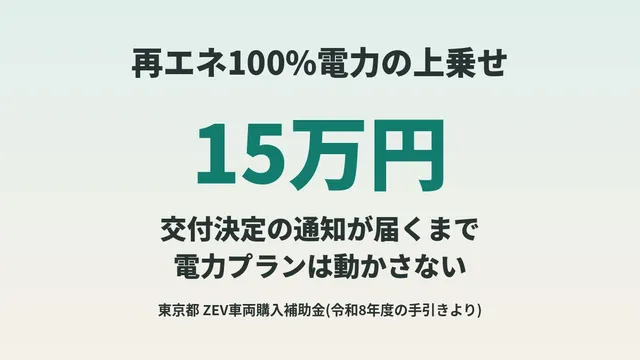
- The annual automobile tax (by engine displacement) is 25,000 yen a year for an EV. Tokyo exempts it for five fiscal years starting the year after registration
- Compulsory automobile liability insurance (CALI) and parking cost the same for an EV and a gas car
- A surcharge on the motor vehicle weight tax for EVs is planned for vehicle inspections from May 2028 onward
EV vs gas car running costs: which items differ and which do not
First, I want to sort the cost items into those that differ and those that do not. In my experience, mixing them together makes the comparison blurry.
| Item | Gas car | EV | Does it differ? |
|---|---|---|---|
| Fuel / electricity | Gasoline | Electricity for charging | Yes (depends on where you charge) |
| Annual automobile tax (by engine displacement) | Set by engine displacement | The 25,000 yen a year bracket | Yes |
| Motor vehicle weight tax | Set by vehicle weight and environmental performance | Exempt at new registration and the first inspection | Yes (under review from 2028) |
| Compulsory automobile liability insurance (CALI) | Private passenger car category | Same category | No |
| Voluntary insurance | Varies by model and conditions | Varies by model and conditions | Depends on the quote |
| Vehicle inspection and routine maintenance | Oil changes and similar come up regularly | No engine-related items | Yes |
| Parking | Same regardless of the car | Same regardless of the car | No |
Our home has no parking space, so we rent a monthly spot. That fee is the same whatever the car. Switching to an EV made it neither cheaper nor more expensive.
Electricity vs gasoline: the cost-per-km formulas
Fuel and electricity are easier to compare once both are expressed as a cost per km. There are only two formulas.
- Gas car: gasoline price (yen/L) ÷ fuel economy (km/L)
- EV: electricity price (yen/kWh) × energy consumption (kWh/km)
Energy consumption is often written in Wh/km. Divide by 1,000 to get kWh/km. For example, 127 Wh/km is 0.127 kWh/km.
For the electricity price, you can use the reference unit price from the Home Electric Appliances Fair Trade Conference. It is currently 31 yen/kWh (tax included), a figure revised on July 22, 2022 (Reiwa 4). The national average gasoline price is published every week by the Agency for Natural Resources and Energy. As a rule it is surveyed on Monday and published on Wednesday, and the most recent release was the one published on October 7, 2026.
Example cost per km calculated from catalog figures
Let me build an example from the official manufacturer catalog figures. These are not measured results, just an assumption made by multiplying official unit prices by WLTC mode values. The gasoline price of 170 yen/L is also a placeholder I chose for the calculation.
| Example car | Catalog figure (WLTC) | Assumed unit price | Per km | 10,000 km a year |
|---|---|---|---|---|
| Gas car (2.5L minivan) | 10.6km/L | 170 yen/L | About 16.0 yen | About 160,000 yen |
| Hybrid (same class) | 17.7km/L | 170 yen/L | About 9.6 yen | About 96,000 yen |
| EV (Model Y L) | 127Wh/km | 31 yen/kWh | About 3.9 yen | About 39,000 yen |
| EV (Model Y L) | 127Wh/km | 60 yen/kWh | About 7.6 yen | About 76,000 yen |
The gas car and hybrid figures are those of the Alphard in the official Toyota specification sheet. For the EV, I used the value certified by the Ministry of Land, Infrastructure, Transport and Tourism (MLIT) as listed on the official Tesla site.
31 yen/kWh is a reference price for household electricity. It is probably close to what you would pay if you can charge at home. Fast charging away from home can cost more than that. So I also ran the numbers with a placeholder price of 60 yen/kWh.
In this example, the gap between the EV and the gas car is about 80,000 to 120,000 yen over 10,000 km a year. That said, if you drive half the distance, the gap halves too. It is also worth keeping in mind that real-world energy consumption and fuel economy tend to be worse than the catalog figures.
How to plug in your own numbers
The figures in the table are only a template. Swap in your own household numbers and I think it becomes something you can actually base a decision on.
- Work out your annual mileage (from the distances recorded on your vehicle inspection certificate or maintenance record book)
- Check the real-world fuel economy of your current car (calculate it from liters filled and distance driven)
- Use the national average for the latest week from the Agency for Natural Resources and Energy, or the pump price near you, as the unit price
- Check the energy consumption of the EV you are considering in the official manufacturer specifications
- Look up the unit price for each place you would charge (your electricity plan at home, the charging service rates away from home)
- Decide the split between home charging and charging elsewhere, and work out an average unit price
- Use the formulas above to get the cost per km, then multiply by your annual mileage
Step 6 is, I feel, the one that matters most in the EV calculation. If you mostly charge at home, the cost gets close to your household electricity rate. If you mostly rely on fast charging away from home, it comes down to those rates.
- Difference = (gas car cost per km − EV cost per km) × annual mileage
- The less a household drives, the smaller the fuel gap
- While a free charging perk is running, also calculate with the unit price that applies after it ends
How fast charging is priced
When you charge away from home, each service has its own approach to pricing. Here is what I could confirm from official sources.
According to Tesla official support, Superchargers bill per kWh wherever possible. At some sites, the unit price differs between busy hours and other times. You can check the rates for a given site on the touchscreen in the car and in the app.
If you leave the car parked after charging, congestion fees may apply. They cover cars at busy sites that are at 80% charge or above, or that have finished charging. There is reportedly a grace period for the first five minutes. Some facilities also have their own separate parking fee rules.
The e-Mobility Power charging network has different rates for members and visitors. There are two member plans: a combined fast and standard charging plan, and a standard charging plan. Both come with a monthly fee plus a per-use charge every time you charge. Visitors pay only the per-use charge.
The billing method is fixed for each charger as either per kWh or per unit of time. Users cannot choose. The specific unit prices can change, so please check the official pricing page.
In my case, I have no charging equipment at home. I charge mostly at Superchargers. I wrote about it in detail in driving a Tesla without home charging.
The annual automobile tax (by engine displacement) is 25,000 yen a year for an EV
The annual automobile tax (by engine displacement), charged every year, is set by engine displacement. An EV has no displacement, so it pays the same amount as the lowest bracket.
In the tax rate table from the Tokyo Metropolitan Government Bureau of Taxation, the annual tax for private passenger cars is as follows (for cars registered from October 2019, Reiwa 1, onward).
- Electric vehicles and 1L or less: 25,000 yen
- Over 1L up to 1.5L: 30,500 yen
- Over 1.5L up to 2L: 36,000 yen
- Over 2L up to 2.5L: 43,500 yen
- Over 2.5L up to 3L: 50,000 yen
- Over 3L up to 3.5L: 57,000 yen
Compared with a 2.5L gas car, the difference at the standard rates is 18,500 yen a year.
There is also the green tax special measure. For an EV, the tax for the fiscal year after the year of registration is reduced by roughly 75%. According to materials from the Ministry of Economy, Trade and Industry (METI), this measure has been extended to March 31, 2028.
Tokyo exempts ZEVs from automobile tax for five fiscal years
Tokyo has its own scheme, the ZEV Introduction Promotion Tax System. It covers electric vehicles, fuel cell vehicles, and plug-in hybrid vehicles.
Cars first newly registered by FY2030 (Reiwa 12) are eligible. The monthly prorated portion at new registration and the annual automobile tax (by engine displacement) for five fiscal years starting the following year are exempt. Our EV, registered in Tokyo, falls under this scheme too.
However, this is a Tokyo scheme. Other prefectures handle it differently. Checking the page of the tax office for your own prefecture is probably the surest way.
The eco-car tax break on weight tax and the end of the environmental performance levy
There is also a difference in the motor vehicle weight tax, which you pay at every vehicle inspection. According to MLIT materials, the eco-car tax break runs from May 1, 2026 (Reiwa 8) to April 30, 2028 (Reiwa 10). Electric vehicles are exempt at new registration and at the first continuing inspection.
According to Ministry of Finance materials, the rate for private passenger cars is set as an annual amount per 0.5 tons. Cars eligible for the eco-car tax break and similar pay the base statutory rate of 2,500 yen. Others pay 4,100 yen, and it goes up once the car is over 13 years old.
| Tax | Gas car (2.5L class example) | EV |
|---|---|---|
| Annual automobile tax (by engine displacement) (every year) | 43,500 yen | 25,000 yen (exempt for five fiscal years in Tokyo) |
| Weight tax (new registration and first inspection) | Set by weight and environmental performance | Exempt |
| Weight tax (later inspections) | 41,000 yen for two years for over 2 tons up to 2.5 tons (if not eligible for the tax break) | 25,000 yen for two years in the same weight class (at the base statutory rate) |
| Environmental performance levy (at purchase) | Abolished on March 31, 2026 | Abolished on March 31, 2026 |
The two-year weight tax amounts are examples I calculated from the rates. The actual tax depends on vehicle weight and environmental performance. I think the quickest way to confirm it is the MLIT lookup service or a written quote.
The environmental performance levy, which used to be charged at purchase, was abolished on March 31, 2026. EVs were already exempt from it, so that particular difference has simply disappeared.
The review of EV taxation from 2028
EV taxes will not necessarily stay as they are forever. The FY2026 (Reiwa 8) tax reform set out a direction for review. These are the two points I could confirm in the METI materials.
- Motor vehicle weight tax: a special surcharge will be introduced for private passenger EVs and PHEVs. It applies to vehicle inspections undergone on or after May 1, 2028 (Reiwa 10)
- Annual automobile tax (by engine displacement): a weight-based taxation method will be introduced for EVs and similar vehicles newly registered as new cars from FY2028 (Reiwa 10) onward
In both cases, the specific rates are due to be decided in the FY2027 (Reiwa 9) tax reform. For new cars, the weight tax surcharge is waived for the initial three years. For cars already registered, the portion due at the first inspection after it takes effect is reportedly waived.
- The tax advantage of EVs may shrink from 2028 onward
- The rates are not decided yet, so leave some range in any long-term estimate
- Check local government schemes, such as the Tokyo exemption, separately
Fixed costs that go out every month, such as phone and internet bills, can be checked with the same template.
Clicking this opens the Rakuten login page. Once you log in, you’ll see the campaign details.
CALI premiums are the same for an EV
The category for compulsory automobile liability insurance (CALI) is set by vehicle type, such as private passenger car or kei car. Looking at the materials from the General Insurance Rating Organization of Japan, there is no category for electric vehicles. So there is no difference in premium between an EV and a gas car.
A 24-month contract for a private passenger car is currently 17,650 yen. For contracts whose insurance period starts on or after November 1, 2026, it changes to 18,560 yen. These amounts are for areas other than remote islands and Okinawa Prefecture.
Voluntary insurance varies with conditions such as the model and your no-claims grade. I do not think you can say across the board that it is higher or lower because the car is an EV. Getting quotes under the same conditions before you switch may give you some peace of mind.
Differences in vehicle inspection and routine maintenance
According to MLIT materials, there are three statutory costs at a vehicle inspection: the motor vehicle weight tax, the CALI premium, and the inspection fee. Of these, only the weight tax differs between an EV and a gas car.
On top of the statutory costs, you pay for inspection and maintenance work. This varies by garage and by the condition of the car. An EV needs no engine oil changes. I have not scheduled one since taking delivery, either.
It is also said that brake pads wear more slowly thanks to regenerative braking. Still, consumables such as tires and wipers are needed on an EV just the same. I think the right way to see it is that maintenance costs do not drop to zero.
Our rough estimate: about 125,000 yen a year
From here on, this is about our household. The comparison is with the large gas minivan class that was a candidate before we switched. I roughly estimated the difference if we kept using the car the same way for a year.
The combined difference in fuel or electricity and routine maintenance feels like about 125,000 yen a year. It is not a precise household ledger, though. Please take it as a rough estimate only.
One favorable condition is built into this figure. We are still within the period of the three-year free Supercharging campaign. Once that ends, the gap should narrow by the cost of charging.
It also changes with mileage. A household that drives only on days off and one like ours that drives daily start from different assumptions. I hope you will take it as one reference point.
Subsidy amounts vary by fiscal year and model
Subsidies are what close the gap in purchase price. There is the national CEV subsidy and the Tokyo ZEV vehicle purchase subsidy. The amounts vary by model and registration date, so here I will only cover the conditions of the schemes.
For the national CEV subsidy (FY2025, Reiwa 7, supplementary budget), the grant amount is set for each model. Lists are published for each registration date bracket. As a rule, you apply within one month of first registration. A car that received the subsidy must, as a rule, be kept for four or three years. If you part with it within that period, you need to go through a procedure in advance and return the subsidy.
The cap on the Tokyo ZEV vehicle purchase subsidy was raised partway through FY2026 (Reiwa 8). According to the Tokyo press release, EVs registered on or after July 1, 2026 are eligible for up to 1.3 million yen. Before the increase it was up to 1 million yen. The amount depends on add-ons that vary by manufacturer, among other things, so checking for each model is essential.
I summarized how my own application went in applying for the national and Tokyo EV subsidies.
When an EV tends to come out ahead, and when it does not
Let me put everything so far into the form of conditions.
| Aspect | Tends to favor an EV | Tends not to |
|---|---|---|
| Mileage | High annual mileage | Just a little driving on weekends |
| Where you charge | You can charge at home or at work | You rely only on high-priced fast charging |
| Taxes | Your local government offers a reduction or exemption | No reduction and you register from 2028 onward |
| Subsidies | Both national and local subsidies are available | Not eligible, or you cannot meet the ownership requirement |
| What you compare against | A large gas car with poor fuel economy | A fuel-efficient hybrid |
| How you use it | Mostly short everyday trips | Lots of long trips where planning charging is hard |
In the worked example too, the gap with the hybrid was smaller than with the gas car. The conclusion changes depending on what you compare against.
Common mistakes and pitfalls
Here are a few points that are easy to overlook with EV running costs.
- Judging on running costs alone without including the difference in vehicle price
- Taking the catalog energy consumption at face value and not allowing for it getting worse in winter or on the highway
- Calculating as if perks such as free charging will last forever
- Forgetting the ownership requirement tied to the subsidy and planning to change cars early
- Assuming the tax breaks will stay the same in the future
I should mention the weak points as well. With no charging equipment at home, our household depends on public fast charging and route planning for every long trip. Compared with filling up a gas car, it does take more planning.
I have no experience yet of long-term battery degradation myself. Costs several years down the road are an unknown at this point. I have laid out what the warranty covers in Tesla extended warranty and warranty transfer.
What to check before you start
- I know my annual mileage and the real-world fuel economy of my current car
- I have looked up my main charging location (home, work, or elsewhere) and its unit price
- I have checked the automobile tax reductions in the prefecture where I live
- I have checked the eligible models and application deadlines for national and local subsidies
- I expect to keep the car for the whole subsidy ownership requirement period
- I have gotten voluntary insurance quotes under the same conditions
- I have included the weight tax review from 2028 onward in my estimate
Frequently asked questions
Q. EV or gas car: which is cheaper to run in the end?
Looking only at fuel and taxes, the EV tends to be cheaper. But for households that drive little, the gap is small. I think it is best to compare the total, including the difference in vehicle price and the subsidies.
Q. How much does an electric vehicle cost to run per year?
It differs for each household, so there is no single figure. In the worked example, electricity for 10,000 km a year came to about 39,000 yen. Add automobile tax, insurance, vehicle inspection, and parking on top of that.
Q. How much is automobile tax for an EV?
The annual automobile tax (by engine displacement) is 25,000 yen a year at the standard rate. For the fiscal year after registration, the green tax special measure reduces it by roughly 75%. In Tokyo, it is exempt for five fiscal years starting the year after registration.
Q. Is an EV still a good deal if I cannot charge at home?
It depends on the unit price of charging away from home and on your mileage. With fast charging only, the cost per km tends to be higher than at household electricity rates. I recommend running the numbers first with the rates of the charging service you plan to use.
Q. Is the vehicle inspection cheaper for an EV?
Of the statutory costs, the weight tax is exempt at new registration and at the first inspection. CALI and the inspection fee are the same. Maintenance charges vary by garage and by the condition of the car, so please confirm with a quote.
Q. Will the weight tax on EVs go up from here?
The direction is for a special surcharge on EVs and PHEVs from inspections on or after May 1, 2028 (Reiwa 10). The rates are due to be decided in the FY2027 (Reiwa 9) tax reform. The amounts are not known yet, so we will have to wait for further news.
Q. Is the environmental performance levy still charged?
The environmental performance levy was abolished on March 31, 2026. It is not charged on purchases after that. The burden when buying a gas car is lighter than it used to be.
Q. Can I sell the car right after receiving the subsidy?
The national CEV subsidy comes with an ownership requirement of four or three years as a rule. If you part with the car within that period, you have to return the subsidy. If you plan to change cars within a few years, reading the conditions beforehand will give you peace of mind.
Official sources I referred to
- Home Electric Appliances Fair Trade Conference: FAQ (reference unit price for electricity)
- Agency for Natural Resources and Energy: Petroleum Product Price Survey results
- Tesla: Range per charge and electricity consumption rate
- Toyota Alphard: main specifications
- Tokyo Metropolitan Government Bureau of Taxation: annual automobile tax (by engine displacement)
- Tokyo Metropolitan Government Bureau of Taxation: automobile tax and the ZEV Introduction Promotion Tax System
- Ministry of Economy, Trade and Industry: FY2026 (Reiwa 8) tax reform (automobile-related)
- Ministry of Land, Infrastructure, Transport and Tourism: overview of the eco-car tax break (motor vehicle weight tax)
- Ministry of Finance: overview of the motor vehicle weight tax
- General Insurance Rating Organization of Japan: revision of CALI standard rates (November 2026)
- Ministry of Land, Infrastructure, Transport and Tourism: statutory costs of vehicle inspection
- Tesla: Supercharging (support)
- e-Mobility Power: FAQ (pricing plans)
- Next Generation Vehicle Promotion Center: guide to the FY2025 (Reiwa 7) supplementary budget CEV subsidy
- Tokyo Metropolitan Government: partial increase in the subsidy cap for EVs and PHEVs
Summary
EV and gas car running costs differ in fuel, taxes, and maintenance. CALI and parking stay the same. Under our conditions the EV came out ahead, but I think the result changes with mileage and where you charge.
Car running costs are one more fixed cost. The approach is the same as in how to start reviewing your fixed costs: break it into items and plug in your own numbers. If you are curious, start by working out your annual mileage.
It might be worth giving your monthly phone and internet bills the same kind of check once.
Clicking this opens the Rakuten login page. Once you log in, you’ll see the campaign details.
This article contains affiliate advertising. If you sign up for a product or service through a link on this site, we may receive compensation from the partner company. The site operator is also an employee of Rakuten Group and may receive compensation through an employee referral program. The content and opinions here are based on the operator’s own experience and research regardless of any advertising relationship, but please read with the above in mind. See the Disclaimer & Affiliate Disclosure for details. Disclaimer & Affiliate Disclosure
This article includes machine-translated content. Please check the official Rakuten Mobile multilingual page for exact terms.
If you have concerns about Rakuten Mobile coverage or signal quality, you can consult through the official signal improvement request form .