- 01The October changes at a glance
- 02Usable share rises to 52.5% or more
- 03Stricter checks on local products
- 04Wider scope for revoking designations
- 051,781 local governments designated from October
- 06What stays the same for donors
- 07Separate from the October 2025 points ban
- 08How gift listings and donation amounts may shift
- 09What our family did in September
- 10Steps for donating from October onward
- 11Using your remaining limit through year end
- 12One-Stop Exception and tax returns
- 13Common mistakes and pitfalls
- 14What our family will do after the revision
- 15What to check before you start
- 16Frequently asked questions
- 17Official sources I referred to
- 18Summary
Good morning, this is まさきん.
On October 1, 2026, hometown tax donations (furusato nozei) started operating under new designation criteria. In September I wrote about how to sort things out before the revision, but it is already October. So I have rewritten this article to focus on what changed from October.
To put the conclusion first: nothing has changed in the donor’s procedure or in how the deduction works. What changed are the rules for municipalities. As a result, which gifts are listed and how much you need to donate for them may shift.
※This information is current as of the time of update. Please check the official websites for the latest conditions.
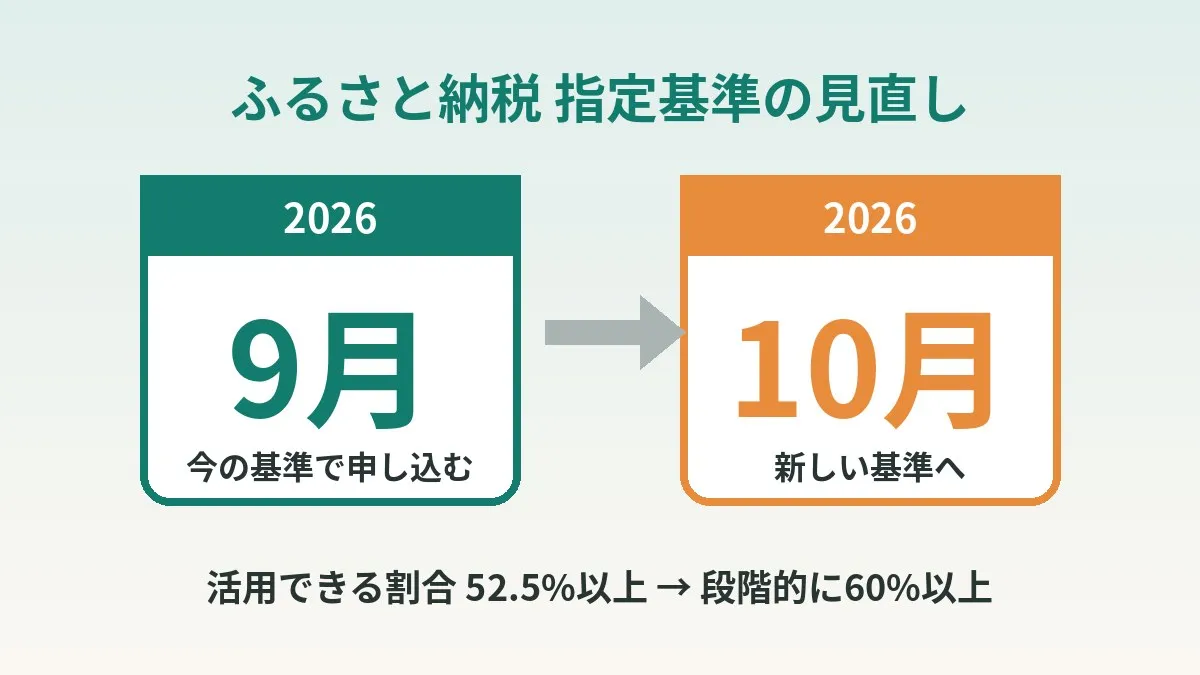
- From October 1, the standard for how much of each donation a municipality can actually use became 52.5% or more
- Checks on local products became stricter, so listings and donation amounts for processed goods and household items are more likely to shift
- How your deduction limit is determined and the five-municipality rule for the One-Stop Exception have not changed
- The rule that gift procurement costs must be 30% or less of the donation amount also stays the same
- For the one year from October, 1,781 of 1,788 local governments have been designated
The October changes at a glance
First, here is a single table showing what changed and what did not. These are the parts my September article described as “about to change.”
| Item | Until September | From October | Impact on donors |
|---|---|---|---|
| Share municipalities can use | Solicitation costs at 50% or less | Usable donation share of 52.5% or more | Some gifts may have their donation amounts revised |
| Checking local products | Each municipality calculated added value its own way | As a rule, price-based calculation and proof from the business | Processed goods and household items are more likely to be delisted |
| Violations considered when revoking designations | The previous scope | Going back up to five years | No direct impact |
| Gift procurement costs | 30% or less of the donation amount | No change | The cap on the gift ratio is the same |
| Deductions and One-Stop Exception | Current system | No change | Same procedure |
Looking at the table, the donor column is mostly “may.” Since this is a revision aimed at municipalities, I suppose that is to be expected.
Usable share rises to 52.5% or more
In the fiscal 2026 (Reiwa 8) tax reform, the Ministry of Internal Affairs and Communications (MIC, Somusho) introduced the idea of a “usable donation amount” (kifukin katsuyo kanougaku). This is the money a municipality can spend on its programs after subtracting the costs of soliciting donations.
The plan is to eventually raise this share to 60% or more, and to require municipalities to publish how the money is used. Rather than jumping straight to 60%, it will rise a little each year.
| Designation year | Usable donation share | Converted to solicitation costs |
|---|---|---|
| Up to 2025 designation | (Old rule) solicitation costs at 50% or less | 50% or less |
| 2026 designation (from October) | 52.5% or more | Equivalent to 47.5% or less |
| 2027 designation | 55% or more | Equivalent to 45% or less |
| 2028 designation | 57.5% or more | Equivalent to 42.5% or less |
| 2029 designation onward | 60% or more | Equivalent to 40% or less |
The right-hand column is my own conversion, subtracting the usable share from 100%. The phrase you often see, “expense ratio going from 50% to 47.5%,” is simply the flip side of this number. I think it is fair to treat them as meaning roughly the same thing.
The key point is that this continues every year. It does not end in October. Another step up is planned for October 2027.
Stricter checks on local products
The other pillar is a review of the local product criteria. It was decided by a revision of the public notice in June 2025 and applies from the October 2026 designation.
The gifts most likely to be affected are those that gain value through manufacturing or processing. Until now, it was enough for “a reasonable amount of added value” to be created within the area, and each municipality calculated it in its own way.
| Item under review | Treatment from October |
|---|---|
| How added value is calculated | As a rule, it is calculated based on price |
| Proof that most of the value is created in the area | The business doing the manufacturing or processing provides the proof |
| Publishing the proof | The municipality publishes a list by the date the gift goes on offer |
| General retail price | Stated on the certificate and published as well |
| Character goods and similar items | Require a track record, such as the municipality having distributed or sold them for promotional purposes |
Aged meat and polished rice were already limited to raw materials produced within the same prefecture. That condition remains after the revision.
The MIC materials even mentioned a case where imported wine was simply stored within the area and then supplied at a high price. The aim seems to be to stop this kind of “padding the added value.”
Wider scope for revoking designations
There is one more revision aimed at municipalities. When deciding whether to revoke a designation, violations going back up to five years can now be taken into account. This also took effect on October 1, 2026.
The revocation period has also changed, from a flat two years to up to three years. That part started earlier, on April 1, 2026. Nothing changes in the donor’s procedure, but it may be one reason municipalities are becoming more cautious when choosing gifts.
1,781 local governments designated from October
On September 25, 2026, the MIC announced the designations for the one year starting in October. The designation period runs from October 1, 2026 to September 30, 2027.
According to news reports, 1,781 of the 1,788 local governments nationwide have been designated. Every local government that submitted an application was designated, and no municipality was newly revoked.
The seven that are not covered fall into two groups. Tokyo Metropolis does not participate in the system in the first place. The remaining six cities and towns are still under past revocations.
If you are wondering about a municipality you want to donate to, you can check the attachment to the MIC press release. Personally, I think you generally do not need to worry about municipalities listed on the portal sites.
What stays the same for donors
This is the part I want to stress. The October revision did not change the rules for donors.
- Your deduction limit is determined by that year’s income and family structure
- The One-Stop Exception can be used if you donate to five or fewer organizations
- The application is due by January 10 of the year after you donate
- Gift procurement costs must be 30% or less of the donation amount
So I do not think you need to see it as “the system became a worse deal from October.” What shifts are the listings and donation amounts of individual gifts.
Separate from the October 2025 points ban
When people hear about an October revision to hometown tax donations, many may think of the ban on points. The ban on soliciting donations with portal-site point rewards was the previous year’s revision, starting in October 2025.
The October 2026 revision is a different thing. It is about the share of money municipalities can use and how local products are verified. Search results mix articles about both, so it is safest to check the year and read them separately.
How gift listings and donation amounts may shift
The portal site announcements I saw in September said little more than “some gifts will be delisted and some donation amounts will change.” Which gifts change and how is decided by each municipality.
Here are the kinds of shifts I would expect.
- Some household items and processed goods made in local factories may be delisted if the proof is not in place
- With less room for solicitation costs, some gifts may require a higher donation amount even if the gift itself is the same
- Primary products such as rice and meat produced within the area are less directly tied to the added-value review
By the way, in a notice from August 2026, the MIC flagged “soliciting donations by announcing future increases in donation amounts” as a problem. So there may be cases where price increases are not announced prominently in advance. For gifts you are interested in, the surest approach is to recheck the donation amount right before you donate.
What our family did in September
Before the revision, we first decided how much of our limit to pay in September. Then we sorted the contents like this.
| Category | Our examples | Moved up to September? | Reason |
|---|---|---|---|
| Household items and consumables | Diapers, toilet supplies | Yes | Many are manufactured goods and may be more affected by the added-value review |
| Primary products | Rice, pork | No | Less directly tied to this added-value review |
Before sorting, I also rechecked how much we had already donated this year. Our family tracks donations in a Notion database. But some entries were missing.
When I went back through our emails, we had actually donated more than I thought. Rakuten order emails alone were not enough; some donations only showed up in “donation completed” emails sent directly by the municipality.
Steps for donating from October onward
From October onward, you will be choosing from gifts under the new criteria. Here is the process our family has in mind, written as steps.
- Pull out this year’s already-paid donations from both the portal order emails and the municipalities’ donation-completed emails
- Check a rough estimate of this year’s deduction limit using a simulator or similar tool
- Subtract what you have already donated from the limit to see how much room is left
- Check that the gifts you are considering are still listed and that their donation amounts have not changed
- If a donation amount has changed, recalculate the return rate and compare again
- Apply using a method that completes payment within the year
- If you use the One-Stop Exception (one-stop tokurei), follow through and submit the application form
Steps 4 and 5 are the ones added after the revision. Even gifts you saved to your favorites in September may have a different donation amount from October onward.
Using your remaining limit through year end
If you moved donations earlier before the revision, it is worth recounting how much room you have left. Moving donations earlier does not raise your annual limit by even a single yen. The more you used in September, the less you have for October through December.
Which year a donation counts toward is the same as before the revision. The FAQ for Rakuten Furusato Nozei says a donation counts toward the year in which payment is completed. When the gift arrives does not matter.
Depending on the payment method, the payment may be completed on a different date than the application. Applications tend to pile up at year end. It may be safer not to leave too much for the last week of December.
The deduction limit is only an estimate. If your expected income changes partway through the year, the limit changes too. In years when bonuses or side income are hard to predict, it is safer to leave a little room.
One-Stop Exception and tax returns
In a year when you move donations earlier, the number of municipalities you donate to tends to grow. The One-Stop Exception can only be used if you donate to five or fewer organizations. Before donating at year end, it is a good idea to count how many you have donated to this year.
Also, if you file a tax return, any One-Stop Exception applications become invalid. In that case, you need to include all your donations in the tax return. We also have some donations where we chose “I want to use it,” so I am being careful not to leave those out when filing.
By the way, fixed costs like phone bills are also easier to compare when you look at “how much goes out per year.” It is the same idea as thinking about your hometown tax donation limit on a yearly basis. Why not line up your phone costs on an annual basis once, too?
Clicking this opens the Rakuten login page. Once you log in, you’ll see the campaign details.
Common mistakes and pitfalls
Here are some mistakes that are easy to make when donating after the revision.
- Forgetting to count what you moved up into September and going over your annual limit
- Counting past donations only from portal order emails and missing the ones made through municipalities
- Not noticing that a gift in your favorites now has a different donation amount from October onward
- Donating to six or more municipalities, which means you can no longer use the One-Stop Exception
- Applying for the One-Stop Exception, then filing a tax return and forgetting to include those donations
- Confusing the 2025 points ban with this revision and misjudging things
The third one in particular is a pitfall unique to the post-revision period. The surest approach is to check the donation amount on the screen right before you apply.
What our family will do after the revision
Once payments are done, our family plans to recheck the donation amounts of every gift. This is still in progress.
Even the same gift may have a different donation amount from October onward. Some may be delisted, too. With a database that calculates the return rate automatically, you only need to update the donation amounts to compare again. I plan to decide where to use our year-end allotment after seeing the results.
What to check before you start
- Checked this year’s already-paid donations in both the portal order emails and the municipalities’ donation-completed emails
- Checked a rough estimate of this year’s deduction limit and know how much room is left
- Confirmed that the gifts I am considering are still listed and their donation amounts have not changed
- Recalculated the return rate for gifts whose donation amounts changed
- If using the One-Stop Exception, the number of municipalities stays at five or fewer
- If filing a tax return, ready to include the donations where the One-Stop Exception was requested
- Chose a payment method that completes payment within the year
Frequently asked questions
Q. Did gift return rates drop from October?
This is not a revision where everything drops by a fixed percentage. The rule keeping gift procurement costs at 30% or less of the donation amount stays in place. How the donation amount or listing of each gift changes is up to each municipality.
Q. Will I lose out by donating from October onward?
The deduction system for donors has not changed, so the system itself does not make it a worse deal. However, the donation amount for the same gift may have gone up. It is a good idea to check the donation amount before applying.
Q. Did moving donations up to September raise my deduction limit?
No. The limit is determined by that year’s income and family structure. Whatever extra you donated in September simply reduces the room you have left until year end.
Q. Did donation amounts for rice and meat go up from October?
Some gifts may have gone up. Because the solicitation cost standard changed, some municipalities may have revised their donation amounts. However, I think primary products produced within the area are less directly tied to the added-value review.
Q. Can I check whether the municipalities I donate to remain eligible after October?
On September 25, 2026, the MIC announced the designations for the one year starting in October. The designated local governments are listed in the attachment to the press release. According to news reports, the only ones not covered are Tokyo Metropolis and six cities and towns whose designations were revoked in the past.
Q. How many municipalities can I use the One-Stop Exception for?
According to the MIC, you can use it if you donate to five or fewer organizations. The application is due by January 10 of the year after you donate. If moving donations earlier has increased the number of municipalities, it is a good idea to count them again.
Q. Is this the same revision as the October 2025 points ban?
No, it is a separate revision. The ban on soliciting donations with point rewards started in October 2025. The October 2026 revision focuses on the share of money municipalities can use and how local products are verified.
Q. Will anything change next October too?
The usable donation share is set to rise in stages. From the October 2027 designation, the standard will be 55% or more. Donation amounts for gifts may be revised every autumn.
Official sources I referred to
- MIC | Press release | Minister’s designations under the hometown tax donation designation system (September 25, 2026) (Japanese)
- MIC | Press release | Revision of the designation criteria for hometown tax donations, etc. (Japanese)
- MIC | On the revision of the designation criteria for hometown tax donations (June 24, 2025) (Japanese)
- MIC | On hometown tax donations (revision of the public notice on designation criteria), March 24, 2026 (Japanese)
- MIC | On the operation of the designation system for hometown tax donations (June 26, 2026) (Japanese)
- MIC | On strict compliance with the proper solicitation standards (August 20, 2026) (Japanese)
- MIC | Hometown tax donation topics (Japanese)
- MIC | About tax deductions (One-Stop Exception) (Japanese)
- Rakuten Furusato Nozei | FAQ (Japanese)
Summary
From October 2026, hometown tax donations changed in two ways: the share of money municipalities can use, and how local products are verified. Nothing has changed in the donor’s procedure or in how the deduction works. However, the listings and donation amounts for gifts like processed goods and household items may be shifting.
Our family moved up only household items into September and pushed rice and pork to October or later. From here, I plan to decide on our year-end donations while checking our remaining limit and the donation amounts.
I wrote about how we keep up with hometown tax donations in my post about donating a little every month. If you want to see the gifts in person, the Rakuten Super Furusato Nozei Festival in November may also be helpful.
To avoid a year-end scramble, take one look at how much of your limit is left.
While you are reviewing your household budget, try looking at your phone bill on an annual basis too. You might find a surprising difference.
Clicking this opens the Rakuten login page. Once you log in, you’ll see the campaign details.
This article contains affiliate advertising. If you sign up for a product or service through a link on this site, we may receive compensation from the partner company. The site operator is also an employee of Rakuten Group and may receive compensation through an employee referral program. The content and opinions here are based on the operator’s own experience and research regardless of any advertising relationship, but please read with the above in mind. See the Disclaimer & Affiliate Disclosure for details. Disclaimer & Affiliate Disclosure
This article includes machine-translated content. Please check the official Rakuten Mobile multilingual page for exact terms.
If you have concerns about Rakuten Mobile coverage or signal quality, you can consult through the official signal improvement request form .