- 01The short version of what is happening
- 02A quick refresher on the electricity and gas bill support
- 03A table of which bill goes up when
- 04Calculating the impact by usage level
- 05Looking at the TEPCO Energy Partner average model
- 06The fuel cost adjustment and the renewable energy surcharge also move
- 07Review step 1: Check your usage on the meter reading slip
- 08Review step 2: Confirm your contract plan
- 09Review step 3: Change how you use electricity
- 10Common misunderstandings
- 11The right review differs by household
- 12What to check before you start
- 13Frequently asked questions
- 14Official sources I referred to
- 15Summary
Good morning, this is まさきん.
I came across a Nikkei headline saying that electricity bills will go up in October because the subsidy is running out. We are a dual-income family with four kids, and electricity is one of the fixed costs I keep an eye on. So I went through the official numbers to work out exactly when the bill changes and by how many yen.
Note: This information is current as of the time of publication. Please check the official sites for the latest conditions.
- The national electricity and gas bill support ends after three months, covering usage from July through September 2026
- The discount is 3.5 yen/kWh for July and September and 4.5 yen/kWh for August (low-voltage contracts)
- On the bill that arrives in October (September usage), the discount shrinks by 1 yen/kWh
- The discount drops to zero starting with October usage (the bill that arrives in November)
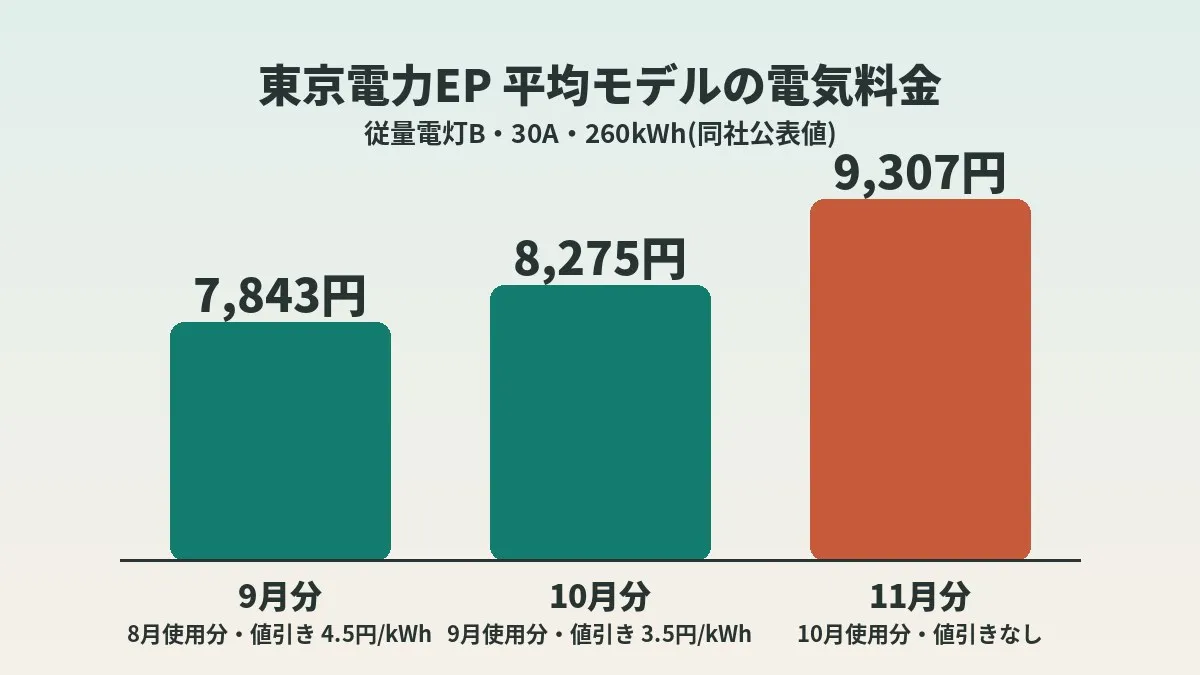
- The TEPCO Energy Partner average model goes from 8,275 yen for the October bill to 9,307 yen for the November bill
The short version of what is happening
To put the conclusion first, electricity bills go up in two steps. The first step is the bill that arrives in October. The second step is the bill that arrives in November, and that one is the bigger jump.
The reason is that the government discount gets smaller and then disappears. August usage had a discount of 4.5 yen/kWh. September usage drops to 3.5 yen/kWh. From October usage onward, there is no discount at all.
News reports say that October electricity bills will hit record highs at every major utility. That part, however, is not something I was able to confirm in official documents. So in this article I only use unit prices and amounts that I could verify from official sources.
A quick refresher on the electricity and gas bill support
This support is a program in which the national government discounts electricity and city gas charges. The Agency for Natural Resources and Energy runs a dedicated site that lists the covered period and the unit discounts.
Households do not need to apply. The retail electricity company you have a contract with deducts the discount from your bill according to how much you used. The dedicated site also states that no application by the user is required.
This round covers three months, from July 2026 usage through September 2026 usage. The Ministry of Economy, Trade and Industry announced the special approval for the discount on June 12. The overview document from the Agency for Natural Resources and Energy puts the relief at around 5,000 yen over three months for a standard household.
A table of which bill goes up when
The confusing part is the gap between the month you used the electricity and the month you are billed. In TEPCO Energy Partner documents, September usage is called the “October bill.” I lined the table up with that naming.
| Usage month | What TEPCO Energy Partner calls it | Electricity discount (low voltage) | City gas discount |
|---|---|---|---|
| July 2026 usage | August bill | 3.5 yen/kWh | 14.0 yen/m³ |
| August 2026 usage | September bill | 4.5 yen/kWh | 18.0 yen/m³ |
| September 2026 usage | October bill | 3.5 yen/kWh | 14.0 yen/m³ |
| October 2026 usage | November bill | None | None |
Meter reading dates differ from household to household. So the actual switchover does not line up neatly with calendar months. I think the surest way is to look at your own meter reading slip and check the usage period printed for each monthly bill.
Personally, I felt that what matters is which meaning of “October” you read into the headline. On the bill that arrives in October, the discount is still there. It disappears completely starting with the electricity you use in October.
Calculating the impact by usage level
The discount is determined by “unit price times usage.” So the more a household uses, the bigger the swing in yen.
The table below is a simple calculation that just multiplies the official discount rate by usage. Your real bill will not match it exactly because of the fuel cost adjustment and your meter reading date. Please treat it as a rough guide.
| Monthly usage | Discount for July and September usage | Discount for August usage | Amount that disappears from September to October usage |
|---|---|---|---|
| 260kWh | 910 yen | 1,170 yen | 910 yen |
| 300kWh | 1,050 yen | 1,350 yen | 1,050 yen |
| 400kWh | 1,400 yen | 1,800 yen | 1,400 yen |
| 500kWh | 1,750 yen | 2,250 yen | 1,750 yen |
The rightmost column is the increase caused by the subsidy going away. If you use the same amount of electricity, a household at 400kWh a month ends up paying about 1,400 yen more.
The change from August usage to September usage is 1 yen per kWh. At 400kWh, that is a 400 yen difference. The change you feel on the bill that arrives in October is this smaller one first.
Looking at the TEPCO Energy Partner average model
Calculations alone can feel abstract, so let us also look at the official average model. Every month, TEPCO Energy Partner publishes the charge for a sample household on the Meter-Rate Lighting B plan at 30A using 260kWh.
| Billing month | Average model charge | Change from previous month | Government discount |
|---|---|---|---|
| September bill (August usage) | 7,843 yen | — | 4.50 yen/kWh |
| October bill (September usage) | 8,275 yen | +432 yen | 3.50 yen/kWh |
| November bill (October usage) | 9,307 yen | +1,032 yen | None |
The 432 yen difference on the October bill includes 260 yen from the smaller discount. The rest comes from movement in the fuel cost adjustment. Of the 1,032 yen difference on the November bill, 910 yen was due to the discount ending.
Over the two months, the average model goes from 7,843 yen to 9,307 yen. The difference is 1,464 yen. That is how much things change even with exactly the same usage.
In the TEPCO area, a wheeling charge revision also overlaps
For TEPCO Energy Partner, there is one more factor in November. Starting November 1, 2026, a revision to wheeling charges is reflected in electricity rates. Wheeling charges are the cost of using the transmission and distribution network.
The September 29 announcement puts the increase at 254 yen a month for the average model. The November bill calculated with the revised unit prices comes to 9,561 yen. The announcement explains that the actual payment will be the total of the old and new rates prorated by day.
Utilities in other areas also announce their rates company by company. The amounts and timing should differ by area. Looking directly at the notices from your own provider seems like the best approach.
The fuel cost adjustment and the renewable energy surcharge also move
Your electricity bill is not determined by the subsidy alone. There are other elements that move every month.
One is the fuel cost adjustment. Its unit price changes monthly in line with fuel import prices. The TEPCO Energy Partner November bill was calculated from fuel prices between June and August 2026.
The other is the renewable energy surcharge. The fiscal 2026 rate is 4.18 yen/kWh, and it applies from the May 2026 bill through the April 2027 bill. This one does not change in the middle of the fiscal year. For the average model at 260kWh, it works out to 1,086 yen a month.
- A higher bill is not necessarily caused only by the end of the subsidy
- The fuel cost adjustment goes up and down month by month, so a single-month comparison is hard to judge from
- Keep in mind that usage itself rises and falls with the seasons
Before being shocked by the total, breaking the electricity bill into its parts may be the shortcut. Looked at the same way, I find that mobile and internet costs are another fixed cost that is easy to review.
Clicking this opens the Rakuten login page. Once you log in, you’ll see the campaign details.
Review step 1: Check your usage on the meter reading slip
From here, this is the order of review you can do at home. First, check the following four things on your meter reading slip or your online account page.
- Look at which dates the usage period for each monthly bill runs from and to
- Look at your usage (kWh) and compare it with the same month last year
- Look at the amounts for the fuel cost adjustment and the renewable energy surcharge
- Look at how much the government discount is taking off
The important thing is to look at usage before the yen amount. The bill is unit price multiplied by usage. If the amount went up while usage stayed the same, the cause is on the unit price side.
I wrote about how to dig into usage down to the time of day in my article on reading a full year of electricity data in 30-minute intervals. If you want to see the seasonal peaks, I recommend lining up 12 months of data.
Review step 2: Confirm your contract plan
Next, check the plan you are currently on. There are three things to look at.
- Whether your contracted amperage (or contracted capacity) fits the way you live
- Whether your rate plan is a regulated rate or a deregulated rate
- Whether it is a plan where the unit price changes by time of day
The government discount works through the retail electricity companies. So I think the presence or absence of the subsidy is unlikely to be a reason to choose one provider over another. If you compare, the basic charge and the per-kWh energy charge are the axis.
We drive an EV, so the electricity plan is also something we are weighing. On September 29, TEPCO Energy Partner announced a plan called Denka Plus that also covers home charging for EVs and PHEVs. It is set to take effect on November 1. With plans like this, it is important to read the eligibility conditions first. I summarized how I think about EV running costs in my EV versus gasoline car comparison.
Bundling electricity and telecom is another option. My article sorting out bundle perks such as Rakuten Denki may also be useful.
Review step 3: Change how you use electricity
Last comes how you use it. This part is general advice, but I think of the order as follows.
- Start with the appliances that use the most, such as heating, cooling, and hot water
- Look for electricity that is always being drawn, such as standby power
- If you are on a time-of-use plan, consider whether you can shift when you use power
October has little heating or cooling, so usage tends to hit a low. That means the impact of losing the subsidy may show up as a fairly small amount. I expect the impact to grow in winter, when heating pushes usage up.
As for whether there will be support this winter, I could not find any official announcement as far as I checked. So it seems safer to build your budget on the assumption that there will be none.
Common misunderstandings
Here are the points where I felt I could easily get it wrong myself while researching.
- Assuming the discount is completely gone starting with the bill that arrives in October
- Thinking you need to apply to receive the discount
- Blaming the entire increase in the bill on the end of the subsidy
- Expecting the subsidy to continue if you switch electricity companies
- Believing that propane gas is also covered by the discount
On the last point, the dedicated site states that propane gas is not covered.
Applications also call for caution. The dedicated site carries a warning about suspicious phone calls asking for personal information or fees. No procedure is needed for the discount, so it seems best not to respond even if someone asks.
The right review differs by household
For households with high usage, differences in unit price translate readily into yen. I think it is worth spending time comparing plans. A large family like ours probably falls into this group.
On the other hand, for households with low usage, the basic charge carries more weight. Starting by checking the contracted amperage may be quicker.
In either case, I feel the trick is not to think about electricity alone. I wrote about how to approach fixed costs as a whole in how to get started with a fixed cost review.
What to check before you start
- I can check my recent usage (kWh) on my meter reading slip or online account page
- I know which dates of usage each monthly bill covers
- I found where the government discount appears on my statement
- I confirmed my contract plan and contracted amperage
- I read the November bill notice from my electricity provider
Frequently asked questions
Q. Through which usage month does the subsidy continue?
The dedicated site of the Agency for Natural Resources and Energy says it covers July 2026 usage through September 2026 usage. There is no discount listed from October usage onward.
Q. Is the bill that arrives in October the amount without the subsidy?
If it is for September usage, it includes a discount of 3.5 yen/kWh. The change is that it is smaller than the 4.5 yen/kWh for August usage. The covered period shifts slightly depending on your meter reading date.
Q. How much does it change for a household using 400kWh a month?
By simple calculation, 3.5 yen times 400kWh is 1,400 yen. That discount disappears between September usage and October usage. The fuel cost adjustment moves separately, so the actual difference will be somewhat higher or lower.
Q. Do I need to do anything to receive the discount?
No. The dedicated site states that no application by the user is required. It also says you will never be asked for personal information or fees.
Q. Does city gas change at the same time?
City gas was covered for the same three months. The discount is 14.0 yen/m³ for July and September usage and 18.0 yen/m³ for August usage. There is no discount from October usage onward.
Q. Does the renewable energy surcharge change in October?
It does not. The fiscal 2026 rate is 4.18 yen/kWh, and it stays the same through the April 2027 bill. The next change is expected from the May 2027 bill.
Q. What happens to the subsidy if I switch electricity companies?
The discount is a mechanism the government carries out through retail electricity companies. The end date should be the same even if you change providers. For the finer details, please check the guidance from your provider.
Q. Will there be support again in winter?
At the time of writing, I could not confirm any official announcement about winter support. If one is decided, it should appear on the dedicated site of the Agency for Natural Resources and Energy.
Official sources I referred to
- Electricity and Gas Bill Support dedicated site (Agency for Natural Resources and Energy, METI)
- Special approval for the electricity and gas bill support for July, August, and September 2026 usage (METI)
- Overview of this summer’s electricity and gas bill support (Agency for Natural Resources and Energy)
- Fuel cost adjustment and related items for the October 2026 electricity bill (TEPCO Energy Partner)
- Fuel cost adjustment and related items for the November 2026 electricity bill (TEPCO Energy Partner)
- Reflecting the wheeling charge revision in electricity rates (TEPCO Energy Partner)
- List of fuel cost adjustment unit prices (TEPCO Energy Partner)
Summary
The national electricity and gas bill support ends with September 2026 usage. On the bill that arrives in October, the discount gets a little smaller. From the bill that arrives in November, the discount is gone.
You can roughly estimate the impact by multiplying 3.5 yen by your own usage. In the TEPCO Energy Partner average model, the November bill came out 1,032 yen higher than the October bill.
Opening a single meter reading slip and looking at your usage seems like a fine place to start. While you are at it, it might be worth glancing over your other fixed costs too.
Clicking this opens the Rakuten login page. Once you log in, you’ll see the campaign details.
This article contains affiliate advertising. If you sign up for a product or service through a link on this site, we may receive compensation from the partner company. The site operator is also an employee of Rakuten Group and may receive compensation through an employee referral program. The content and opinions here are based on the operator’s own experience and research regardless of any advertising relationship, but please read with the above in mind. See the Disclaimer & Affiliate Disclosure for details. Disclaimer & Affiliate Disclosure
This article includes machine-translated content. Please check the official Rakuten Mobile multilingual page for exact terms.
If you have concerns about Rakuten Mobile coverage or signal quality, you can consult through the official signal improvement request form .