- 01What changes depending on whether it is under ¥100,000
- 02Comparison table by acquisition cost band
- 03What “small-amount depreciable assets (under ¥100,000)” means
- 04Lump-sum depreciable assets (¥100,000 to under ¥200,000)
- 05The under ¥400,000 special rule starts from April 2026
- 06The depreciable asset tax return is where the difference shows
- 07Tax-included or tax-excluded: which amount is used for the judgment
- 08Why I passed on an expensive device
- 09Points that need confirming (personal-use apportionment, business scale, useful life)
- 10Steps to take before buying
- 11Common mistakes and pitfalls
- 12What to check before you start
- 13Frequently asked questions
- 14Official sources I referred to
- 15Summary
Good morning, this is まさきん.
I have been thinking about buying an additional device that I would also use for my business, so I looked again at where the line for “expenses under ¥100,000” is drawn. Along the way I also learned that the special rule for small-value depreciable assets was widened to under ¥400,000 from 2026. I am writing up the conditions for expensing a PC or tablet as a record of my decision.
Note: This information is current as of publication. Please check the official sites for the latest conditions.
- A device with an acquisition cost under ¥100,000 can be fully deducted as a necessary expense in the year you start using it
- The special rule for small-value depreciable assets was widened to under ¥400,000 for acquisitions on or after April 1, 2026
- Assets where the special rule was used must be reported as depreciable assets regardless of amount (per Tokyo guidance)
- Under ¥100,000, the item ends up on neither the fixed asset ledger nor the depreciable asset return
- Because of the bookkeeping effort, I decided to center my plan on a refurbished tablet under ¥100,000
What changes depending on whether it is under ¥100,000
A PC or tablet used for business is, strictly speaking, a depreciable asset. The principle is to expense it over several years.
However, the treatment changes if the acquisition cost is under ¥100,000. The National Tax Agency’s Tax Answer (No. 2100) says the full amount is treated as a necessary expense in the year the asset is put into business use. Items with a useful life of less than one year are treated the same way.
In other words, the matter is finished within that year’s expenses. There is no processing carried into later years. What caught my attention was this part about it being “finished.”
Comparison table by acquisition cost band
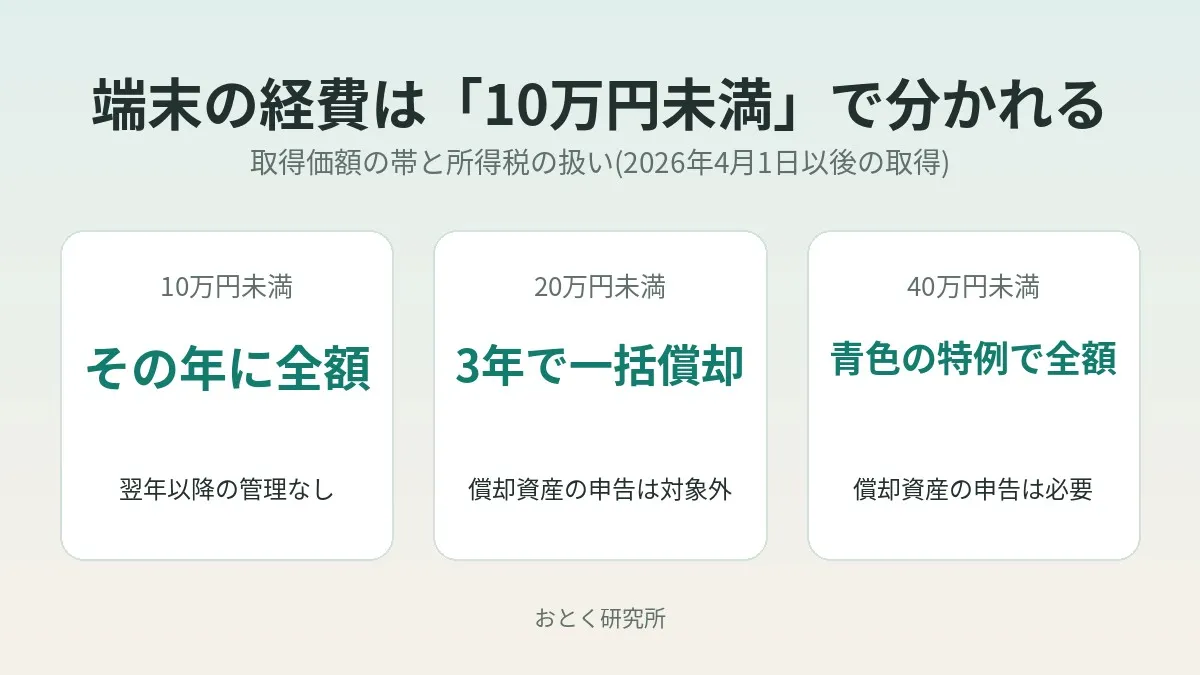
First, the overall picture in a table. This is for individual income tax, for assets acquired on or after April 1, 2026.
| Acquisition cost | Income tax treatment | Management in later years | Depreciable asset return |
|---|---|---|---|
| Under ¥100,000 | Full amount as a necessary expense in the year you start using it | None | Not subject |
| ¥100,000 to under ¥200,000 | Choose from lump-sum depreciation (one third each over 3 years), full amount under the blue return special rule, or ordinary depreciation | Lump-sum depreciation stays for 3 years | Lump-sum depreciation is not subject; the special rule and ordinary depreciation are subject |
| ¥200,000 to under ¥400,000 | Full amount under the blue return special rule, or ordinary depreciation | Ordinary depreciation stays for the useful life | Both are subject |
| ¥400,000 or more | Ordinary depreciation (4 years for a PC) | Stays for the useful life | Subject |
The income tax column is based on the National Tax Agency’s No. 2100, and the depreciable asset column on guidance from the Tokyo Metropolitan Bureau of Taxation. For acquisitions through March 31, 2026, the special rule’s ceiling is under ¥300,000.
Depreciable asset returns are filed with your municipality, so the forms and filing methods differ by local government. Please check the guidance from the municipality where you live as well.
What “small-amount depreciable assets (under ¥100,000)” means
The under ¥100,000 treatment applies whether or not you file a blue return. It is the most basic rule, written in Note 1 of No. 2100.
The Tokyo filing guide also had a note about individuals. It says that all assets under ¥100,000 become necessary expenses. It also said they are not depreciated individually. For individuals, it seems to be less a choice and more something that happens automatically.
There is also a rule about the unit of judgment. The Income Tax Basic Circular says the judgment is made per unit in which the item is normally traded. For equipment and fixtures, that is per piece or per set.
Lump-sum depreciable assets (¥100,000 to under ¥200,000)
For assets of ¥100,000 to under ¥200,000, there is a method called lump-sum depreciation. You deduct one third of the total acquisition cost as a necessary expense each year over three years.
You can expense it faster than with ordinary depreciation. However, it stays on the books for three years. At each year-end closing, the processing of writing off one third continues.
On the other hand, the treatment is lighter for the depreciable asset return. The Tokyo guide says assets under ¥200,000 that are being depreciated in a lump sum over 3 years do not need to be reported.
The under ¥400,000 special rule starts from April 2026
This is the part I learned about partway through my research this time. The special rule for small-value depreciable assets for small and medium businesses was revised in the FY2026 tax reform.
| Item | Details |
|---|---|
| New ceiling | Acquisition cost under ¥400,000 (acquisitions on or after April 1, 2026) |
| Previous ceiling | Under ¥300,000 (acquisitions through March 31, 2026) |
| Applicable until | Acquisitions through March 31, 2029 |
| Annual total limit | ¥3,000,000 (unchanged) |
| Eligible individuals | Blue return filers who meet certain requirements |
The Ministry of Finance’s tax reform outline says the ceiling will be raised to under ¥400,000. There was also a sentence saying the same applies for income tax. The National Tax Agency’s No. 2100 also shows under ¥400,000 in its content as of April 1, 2026.
Using this special rule, you can deduct the full amount of an asset under ¥400,000 as an expense in that year . According to the Small and Medium Enterprise Agency’s guidance, sole proprietors apply it by writing “Sochi-ho 28-2” (措法28の2) on the blue return financial statement.
Note that the under ¥100,000 and under ¥200,000 thresholds do not appear to have changed. I found no mention of a revision in either the outline or the National Tax Agency’s reform materials. My understanding is that only the special rule’s ceiling moved.
Individuals calculate by calendar year, so 2026 gets a little complicated. The threshold splits: under ¥300,000 for acquisitions from January to March, and under ¥400,000 from April onward. Things like how the ¥3,000,000 annual limit is counted are worth checking before filing.
The depreciable asset tax return is where the difference shows
With the special rule, even an expensive device can be expensed in one year. So at first I thought there was little point in fixating on ¥100,000.
However, the treatment was different for depreciable assets under the fixed asset tax. The Tokyo Metropolitan Bureau of Taxation’s guidance says assets expensed immediately under the special rule must be reported. The position is that a special rule allowed for national tax is “not allowed regardless of amount” for fixed asset tax.
For depreciable assets, you report what you own as of January 1 each year by January 31. The exemption threshold is a tax base of under ¥1,500,000. The Ministry of Internal Affairs and Communications materials gave the same amount.
So I think it is very unlikely that a single device would produce any tax. However, the Tokyo guide asks for a return even when you are below the exemption threshold. Even if no tax is due, the effort of putting the asset on a ledger and managing it remains.
There is one caveat. Tokyo’s FY2026 guide still showed the pre-revision figure of under ¥300,000. I have not yet been able to confirm any local government materials that reflect under ¥400,000. From the wording “regardless of amount,” I read it as the same treatment applying under ¥400,000 too.
Tax-included or tax-excluded: which amount is used for the judgment
Is the ¥100,000 line judged on the tax-included or tax-excluded price? This is another point that is easy to miss.
| Position | Amount used for the judgment |
|---|---|
| Tax-exempt business | Tax-included |
| Taxable business using tax-included accounting | Tax-included |
| Taxable business using tax-excluded accounting | Tax-excluded |
The National Tax Agency’s circular says the judgment is made on the acquisition cost calculated under the accounting method you apply. Tax-exempt businesses are treated as calculating with tax-included accounting.
The corporate tax Q&A also had a concrete example. A PC costing ¥107,800 including tax is judged at ¥98,000 under tax-excluded accounting. The thinking is the same for income tax.
For a small business not registered for the invoice system, you would look at whether it is under ¥100,000 including tax. When the price is close to the boundary, it is safest to check against the amount on the receipt.
Why I passed on an expensive device
Alongside my job as a company employee, I file a tax return for a small business. As a device I would also use for that business, I had been considering an expensive new foldable.
To start with the conclusion: I passed on it. If I buy something additional, I have decided to center the plan on a refurbished tablet that fits under ¥100,000. It is a Wi-Fi model. I have not bought it yet.
The deciding factor was not short-term cash flow. It was the bookkeeping effort. Under ¥100,000, I can write it off directly as that year’s expense. Neither a fixed asset ledger nor depreciable asset management is needed.
Partway through my research, I learned that the special rule had been widened to under ¥400,000. As a result, there was no tax difference between the expensive devices. It did not serve as a basis for judging the price gap.
What remained was only the ¥100,000 line. Inside this line, you expense it and you are done. Step outside it and some kind of management remains whichever method you choose. The moment I understood the mechanism, the choice felt simple.
The refurbished tablet option
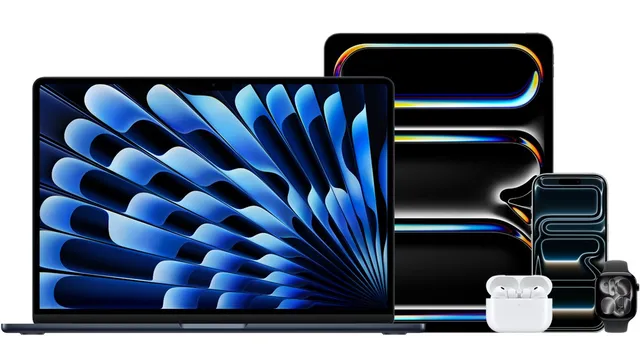
What I am looking at as a candidate is an Apple Certified Refurbished product. According to the official description, it comes with a one-year limited hardware warranty. Refurbished iOS devices reportedly get a new battery and outer shell.
The price is described as “special pricing of up to 15% off.” I checked the official page on October 4, 2026. The iPad mini (A17 Pro) Wi-Fi 128GB was ¥84,800 (tax included) .
That price fits under ¥100,000 even with tax included. By that math, it falls inside the line even for a tax-exempt business.
However, refurbished products are limited in quantity. The official page also says availability changes constantly. I plan to look at both the price and the stock once more right before buying.
Beyond the device price, monthly communication costs affect both your expenses and your household budget. If you go with a Wi-Fi model, reviewing the line on the smartphone you already have may be one option.
Clicking this opens the Rakuten login page. Once you log in, you’ll see the campaign details.
Points that need confirming (personal-use apportionment, business scale, useful life)
From here on are the parts where I do not have an answer yet. I am leaving them as points that need confirming, without asserting anything.
- For a device subject to personal-use apportionment, whether the ¥100,000 judgment uses the amount before or after apportionment
- Whether the under ¥400,000 special rule can be used when the scale of the business is very small
- How many years to use as the useful life of a smartphone or tablet
The judgment when apportioning for personal use
For a device also used privately, you expense only the share used for business. So is the ¥100,000 judgment made before or after apportionment? I could not find a place on the National Tax Agency’s pages that states this explicitly.
All the circular has is the rule that the judgment is made per unit of transaction. How to view the amount when apportioning is, I think, something to confirm with the tax office or a tax accountant.
On the fixed asset tax side, there was a clear statement. The Tokyo guide says that for assets serving both business and non-business use, you enter the full acquisition cost. Apportionment is not allowed.
Whether the business is of a scale that can use the special rule
For individuals, the under ¥400,000 special rule is for “blue return filers who meet certain requirements.” The Small and Medium Enterprise Agency’s guidance also lists a condition on the number of employees.
However, what happens when the business is very small is a separate matter. For example, can it be used when you run something very small as a side business? I was not able to find an official page that states this explicitly.
Useful life of smartphones and tablets
The useful life of a PC is listed as 4 years in the National Tax Agency’s table. That is the category for personal computers other than those used as servers.
On the other hand, I found no entry that names smartphones or tablets. How many years to depreciate over is something I cannot settle on my own. If I keep it under ¥100,000, this whole issue disappears.
Homework to check with a tax accountant
I have left the following two items as homework to check with a tax accountant.
- How to decide the personal-use apportionment ratio
- Whether the special rule for small-value depreciable assets can be used at the scale of my business
The first is needed even for a device under ¥100,000. That is because only the portion used for business can be fully expensed. Do I split by hours of use, or by purpose? I want to have it in a form where I can explain the basis.
Tax treatment varies with the nature of the business and the filing method. This article covers only what I organized from reading official information. For individual decisions, please check with a tax accountant or the tax office.
Steps to take before buying
Here is the order I have in mind, as steps. I have not bought anything yet, so these are preparation steps.
- Check your own accounting method and decide whether to judge on a tax-included or tax-excluded basis
- Check whether the candidate device’s price is under ¥100,000 on the amount used for the judgment
- If buying peripherals at the same time, check with a tax accountant how one unit is defined
- Decide the personal-use apportionment ratio and how to keep a record of its basis
- Keep the purchase receipt and record the date you started using it for business
- If it will be ¥100,000 or more, decide in advance between lump-sum depreciation and the special rule
- If using the special rule, schedule the depreciable asset return for the following January
For the expense bookkeeping itself, I use a setup that reconciles accounting SaaS and email with AI. Buying in a way that leaves a receipt email makes the later reconciliation easier.
Common mistakes and pitfalls
Here are the points I felt were easy to get wrong as I researched.
- Being a tax-exempt business but not judging on the tax-included price, because the tax-excluded price is under ¥100,000
- Leaving an asset fully expensed under the special rule off the depreciable asset return
- Applying the under ¥400,000 threshold to assets bought from January to March 2026
- Expensing the full amount of a device that is also used privately
- Assuming the under ¥100,000 threshold was raised too
- Applying the same rules to equipment meant to be lent to others
Let me add a little on the last point. Assets provided for lending are excluded, except for lending as a principal business. Neither the under ¥100,000 treatment, nor lump-sum depreciation, nor the special rule can be used, according to the rules. It does not concern a device I use myself, but I keep it in the back of my mind.
What to check before you start
- I know whether I am a tax-exempt or taxable business and whether my accounting is tax-included or tax-excluded
- I checked the price of the candidate device on the amount used for the judgment
- I checked whether the acquisition date is on or after April 1, 2026
- I checked with a tax accountant whether I file a blue return and whether I qualify for the special rule
- I decided the personal-use apportionment ratio and how to keep a record of its basis
- I understand that a depreciable asset return is required if I use the special rule
- I scheduled a final check with a tax accountant or the tax office
Frequently asked questions
Q. Did the amount for expenses under ¥100,000 change with the 2026 reform?
It does not appear to have changed. The National Tax Agency’s No. 2100 still showed under ¥100,000 in its content as of April 1, 2026. What was raised is the ceiling of the special rule for blue return filers.
Q. From which acquisitions does the under ¥400,000 special rule for small-value depreciable assets apply?
From assets acquired on or after April 1, 2026. For acquisitions through March 31, 2026, the ceiling is under ¥300,000. It is said to apply to acquisitions through March 31, 2029.
Q. If each is under ¥400,000, can I fully expense as many as I buy?
There is a limit on the annual total. According to National Tax Agency materials, the limit remains ¥3,000,000 a year. It applies only to blue return filers who meet certain requirements.
Q. Are PCs and tablets treated differently as expenses?
Under ¥100,000, both are the same: an expense in the year you start using them. The difference in useful life comes in when the item is ¥100,000 or more and you use ordinary depreciation. A PC is 4 years, but I found no entry naming tablets in the National Tax Agency’s table.
Q. Does a device costing exactly ¥100,000 count as under ¥100,000?
No. Because it says “under,” exactly ¥100,000 falls in the ¥100,000 or more category. The result also changes depending on whether you look at the tax-included or tax-excluded price, so you need to check it together with your accounting method.
Q. Is depreciable asset tax charged on a device expensed under the special rule?
It does become subject to reporting. Tokyo’s guidance says assets where the special rule was applied must be reported. However, if the total tax base is under ¥1,500,000, no tax is due.
Q. Can a company employee with a side business also expense a device under ¥100,000?
For an asset used for business, the under ¥100,000 treatment itself is not conditional on filing a blue return. However, the result changes depending on the income category and the apportionment with personal use. On this, checking with a tax accountant or the tax office is the surest route.
Official sources I referred to
- National Tax Agency | No. 2100 Overview of depreciation
- National Tax Agency | No. 5403 Examples of judging whether an item is a small-amount depreciable asset
- National Tax Agency | No. 5403 Q&A (consumption tax accounting method and the judgment)
- National Tax Agency | Income Tax Basic Circular 49-39 and others
- National Tax Agency | Income tax treatment following enforcement of the Consumption Tax Act
- National Tax Agency | FY2026 overview of revisions to corporate tax laws (SME taxation)
- National Tax Agency | Table of useful lives of major depreciable assets
- Ministry of Finance | Outline of the FY2026 tax reform
- Small and Medium Enterprise Agency | Special rule for small-value depreciable assets
- Ministry of Internal Affairs and Communications | Overview of fixed asset tax
- Tokyo Metropolitan Bureau of Taxation | Fixed asset tax (depreciable assets)
- Tokyo Metropolitan Bureau of Taxation | FY2026 filing guide for fixed asset tax (depreciable assets)
- Apple | Why choose Certified Refurbished
- Apple | Refurbished iPad mini
Summary
When replacing a device, whether it is under ¥100,000 made a big difference to the bookkeeping effort. Inside the line, it is finished within that year’s expenses. It goes on neither the fixed asset ledger nor the depreciable asset return.
The under ¥400,000 special rule is available for acquisitions on or after April 1, 2026. However, assets where the special rule is used must be reported as depreciable assets. Whether you can expense something and whether management remains turned out to be separate questions.
I passed on the expensive device and centered my plan on a refurbished tablet under ¥100,000. Personal-use apportionment and whether I can use the special rule remain as homework to ask a tax accountant.
I am continuing my fixed cost review with the approach of tackling one contract per week. Whether to separate out a line for work is covered in my article on choosing a plan as a sole proprietor.
Next time you buy a device, why not jot a quick note next to the price: “is it under ¥100,000?”
Beyond the device price, monthly communication costs affect both your expenses and your household budget. Try looking at these as an annual amount too.
Clicking this opens the Rakuten login page. Once you log in, you’ll see the campaign details.
This article contains affiliate advertising. If you sign up for a product or service through a link on this site, we may receive compensation from the partner company. The site operator is also an employee of Rakuten Group and may receive compensation through an employee referral program. The content and opinions here are based on the operator’s own experience and research regardless of any advertising relationship, but please read with the above in mind. See the Disclaimer & Affiliate Disclosure for details. Disclaimer & Affiliate Disclosure
This article includes machine-translated content. Please check the official Rakuten Mobile multilingual page for exact terms.
If you have concerns about Rakuten Mobile coverage or signal quality, you can consult through the official signal improvement request form .