- 01What Is an Education Cost “Cliff Year”?
- 02Why Costs Overlap When You Have Multiple Kids
- 03Figures from MEXT’s “Survey on Children’s Learning Expenses”
- 04Looking by Grade Makes the Peaks Clear
- 05High School and University Entry Costs from the Japan Finance Corporation Survey
- 06How to Build an Education Cost Timeline
- 07How to Save for the Cliff Year
- 08Putting the Child Allowance Toward the Cliff
- 09High School Tuition Support
- 10The New Higher Education Study Support System
- 11Common Mistakes and Pitfalls
- 12Things to Confirm Before You Start
- 13FAQ
- 14Official Sources I Referenced
- 15Summary
Good morning, this is まさきん.
We have four kids in our family. Recently, during our weekly household budget review, I laid out our education costs on a timeline. That’s when I spotted a “cliff”: a school year a few years out where education costs nearly double from the year before. In this post, I’ll walk through how to find a year like that and how to prepare for it, using official statistics and government programs.
This information is current as of publication. Please check the official sites for the latest details.
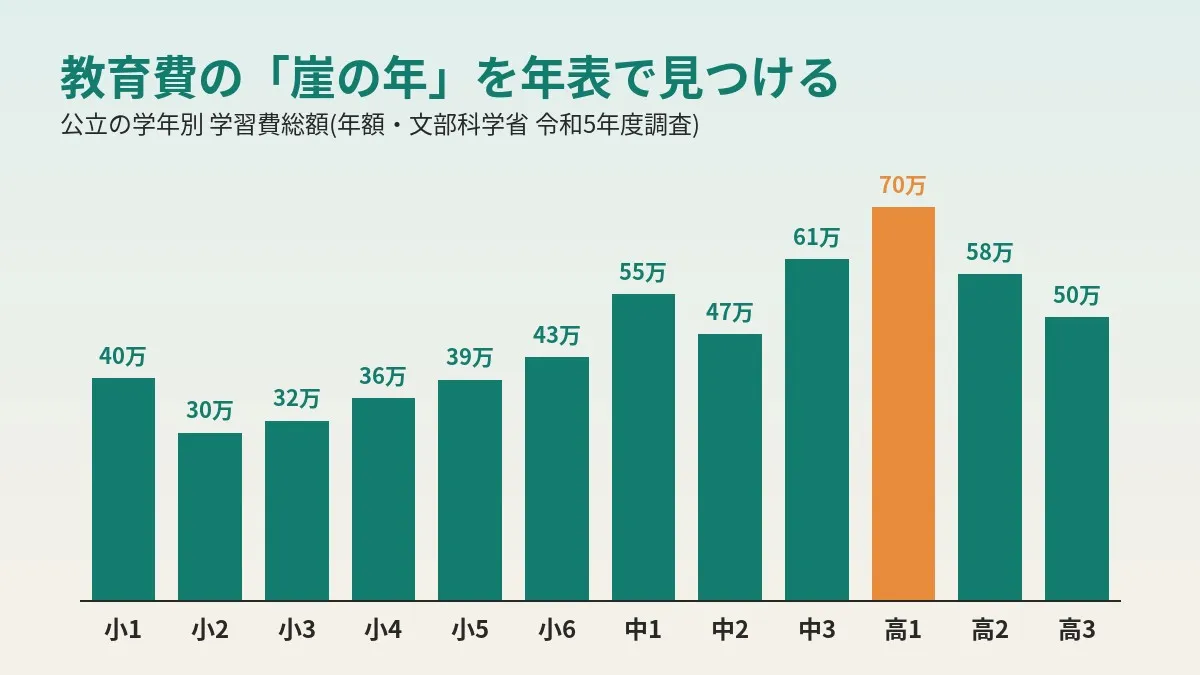
- Education costs rise and fall by grade. In the Ministry of Education (MEXT) survey, total learning costs for the first year of public high school are about 700,000 yen, the highest of any grade in public schools
- With multiple kids, peaks from school entries, entrance exams, and cram school tend to land in the same school year
- Lining up every child’s grade by school year lets you spot the “cliff year,” when spending suddenly jumps, well in advance
- The basic approach is to set aside “the increase over the previous year ÷ months until the cliff year” in a separate fund
- Since October 2024, the Child Allowance (児童手当) has had no income cap and is paid through high school age, making it easier to put toward the cliff
What Is an Education Cost “Cliff Year”?
In this post, a “cliff year” means a school year when education costs jump sharply compared with the year before. It tends to happen when entrance fees, uniforms, exam fees, and cram school seasonal courses all pile up at once.
Education costs aren’t the same every year. Looking at your monthly budget, they seem to creep up slowly, but when you break them down by school year, you can see distinct steps.
If you can see a cliff year coming several years ahead, you may be able to smooth it out with monthly savings.
Why Costs Overlap When You Have Multiple Kids
With one child, the peaks come one at a time, in order. With two or more, separate peaks can land in the same school year.
For example, siblings three grades apart will start high school and junior high in the same year. Their exam years tend to overlap as well.
Cram school costs also tend to rise as kids move up in grade. With four kids, our family is set up in a way that makes these overlaps likely.
Figures from MEXT’s “Survey on Children’s Learning Expenses”
First, let’s look at the annual amounts by school type using public statistics. I’m using the Ministry of Education’s “FY2023 Survey on Children’s Learning Expenses” (令和5年度子供の学習費調査), the latest edition published.
A corrected edition of the results was released on January 16, 2026, so the figures below are taken from that version.
| Category | Total learning costs | School education costs | Out-of-school activity costs |
|---|---|---|---|
| Public kindergarten | 184,646 yen | 69,362 yen | 100,049 yen |
| Private kindergarten | 347,338 yen | 154,062 yen | 157,535 yen |
| Public elementary school | 366,599 yen | 74,336 yen | 256,489 yen |
| Private elementary school | 1,741,516 yen | 978,271 yen | 709,667 yen |
| Public junior high school | 542,450 yen | 150,761 yen | 356,018 yen |
| Private junior high school | 1,560,359 yen | 1,128,061 yen | 422,981 yen |
| Public high school (full-time) | 596,954 yen | 351,523 yen | 245,431 yen |
| Private high school (full-time) | 1,179,261 yen | 832,650 yen | 346,611 yen |
Source: MEXT, “Key Points of the FY2023 Survey on Children’s Learning Expenses (Corrected Edition).” These are annual amounts per child, and the totals include school lunch fees.
A notable feature of public elementary and junior high schools is that out-of-school activity costs exceed school education costs. Out-of-school activity costs cover things like cram school and extracurricular lessons. Even if your kids go to public school, it looks like you need to put cram school peaks on your timeline.
Looking by Grade Makes the Peaks Clear
The same survey also lists amounts by grade, which you can use directly to draft your timeline.
| Grade | Public total learning costs | Private total learning costs | Public out-of-school costs | Private out-of-school costs |
|---|---|---|---|---|
| Elementary 1st grade | 395,394 yen | 2,165,693 yen | 216,850 yen | 653,973 yen |
| Elementary 2nd grade | 297,710 yen | 1,493,663 yen | 211,919 yen | 610,771 yen |
| Elementary 3rd grade | 318,916 yen | 1,548,734 yen | 230,993 yen | 608,477 yen |
| Elementary 4th grade | 359,778 yen | 1,638,939 yen | 271,274 yen | 692,195 yen |
| Elementary 5th grade | 392,755 yen | 1,736,557 yen | 295,538 yen | 806,849 yen |
| Elementary 6th grade | 432,708 yen | 1,874,114 yen | 307,345 yen | 891,409 yen |
| Junior high 1st year | 545,239 yen | 1,869,839 yen | 278,315 yen | 371,556 yen |
| Junior high 2nd year | 473,569 yen | 1,281,980 yen | 341,591 yen | 362,056 yen |
| Junior high 3rd year | 607,325 yen | 1,519,770 yen | 446,096 yen | 539,226 yen |
| High school 1st year | 700,240 yen | 1,392,712 yen | 195,191 yen | 293,299 yen |
| High school 2nd year | 580,958 yen | 1,150,924 yen | 225,761 yen | 381,273 yen |
| High school 3rd year | 503,697 yen | 977,725 yen | 319,200 yen | 367,860 yen |
Source: Tables 2 and 5 of MEXT, “Overview of the FY2023 Survey on Children’s Learning Expenses (Corrected Edition).” High school figures are for full-time programs.
Entry years tend to be expensive. The highest for public schools is the first year of high school, at about 700,000 yen. For private schools, the highest was the first grade of elementary school, at about 2,166,000 yen. Exam years are peaks too: out-of-school activity costs in the third year of public junior high are higher than in the second year.
High School and University Entry Costs from the Japan Finance Corporation Survey
From high school onward, the Japan Finance Corporation’s (日本政策金融公庫) “Survey on the Burden of Education Costs” is also a useful reference. The latest edition is the FY2021 survey (published December 2021), so it’s best treated as a rough guide.
| Category | Entry costs (per child) | Annual costs while enrolled |
|---|---|---|
| High school | 350,000 yen | 756,000 yen |
| Technical colleges, vocational and miscellaneous schools | 502,000 yen | 1,169,000 yen |
| Junior college | 730,000 yen | 1,370,000 yen |
| University | 811,000 yen | 1,499,000 yen |
| National or public university | 672,000 yen | 1,035,000 yen |
| Private university (humanities) | 818,000 yen | 1,520,000 yen |
| Private university (sciences) | 888,000 yen | 1,832,000 yen |
Source: Japan Finance Corporation, “FY2021 Survey on the Burden of Education Costs.” Entry costs include exam fees and payments to schools the child ended up not attending. Annual enrollment costs include school education costs such as tuition, as well as home education costs such as cram school and lessons.
The same survey found that entry and enrollment costs from starting high school through graduating from university came to 9,425,000 yen per child.
However, the definitions differ from the MEXT survey. It’s probably safer not to add or compare the two sets of numbers.
How to Build an Education Cost Timeline
You can make the timeline in a spreadsheet or on paper. Here are the steps:
- Along the horizontal axis, list school years from this year until around when your youngest finishes university
- Along the vertical axis, list your kids, one per row
- In each cell, write the child’s grade for that school year (using their grade as of April)
- Mark the years of school entry, entrance exams, and graduation
- Enter an estimated amount for each grade (listing tuition, cram school, and exam costs separately)
- Add up each school year vertically to get total education costs for all your kids
- Calculate the difference from the previous year and color in the years with big jumps
For your estimates, use actual figures for items you already have records for. For future grades, the easy option is to plug in the survey’s per-grade figures as placeholders. If your kids’ paths aren’t decided yet, building both a public and a private version might show you the range.
Our family also laid out tuition, cram school, and exam costs on a timeline, and found a cliff a few years out where costs nearly double from the previous year. I think it’s the kind of step that’s hard to notice just from looking at the monthly budget.
Timeline Template
Here’s what the layout looks like before you fill in any amounts, for a case with two kids three grades apart.
| School year | Child A | Child B | Notes |
|---|---|---|---|
| Year 1 | Junior high 2nd year | Elementary 5th grade | |
| Year 2 | Junior high 3rd year (exams) | Elementary 6th grade | Exams |
| Year 3 | High school 1st year (entry) | Junior high 1st year (entry) | Two entries |
| Year 4 | High school 2nd year | Junior high 2nd year | |
| Year 5 | High school 3rd year (exams) | Junior high 3rd year (exams) | Two exam years |
| Year 6 | University 1st year (entry) | High school 1st year (entry) | Two entries |
In this case, the peaks overlap in Years 3, 5, and 6. The key is to list exam years and entry years separately. Exam fees come up in the exam year, while entrance fees are often due just before the next school year starts. Decide in advance which year to count payments that straddle two school years, and you won’t have to agonize over it later.
How to Save for the Cliff Year
Once you’ve found the cliff, the next step is preparing for it. The idea is simple:
Monthly savings = the increase in the cliff year ÷ the number of months until the cliff year
The increase is the cliff year’s education costs minus the previous year’s. The assumption is that your regular budget can cover costs up to the previous year’s level. You only set aside the amount that goes beyond that, ahead of time.
The important thing is to keep it in a separate account. If it sits in the same account as your living expenses, it may get spent without you noticing. With a dedicated place for it, the balance shows your progress at a glance.
The sooner you start, the smaller the monthly amount. When the cliff is close, the monthly amount gets bigger and can squeeze your budget. I think the earlier you build the timeline, the more options you’ll have left.
Our family decided to prepare by setting aside the difference in a separate fund before the cliff year. We made that decision during our weekly budget review as well. We haven’t yet decided which account to use or when to start.
Also, money for the cliff year has a set time when it’ll be spent. It’s best to keep it separate from your fund for unexpected expenses. I explained that way of thinking in my post on emergency funds.
Cutting fixed costs is an easy way to build up funds for the cliff year, and your phone bill may be the classic example.
Clicking this opens the Rakuten login page. Once you log in, you’ll see the campaign details.
Putting the Child Allowance Toward the Cliff
The Child Allowance is an easy source of funds to put toward the cliff. The program was expanded starting with payments for October 2024. Here’s a summary based on information from the Children and Families Agency (こども家庭庁):
- The income cap was removed (the agency’s program overview states “no income cap”)
- The payment period was extended through high school age (until the first March 31 after the child turns 18)
- The monthly amount is 15,000 yen for children under 3, and 10,000 yen from age 3 through high school age
- For the third child and beyond, it’s 30,000 yen per month regardless of age
- It’s paid six times a year in even-numbered months, two months at a time covering the preceding months
When the Child Allowance lands in your living expenses account, it tends to blend into everyday spending. Moving it to your cliff-year account every time it comes in makes it easier to keep separate.
One thing to watch is how the third and later children are counted. Older siblings are counted until the end of the school year in which they turn 22, provided parents or others are financially supporting them. When an older child drops out of the count, for example by getting a job, the allowance for a younger child can go down.
In other words, the allowance itself can have a “cliff.” Adding a row for changes in the allowance to your timeline might help you avoid missing it. I’ve covered benefits around childbirth in Benefit programs you can use for childbirth and childcare.
High School Tuition Support
For high school tuition, there’s the national High School Tuition Support Fund (高等学校等就学支援金). According to MEXT, the new system starting in FY2026 eliminated the income cap.
| Category | Maximum annual payment |
|---|---|
| Public high school | 118,800 yen |
| Private high school | 457,200 yen |
| Private high school correspondence program | 337,200 yen |
Source: MEXT, “Overview of the New High School Tuition Support Fund System.” The private school cap is said to be set at a level that takes average private high school tuition into account.
However, the support is meant to go toward tuition. Entrance fees, uniforms, and so on are separate costs, so the year your child starts high school may still be a cliff. You also need to apply for it.
The New Higher Education Study Support System
For universities and similar institutions, there’s the New Higher Education Study Support System (高等教育の修学支援新制度). It’s a national program that combines tuition and entrance fee reductions with grant-type scholarships that don’t need to be repaid.
Starting in FY2025, students from large families get their tuition and entrance fees reduced up to a set amount, with no income cap. A large family here means a household supporting three or more children. The annual reduction caps for universities are as follows:
- National or public universities: 280,000 yen for the entrance fee, 540,000 yen for tuition
- Private universities: 260,000 yen for the entrance fee, 700,000 yen for tuition
Again, you need to pay attention to how kids are counted. When an older child gets a job and is no longer a dependent, a younger child may lose eligibility. It’s reassuring to also note “number of dependent children” on your timeline. There are academic requirements too, so check the official page for details.
Common Mistakes and Pitfalls
Here are the points where people tend to stumble when building a timeline:
- Thinking about each child separately and missing the overlaps
- Not deciding whether entrance fees and uniforms belong in the exam year or the entry year
- Forgetting costs other than monthly fees, like seasonal courses or deposits at backup schools
- Overlooking the years when allowances or support drop after an older child becomes independent
- Mixing cliff-year money into your living expenses account and spending it without noticing
- Building the timeline once and never updating it when your kids’ plans change
School paths and extracurriculars change from year to year. Reviewing the timeline about once a year is probably about right.
Things to Confirm Before You Start
- Each child’s current grade, and the school years through about when your youngest finishes university
- Public or private, and which school paths are still undecided
- The annual amount you currently pay for tuition, cram school, and lessons
- Expected costs in exam years, such as exam fees and seasonal courses
- The account that receives the Child Allowance, and how your third and later children are counted
- The school years when the number of dependent children will change
- Whether you have a separate account you can set aside for the cliff year
The statistics are national averages. Actual amounts vary widely by region, school, and choice of cram school. They’re fine as placeholders on your timeline, but I recommend replacing them with your own actual figures and information from schools as you go.
I’ve outlined the bigger picture of building up funds in How to get started reviewing your fixed costs.
FAQ
Q. How recent is the latest Survey on Children’s Learning Expenses?
The latest one published on the MEXT site is the FY2023 survey. It was released in December 2024, with a corrected edition on January 16, 2026. Results are said to be published around December of the year after the survey.
Q. How far ahead should I start preparing for a “cliff year”?
There’s no set answer, but the earlier you start, the smaller your monthly savings. A good first step is to build a timeline and see how many years away the cliff is.
Q. If my kids will go to public school, is the cliff smaller?
Total costs are lower than for private school. But even at public schools, total learning costs in the first year of high school are about 700,000 yen. Out-of-school activity costs rise in the third year of public junior high, so the exam year tends to be a peak too.
Q. How much is the Child Allowance?
According to the Children and Families Agency, it’s 15,000 yen per month for children under 3, 10,000 yen per month from age 3 through high school age, and 30,000 yen per month for the third child and beyond. The income cap was removed starting with payments for October 2024.
Q. Will high school tuition be free?
Under the new High School Tuition Support Fund system starting in FY2026, the income cap has been removed. The maximum payment is 118,800 yen a year for public schools and 457,200 yen a year for private schools. Costs other than tuition aren’t covered, so it’s safest to assume you’ll still face a fair amount of spending in the entry year.
Q. Is university tuition free for large families?
Students from households supporting three or more children get reductions up to a set amount, with no income cap. However, anything above the cap is paid out of pocket. Eligibility may also be lost when an older child is no longer a dependent.
Q. Where should I keep the savings?
The basic rule is to keep it in an account separate from your living expenses. Since this money has a set time when it’ll be spent, it may be wise to think carefully before putting it into investments whose value fluctuates.
Official Sources I Referenced
- Overview of the FY2023 Survey on Children’s Learning Expenses (MEXT)
- Key Points of the FY2023 Survey on Children’s Learning Expenses, Corrected Edition (MEXT, PDF)
- Overview of the FY2023 Survey on Children’s Learning Expenses, Replacement Edition (MEXT, PDF)
- Survey on the Burden of Education Costs, all editions (Japan Finance Corporation)
- FY2021 Survey on the Burden of Education Costs (Japan Finance Corporation, PDF)
- More Support for Child-Rearing! Child Allowance (Children and Families Agency)
- Guide to the Child Allowance Program (Children and Families Agency)
- Study Support for High School Students (MEXT)
- Overview of the New High School Tuition Support Fund System (MEXT, PDF)
- New Higher Education Study Support System (MEXT)
- Tuition Reductions for Large Families at Universities from FY2025 (MEXT, PDF)
Summary
Education costs aren’t the same every year; they step up in years with school entries and entrance exams. When you have multiple kids, those steps tend to land in the same school year.
Putting them on a timeline lets you see that “cliff year” several years in advance. Once you can see it, all that’s left is dividing the difference by the number of months and setting it aside separately. Our family is still at the stage of picking an account, but now that we can see the cliff, the next step is clear.
Start by laying out every child’s grade by school year on a single sheet.
I think the easiest way to keep building funds for the cliff year is to free up a little from your monthly fixed costs at a time. Your phone bill is the classic example.
Clicking this opens the Rakuten login page. Once you log in, you’ll see the campaign details.
This article contains affiliate advertising. If you sign up for a product or service through a link on this site, we may receive compensation from the partner company. The site operator is also an employee of Rakuten Group and may receive compensation through an employee referral program. The content and opinions here are based on the operator’s own experience and research regardless of any advertising relationship, but please read with the above in mind. See the Disclaimer & Affiliate Disclosure for details. Disclaimer & Affiliate Disclosure
This article includes machine-translated content. Please check the official Rakuten Mobile multilingual page for exact terms.
If you have concerns about Rakuten Mobile coverage or signal quality, you can consult through the official signal improvement request form .