- 01We planned to keep 12 months’ worth
- 02What the common guidelines say
- 03What “months of expenses” protects against
- 04Households better off thinking in months
- 05What happens with two income sources
- 06How much public programs can cap
- 07Looking at sudden expenses by worst-case amount
- 08Steps to work backward from the worst-case amount
- 09Why we went with the smallest option
- 10Rules to set if you keep a thinner fund
- 11Who this suits and who it does not
- 12What to check before you start
- 13Frequently asked questions
- 14Official sources I referred to
- 15Summary
Good morning, this is まさきん.
Our family recently rethought how we size our emergency fund. We set aside the usual yardstick of “so many months of living expenses” for a while. I want to write down how I sorted out my thinking.
This is not a post recommending investments. It is a note, from the perspective of a financial planner (FP), on how to measure a household’s safety net. The final call depends on your own family’s situation.
※This information is current as of publication. Please check the official websites for the latest conditions.
- The Japan FP Association’s page gives “3 months to 1 year of living expenses” as a guideline for an emergency fund
- For households whose income can easily stop, thinking in months of expenses may be the better fit
- For households with two sources of income, you can also work backward from the realistic worst-case unexpected expense
- Public programs cover medical costs, time off work and unemployment, with caps and benefits that are fairly well defined
- If you keep a thinner emergency fund, set rules at the same time, such as not going back to revolving credit
We planned to keep 12 months’ worth
At first, our family planned to keep an emergency fund of “12 months of living expenses.” We are a dual-income household with four kids. So I thought having a thick cushion would give us peace of mind.
But when I thought about it again, something bothered me. What exactly was the 12-month figure meant to protect against? I could not explain it.
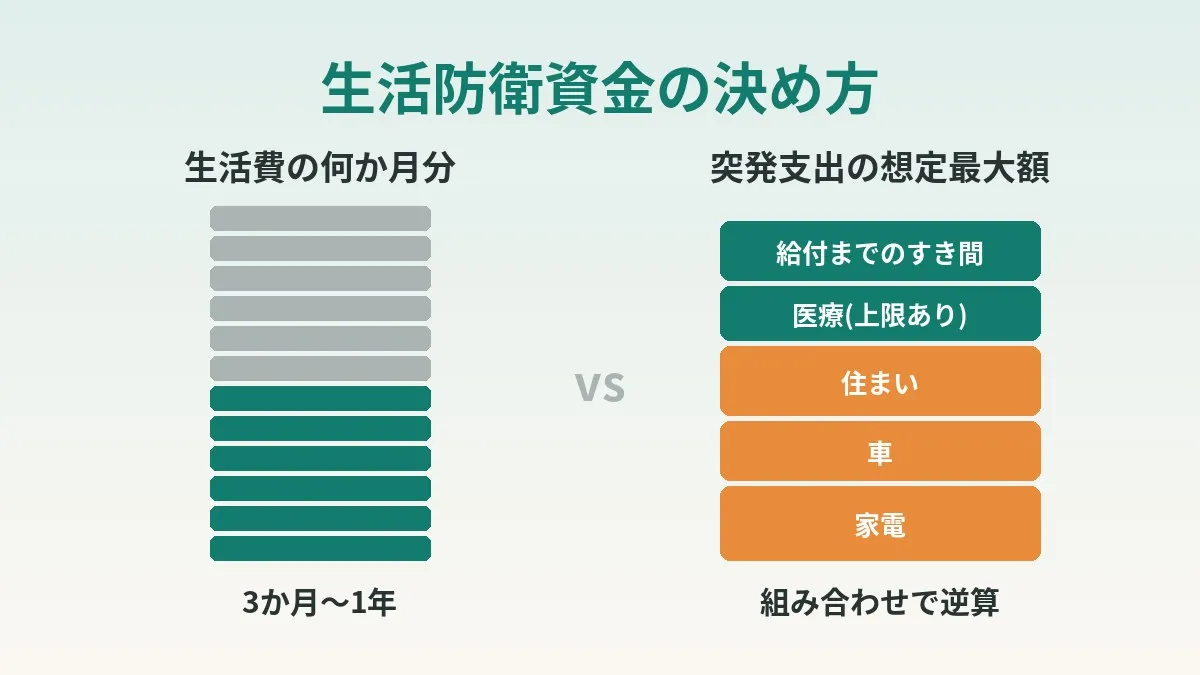
In the end, we decided to set the amount not by “months of living expenses” but by “the realistic worst-case unexpected expense.” We compared several options and chose the smallest one. It was a downward revision from our original plan.
What the common guidelines say
First, let me check the guidelines you often hear. Here is what I could confirm from public and neutral sources.
| Source | What it says |
|---|---|
| Japan FP Association | As an emergency fund, “set aside 3 months to 1 year of living expenses” |
| J-FLEC (Japan Financial Literacy and Education Corporation) | Think of your money in three groups. Also picture how much unwanted emergency spending might cost |
| Common wisdom | Often said to be 3 to 6 months for employees and 1 year for the self-employed |
The Japan FP Association page gives a guideline with a wide range. From 3 months to 1 year is quite a spread. On the other hand, I could not find a finer distinction between employees and the self-employed in any public materials.
So the bottom row is probably best taken as “what people often say.” Personally, I think the width of the range is itself a hint. It may mean the right number differs from household to household.
What “months of expenses” protects against
The idea of so many months of living expenses assumes a situation where income stops. For example, when you lose your job or cannot work because of illness. The image is bridging your living costs during that time with cash on hand.
J-FLEC’s lecture materials divide money into three groups: “money needed for daily life,” “money you plan to use in the near future,” and “money you do not plan to use for the time being.” I think an emergency fund falls under the safety net that protects daily life.
But income stopping is not the only thing that can knock a household budget off balance. The water heater breaks. Several car repairs pile up. Sudden expenses on the “money going out” side can shake the budget just as much.
Households better off thinking in months
For households with a high risk of income stopping, I think thinking in months of expenses is a good fit. For example, households like these.
- Self-employed or freelance, with income that swings a lot from month to month
- A large share of pay comes from commission or performance-based pay
- Planning to change jobs or go independent soon
- Only one source of income supports the household
For these households, it is hard to predict how long income might drop to zero. So the yardstick of “how many months can we last” works well. For the self-employed, some of the public benefits available to employees are not available. You could say the reasons for keeping a thicker cushion are clear.
What happens with two income sources
On the other hand, the situation is a little different for dual-income households with two sources of income. The chance that both people lose their income at the same time is presumably lower than for one person. Even if one stops, the other income remains.
Also, if you are an employee, there are public benefits when you take time off or lose your job. The period when income drops completely to zero may be shorter than you imagine.
Seen this way, the need to hold many months of full living expenses fades. Instead, isn’t it the sudden large expenses you should really be worried about?
How much public programs can cap
Here, let me check what the public programs actually offer. Medical costs, time off and unemployment all have caps or benefit systems.
| Program | What it caps | Main points confirmed in official sources | Things to watch |
|---|---|---|---|
| High-cost medical expense benefit (kogaku ryoyohi) | Out-of-pocket medical costs | The monthly cap depends on age and income. Revised from August 2026, with a new yearly “annual cap” | Cap amounts change with revisions. Costs not covered by insurance are separate |
| Injury and sickness allowance (shobyo teatekin, Kyokai Kenpo) | Income while off work due to illness or injury | Paid from the 4th day after 3 consecutive waiting days. The daily amount is two-thirds of an amount based on standard monthly pay. Up to 1 year and 6 months in total | Not paid while you are receiving salary. For members of employee health insurance |
| Basic unemployment allowance (kihon teate, employment insurance) | Income after leaving a job | Roughly 50-80% of your daily wage. Benefit days range from 90 to 360 | There is a 7-day waiting period. Leaving voluntarily also comes with a benefit restriction |
The Ministry of Health, Labour and Welfare page also gave a concrete example. It is for someone under 70 with an annual income of about 3.7 million yen to about 5.1 million yen, under the system from August 2026. Even for treatment costing 1 million yen, the out-of-pocket amount is said to be capped at about 93,000 yen.
Laid out as numbers it looks dry, but I feel this is an important point. Neither medical costs nor lost income are unlimited. They give you a ceiling to work with when you think about “how bad can it get.”
However, benefits come with waiting periods and reviews. It takes time before the money arrives. You still need cash to bridge that “gap.” I think it matters to look at both the program caps and the gap.
Looking at sudden expenses by worst-case amount
So how do you estimate sudden expenses? Here, I will call “the realistic worst case among possible expenses” the worst-case amount.
| Category | Examples | How to estimate |
|---|---|---|
| Appliances | Fridge, washing machine, air conditioner | Check how old they are and decide how many might break at once |
| Car | Repairs, tires, inspection costs running over | Refer to recent service records and quotes |
| Home | Water heater, plumbing, roof and exterior walls | Check the age of the equipment. If renting, check your share of costs in the lease |
| Medical | Out-of-pocket costs for hospital stays and visits | Consider the high-cost medical expense cap separately from costs not covered by insurance |
| Weddings and funerals | Celebrations and funerals in the family | Include travel and lodging costs for going back home |
| Moving | Job transfer or relocating | Talk as a family about whether it could happen |
| Income gap | The period until benefits arrive | Bridge the waiting and review period with cash on hand |
The key is not to assume “everything happens at once.” If you add it all up, you end up with an amount larger than many months of expenses. It may be more realistic to decide on a combination, such as “one big thing and one medium thing happening together.”
Steps to work backward from the worst-case amount
Here is the flow of thinking, written as steps.
- List possible sudden expenses. For each category in the table above, write down the equipment in your home and events that could happen.
- Estimate the worst-case amount. Put a rough figure on each one. Also decide which combinations could happen at the same time.
- Subtract what public programs cover. Think about medical costs in terms of the high-cost medical expense cap. For time off and unemployment, assume the benefits and keep only the gap period.
- Hold the rest in cash. Whatever is left after subtracting is what you keep in cash as your emergency fund.
- Decide when to review. Review it when your family structure or work situation changes, or after a big replacement purchase.
I think step 3, the “subtract,” is the heart of this method. You may not need to hold your own cash for everything that public programs already cover. That said, the details of the programs vary depending on your insurance and employer. Please check your own conditions with your insurer or your employer’s guidance.
Why we went with the smallest option
Our family lined up several options and compared them. Then we settled on the smallest one.
The reason is that, right now, there was something we wanted to prioritize over a thicker emergency fund: improving our monthly cash flow. Specifically, we decided to move ahead with reviewing fixed costs and loan repayments first.
Even with a thicker emergency fund, the sense of security does not last if the monthly budget stays tight. Conversely, if you have more room each month, you can refill the fund faster after using it. Personally, I feel this does more to strengthen the household’s underlying finances.
The nice thing about reviewing fixed costs is that once you do it, the effect keeps going. For example, your phone bill may be one of the easier items to tackle.
Clicking this opens the Rakuten login page. Once you log in, you’ll see the campaign details.
Rules to set if you keep a thinner fund
Keeping a thinner emergency fund carries a clear risk. When it runs short, it is easy to drift toward borrowing. So if you decide on an amount, you want to set rules at the same time.
- When you run short, do not go back to card installment payments or revolving credit
- After using it, prioritize refilling it over other savings
- Keep the emergency fund somewhere separate from everyday spending
- Do not schedule any big purchases until it has been refilled
I think the first two are especially important. Installment payments and revolving credit let you pay even when you have little cash on hand. They are convenient, but they come with fees. The balance also tends to be harder to see.
J-FLEC’s materials also say investing should be done with spare money. If you fill the gap from cutting your emergency fund with borrowing, you have lost the plot. If you want to tidy up how you use cards, the idea of consolidating to one main card may also be helpful.
Who this suits and who it does not
I do not think this backward-calculation method fits every household. Roughly speaking, it looks like this.
| May suit you if | May not suit you if |
|---|---|
| You have two or more income sources, such as a dual-income household | You have one income source and the budget falls apart if it stops |
| You are an employee enrolled in employee health insurance and employment insurance | You are self-employed or freelance with limited public benefits |
| Your monthly budget has room to put toward refilling the fund | Your monthly budget is already slipping into the red |
| You can commit to not using card installment payments or revolving credit | You tend to rely on revolving credit when you run short |
If you fall on the “may not suit” side, thinking in months of expenses may give you more peace of mind. Rather than one being right, I think it is something to choose based on the shape of your household.
Common pitfalls
The backward-calculation method also has a few pitfalls.
- Estimates get too optimistic. If the desire to keep the amount small comes first, you tend to underestimate the worst case.
- Over-relying on programs. Even with caps and benefits, you need cash until the money arrives.
- Putting off refilling. If you leave it depleted, you cannot withstand the next sudden expense.
- Forgetting to review. When your family grows or your work changes, the assumptions break down.
I think anyone can fall into the first one especially easily. Estimating a little on the high side may be just right.
What to check before you start
- How many income sources the household has, and how likely they are to stop at the same time
- The type of health insurance you have, and whether it offers the injury and sickness allowance
- What the high-cost medical expense cap is for your age and income bracket
- Whether you are enrolled in employment insurance
- How old your appliances, car and home equipment are
- Whether your family can agree not to use card installment payments or revolving credit
- How many months it would take to refill the emergency fund after using it
Frequently asked questions
Q. So how many months of living expenses is the right answer?
I think the right answer differs for each household. The Japan FP Association page gives a range of 3 months to 1 year of living expenses. Where you land within that range will likely depend on how stable your income is and your family structure.
Q. If we are a dual-income household, can we keep a smaller emergency fund?
You may be able to. However, if both of you work in the same industry, you could both be affected at the same time. Check how “separate” your income sources really are.
Q. Can I use this method if I am self-employed?
It is not impossible, but you may want to think carefully. In many cases, the injury and sickness allowance and the basic unemployment allowance for employees are not available as they are. If you are self-employed, I think it is safer to use the months-of-expenses approach as your base.
Q. If there is a high-cost medical expense benefit, do I not need to prepare for medical costs?
I do not think you can go that far. Even with a cap, you still pay out of pocket up to that cap. Costs not covered by insurance and transportation to appointments also add up separately.
Q. Can I invest my emergency fund through the new NISA?
Personally, I think the basic approach is to keep an emergency fund in cash, which does not fluctuate in value. When you suddenly need it, it may have dropped in value. Whether to invest it is your own decision.
Q. How often should I review it?
Rather than a fixed schedule, I think the time to review is when your household’s assumptions change. For example, when your family grows or your work situation changes. After a big replacement purchase is also a good time. Lining it up with an annual review of your overall household budget seems like a good idea too.
Q. What if I want advice on my own household’s situation?
For individual decisions, I think it is best to consult a specialist such as an FP. You can check the detailed conditions of public programs at your health insurer or at the Hello Work office. This post is about organizing the way of thinking, so please do not apply it as is.
Official sources I referred to
- Guidelines for the costs of major life events (Japan FP Association) (Japanese)
- Lecture material: Life planning and household finance (J-FLEC, Japan Financial Literacy and Education Corporation) (Japanese)
- For those using the high-cost medical expense benefit (Ministry of Health, Labour and Welfare) (Japanese)
- Injury and sickness allowance (Kyokai Kenpo) (Japanese)
- About the basic allowance (Hello Work Internet Service) (Japanese)
- Specific procedures for employment insurance (Hello Work Internet Service) (Japanese)
Summary
Emergency funds are often talked about in terms of months of living expenses. But for households with two income sources, you can also work backward from the realistic worst-case unexpected expense. If you subtract the caps from public programs, the cash you need may turn out smaller than you thought.
Our family revised our original plan of 12 months and chose the smallest of several options. In exchange, we are prioritizing improving our monthly cash flow. Not going back to revolving credit and refilling the fund after using it go hand in hand with that.
If you want to start with reviewing fixed costs, how to get started reviewing fixed costs may be helpful. I wrote about the refund process for medical costs in my post about paying our baby’s medical bills upfront.
The final amount will depend on your family’s situation. As a first step, how about writing down the ages of the equipment in your home?
Lowering fixed costs like your phone bill may make refilling your emergency fund a little easier too.
Clicking this opens the Rakuten login page. Once you log in, you’ll see the campaign details.
This article contains affiliate advertising. If you sign up for a product or service through a link on this site, we may receive compensation from the partner company. The site operator is also an employee of Rakuten Group and may receive compensation through an employee referral program. The content and opinions here are based on the operator’s own experience and research regardless of any advertising relationship, but please read with the above in mind. See the Disclaimer & Affiliate Disclosure for details. Disclaimer & Affiliate Disclosure
This article includes machine-translated content. Please check the official Rakuten Mobile multilingual page for exact terms.
If you have concerns about Rakuten Mobile coverage or signal quality, you can consult through the official signal improvement request form .