- 01Does the Marriott Bonvoy Amex annual fee pay for itself?
- 02Terms of the standard card and the Premium card
- 03The return rate changes with how you value 1 point
- 04Steps for estimating the break-even point
- 05My estimate
- 06Costco stays on Rakuten Card
- 07Why I am still not getting it now
- 08Decision table: get it or wait
- 09Check the welcome campaign on the official site
- 10Common mistakes and pitfalls
- 11Who it suits and who it does not
- 12Things to check before you start
- 13Frequently asked questions
- 14Official sources I referred to
- 15Summary
Good morning. まさきん here.
Does the Marriott Bonvoy Amex annual fee pay for itself? I ran the numbers using one year of card statements. The calculation came out positive, but I have decided “not to get it for now.” Here are my reasons, along with the steps for running the same estimate yourself.
Note: This article reflects information at the time of publication. Please check the official sites for the latest terms.
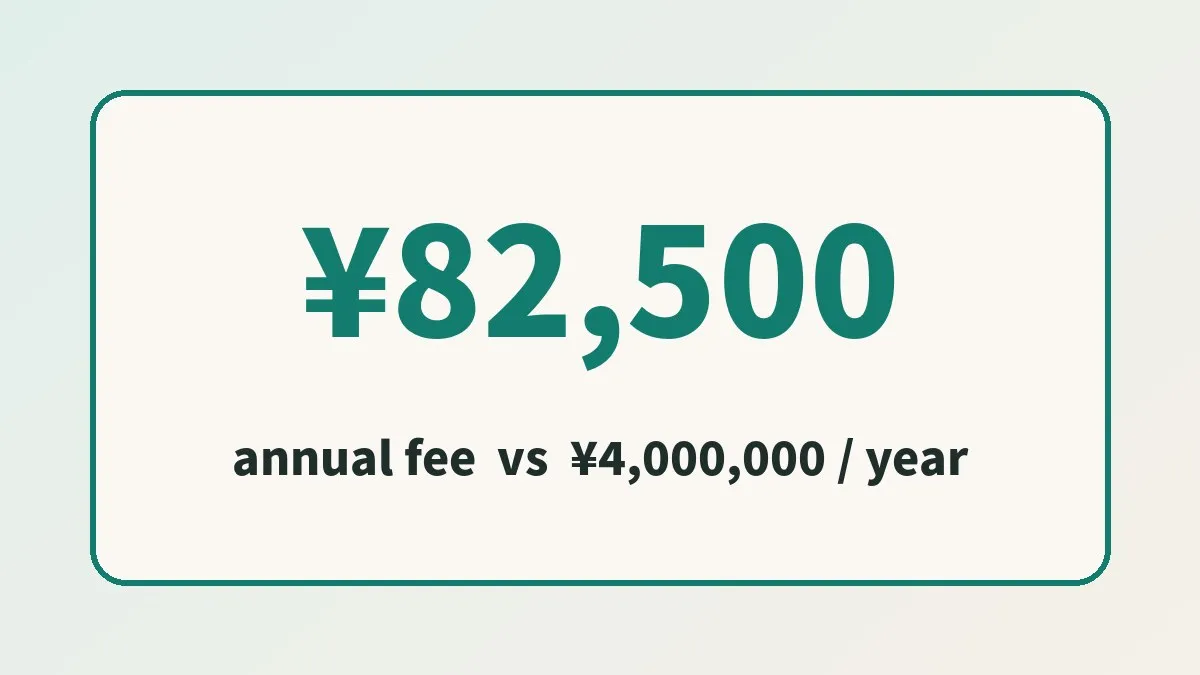
- The annual fee is 34,100 yen for the standard card and 82,500 yen for the Premium card (tax included)
- The free night award requires annual spending of at least 2.5 million yen on the standard card and 4 million yen on the Premium
- The break-even point moves a lot depending on “how many yen you value 1 point at”
- In my estimate, the card beat its annual fee as long as I use the free night award
- Even so, my application is on hold until our household cash flow settles down
Does the Marriott Bonvoy Amex annual fee pay for itself?
I will give the conclusion first. In my case, concentrating spending on the Premium card came out positive for the year. But that assumes I use the free night award.
Without the award, almost no difference is left. So I think “does it pay for itself” depends on your annual spending and your plans to stay at hotels.
This article is not a recommendation for the card. It is a record of how I calculated it for my household. I hope the way I set up the numbers is a useful reference, and nothing more.
Terms of the standard card and the Premium card
First, I checked the terms on the official American Express site. This is what the pages showed when I opened them in October 2026.
| Item | Standard card | Premium card |
|---|---|---|
| Annual fee (tax included) | 34,100 yen | 82,500 yen |
| Family cards | First card free, 17,050 yen from the second | First card free, 41,250 yen from the second |
| Everyday spending (per 100 yen) | 2 points | 3 points |
| Marriott Bonvoy participating hotels (per 100 yen) | 5 points | 6 points |
| Free night award requirement | Annual spending of 2.5 million yen or more | Annual spending of 4 million yen or more |
| Free night award cap | Up to 50,000 points per night | Up to 75,000 points per night |
| Status on joining | Gold Elite | Gold Elite |
| Elite night credits | 5 nights | 15 nights |
The standard card is described as earning 3 points per 100 yen on airfare and overseas spending. That is set a little higher than the 2 points for everyday use.
With the Premium card, annual spending of 5 million yen or more puts Platinum Elite within reach. The official revision notice listed this as the condition from 2026 onward.
The terms were revised in 2025
This needed care. Both cards had their benefits and annual fees revised on August 21, 2025. The Premium annual fee went from 49,500 yen to 82,500 yen.
Older articles may still carry the pre-revision figures. I think rechecking the annual fee and the spending requirement for the free night award on the official site is the sure way.
Conditions of the free night award
Whether the fee pays for itself is decided almost entirely by this award. So I read the conditions closely.
The official free night award page explains it as follows.
- The program period is one year each year, starting from the date you joined or switched cards
- During that period, you spend at least the qualifying amount on the card
- The award arrives roughly 1 to 2 months after the annual fee is billed
- The award is valid for 1 year from issue
- You are not eligible if you cancel or fall behind on payments
What caught my attention was when it arrives. The award arrives after the next annual fee is billed. In other words, I read it as an award that assumes you keep the card.
The page also said the Premium card lets you combine points you already hold. You can add up to 25,000 points and redeem for a stay worth up to 100,000 points per night. I could not confirm on these pages whether the standard card allows combining.
The return rate changes with how you value 1 point
Marriott Bonvoy points have no official yen conversion. So “3 points per 100 yen” cannot simply be called 3%.
I decided to work out the value from the hotels I would actually stay at. The calculation is “cash room rate ÷ points required.” This value changes with the hotel and the date.
With some assumed values, the rough return looks like this. It is an arithmetic example, not official figures.
| Value placed on 1 point | Standard card (2 points per 100 yen) | Premium (3 points per 100 yen) |
|---|---|---|
| 0.5 yen | Equivalent to 1.0% | Equivalent to 1.5% |
| 0.7 yen | Equivalent to 1.4% | Equivalent to 2.1% |
| 1.0 yen | Equivalent to 2.0% | Equivalent to 3.0% |
One assumption alone doubles the return. Set it aggressively, and the estimate can look as good as you like. I made a point of checking first whether it holds up even at a low value.
Steps for estimating the break-even point
This is the main part. Here are the steps for working out, yourself, the spending level at which the annual fee pays for itself.
There are six inputs to prepare.
| Input | Where to find it | Notes |
|---|---|---|
| Annual card spending | 12 months of card statements | Remove duplicated rows before totaling |
| Spending at stores that do not take Amex | The same statements | In my case, Costco |
| Value of 1 point | Cash price of the hotel ÷ points required | Set both a low and a high value |
| Return rate of your current card | Official page of your current card | For me, 1% on Rakuten Card |
| Annual fee | Official Amex site | Add second and later family cards too |
| Value of the free night award | Cash price of the hotel you plan to stay at | Set it to 0 yen if you have no plan to use it |
The steps are as follows.
- Gather 12 months of card statements
- Remove rows duplicated by things like payment-method changes
- Subtract the spending that cannot be moved to Amex
- Multiply the remaining amount by “point value × points earned”
- Subtract the rewards you get on your current card
- Subtract the annual fee from that
- Add the value of the free night award only if you will use it
- Change the value of 1 point and calculate again
The key is that step 7 is kept separate at the end. You hold one figure without the award and another with it. That way you can see what the surplus is relying on.
Example break-even points without the award
Let me set the comparison card as one with a 1% return rate. The calculation is simply the annual fee divided by the difference in return.
| Value placed on 1 point | Standard card break-even | Premium break-even |
|---|---|---|
| 1.0 yen | 3.41 million yen a year | 4.125 million yen a year |
| 0.7 yen | 8.525 million yen a year | 7.5 million yen a year |
Even valuing 1 point at 1 yen, the Premium breaks even at 4.125 million yen a year. The free night award requirement is 4 million yen a year, so the two are at nearly the same level.
In other words, paying off the fee with points alone does not look easy. I feel that recovering the annual fee comes down to whether you can use the free night award.
My estimate
I ran the estimate on 12 months of card statements imported into my accounting software. This is the calculation for concentrating spending on the Premium card.
The result beat the annual fee, on the assumption that I use the free night award. It works out positive for the year. In a year when I do not use the award, on the other hand, almost no difference is left.
So on the numbers alone, it leaned toward “fine to get it.” But that is the case only if I can use up the award every year. I want to be honest about that here.
What to watch for when totaling statements
Where I stumbled most in the estimate was double counting in the statements.
Card statements sometimes contain rows for payment-method changes. These are the rows created when you later switch a charge to installments or revolving payments. Such a row duplicates the row for the original charge.
Total them as they are, and annual spending comes out larger than it really is. The judgment on whether you reach the free night award line is thrown off as well. I had to remove these rows from the total.
How to read statements is also covered in the steps for knowing your Rakuten Card spending before it is finalized. I think the routine of getting a grip on monthly figures also serves as groundwork for the estimate.
Costco stays on Rakuten Card
One more thing that affected the estimate was Costco. Costco was spending that could not be moved to Amex.
I have decided not to give up Costco for the sake of card rewards. I will keep paying at Costco with my Rakuten Card (Mastercard). I summarized the background and the payment rules in Costco accepts only Mastercard for payment.
So the 4 million yen a year line has to be judged without Costco. That is the amount subtracted in step 3. In the end, Rakuten Card became the card that stays.
The growing number of cards does bother me a little. My thinking on narrowing down the main card is as written in the case for running a household on one main card. Even if I get the card, I intend to split the roles cleanly between the two.
Why I am still not getting it now
The estimate was positive. Even so, I am holding off on applying.
The reason is our household cash flow. The annual fee is money that goes out before the award comes in. The free night award arrives after the next annual fee is billed. So I see it as a card with a long period of paying up front.
At a time when the household budget has not settled, I did not want to add a prepaid fixed cost. I plan to rerun the estimate in about 2 months and decide then. There is no result yet.
There is one thing I have decided. If I get it, I will go with the Premium from the start.
This is also a time when I want to get the money that goes out every month in order before any card. Fixed costs like telecom keep paying off once you review them.
Clicking this opens the Rakuten login page. Once you log in, you’ll see the campaign details.
Why I did not choose a mileage card
Many travel-oriented cards earn airline miles. But I judged that I do not need a mileage card.
That is because our family trips are mostly by car. If we do not fly, there is nothing to spend miles on. A card whose perks sit on the place we stay still seemed the better fit.
The official site says Marriott Bonvoy points can also be transferred to airline miles. In my estimate, though, I did not count this use.
Decision table: get it or wait
I turned everything so far into a decision table. These are strictly my own criteria.
| What to check | Leans toward getting it | Leans toward waiting |
|---|---|---|
| Annual spending that can move to Amex | Comfortably exceeds the free night award requirement | Falls short of the requirement, or only just reaches it |
| Use for the free night award | The hotel and timing are already decided | No plan to stay anywhere yet |
| Estimate without the award | Not a large loss even without the award | Without the award, the annual fee is pure expense |
| Household cash flow | Paying the annual fee up front is no trouble | I do not want to add a prepaid fixed cost |
| Details of the welcome offer | Checked on the official page myself | Seen only in secondhand sources |
For me, the top two leaned toward “getting it.” The bottom two leaned toward “waiting.” So the conclusion was to hold.
Check the welcome campaign on the official site
Here is one story of a mistake. I had taken the deadline of a welcome campaign on assumption.
My only basis was a single blog post. I took the date written there as if it were a hard deadline. I had not managed to check the campaign section on the official page.
This time, I opened the official site again. The welcome offer listed there was as follows.
- Premium: 10,000 points for spending 300,000 yen or more within 3 months of joining
- Standard card: 5,000 points for spending 300,000 yen or more within 3 months of joining
On the official pages I opened, I could not find an application deadline for this offer. I also have not been able to confirm whether there is any limited-time bonus on top. I think it is best to check the official page before applying.
Do not judge a deadline from secondhand information alone. That is the lesson this time. When you decide under deadline pressure, the estimate tends to get sloppy.
Common mistakes and pitfalls
- Running the estimate with the pre-revision annual fee or spending requirement
- Valuing 1 point too high and overestimating the return
- Not removing payment-method-change rows and counting spending twice
- Including spending at stores that do not take Amex in the total
- Adding the value of the free night award even though you have no plan to use it
- Assuming a welcome offer deadline based only on blog information
The third and the sixth are ones I actually came close to making. Both could have been prevented by going back to the source material for the numbers.
Who it suits and who it does not
| Likely a good fit | Likely not a good fit |
|---|---|
| People who stay at hotels several times a year | People with almost no plans to stay anywhere |
| People who can concentrate spending on one card | People who spend a lot at stores that do not take Amex |
| People who can use the free night award before it expires | People who tend to put off booking with the award |
| People whose budget still works after paying the annual fee up front | People in the middle of cutting fixed costs |
Even if the right-hand column applies to you, that does not necessarily mean the card is a poor fit. But it may be safer to set the estimate on the strict side.
Things to check before you start
- Whether you have gathered 12 months of card statements
- Whether you have removed duplicated rows such as payment-method changes
- Whether you have subtracted spending at stores that do not take Amex
- Whether you have set both a low and a high value for 1 point
- Whether you have also produced a figure without the free night award
- Whether you have checked the annual fee and award conditions on the official pages
- Whether you have checked the welcome offer details and deadline on the official pages
- Whether the household budget still works after paying the annual fee up front
Frequently asked questions
Q. How much is the Marriott Bonvoy Amex annual fee?
On the official pages, the standard card is 34,100 yen. The Premium is 82,500 yen. Both include tax. The first family card is free, and an annual fee applies from the second card.
Q. What are the conditions for the free night award?
Annual spending of 2.5 million yen or more on the standard card, and 4 million yen or more on the Premium. The period is counted as one year from the date you joined or switched. The award is described as arriving roughly 1 to 2 months after the annual fee is billed.
Q. Can the free night award be used at any hotel?
There is a cap. It is up to 50,000 points per night on the standard card and up to 75,000 points on the Premium. The Premium is described as letting you add up to 25,000 of your own points. Please check eligible hotels and availability on the official site before booking.
Q. If it is 3 points per 100 yen, is the return rate 3%?
Not necessarily. That is because Marriott Bonvoy points have no official yen conversion. I set the value using “cash price of the hotel ÷ points required.” It changes with the hotel and the season, so I think it is reassuring to run the estimate at a low value too.
Q. Which is the better deal, the standard card or the Premium?
It depends on your spending and where you stay. The difference in annual fee is 48,400 yen. The free night award cap and the required annual spending also differ. In my case, I have decided that if I get one, it will be the Premium from the start.
Q. Can I use the Marriott Bonvoy Amex at Costco?
The credit cards accepted at Costco are Mastercard-branded. So I will keep paying at Costco with my Rakuten Card (Mastercard). The details of the payment rules are in my Costco article.
Q. How long does the welcome campaign run?
On the official pages I opened, I could not find an application deadline. The condition of spending 300,000 yen or more within 3 months of joining is stated. The details can change, so please check the official page before applying.
Q. Will you cancel your Rakuten Card?
No. I will keep using Rakuten Card at Costco and for Rakuten services. Even if I get the Marriott Bonvoy Amex, I intend to split the roles between the two cards.
Official sources I referred to
- Marriott Bonvoy American Express Premium Card (official Amex site)
- Marriott Bonvoy American Express Card (official Amex site)
- Free night award (official Amex site)
- Marriott Bonvoy points (official Amex site)
- Premium Card services (official Amex site)
- Standard card services (official Amex site)
- Premium Card service revisions (official Amex site)
Summary
On paper, the Marriott Bonvoy Amex came out positive. But that surplus relies on the free night award. I feel that whether you have the room to pay the annual fee up front matters just as much.
I plan to run the estimate once more in about 2 months. Before deciding on a card, start by laying out 12 months of statements.
Clicking this opens the Rakuten login page. Once you log in, you’ll see the campaign details.
This article contains affiliate advertising. If you sign up for a product or service through a link on this site, we may receive compensation from the partner company. The site operator is also an employee of Rakuten Group and may receive compensation through an employee referral program. The content and opinions here are based on the operator’s own experience and research regardless of any advertising relationship, but please read with the above in mind. See the Disclaimer & Affiliate Disclosure for details. Disclaimer & Affiliate Disclosure
This article includes machine-translated content. Please check the official Rakuten Mobile multilingual page for exact terms.
If you have concerns about Rakuten Mobile coverage or signal quality, you can consult through the official signal improvement request form .