- 01The week I looked into a “lease” on my statement
- 02It was actually a zero-interest plan of 60 installments
- 03It cannot be cancelled or reduced
- 04Early repayment reduces future fees
- 05With zero interest, paying early gains nothing
- 06How installment fees are determined
- 07The definition of the word “installment sale”
- 08Even with zero interest, someone bears the cost
- 09If the early-repayment money sits in a deposit
- 10I took it off the fixed-cost list and gave it a separate bucket
- 11What to record in the separate bucket
- 12Steps when you find an unknown charge on your statement
- 13Even a week with zero savings has results
- 14Common mistakes and pitfalls
- 15Who it suits and who it does not
- 16Things to check before you start
- 17Frequently asked questions
- 18Official sources I referred to
- 19Summary
Good morning. まさきん here.
While reviewing my fixed costs, I ran into a monthly charge that could be neither cancelled nor reduced. It turned out to be a zero-interest installment plan. It was the kind where paying it off early gains nothing, so here is how I decided to handle it.
Note: This article reflects information at the time of publication. Please check the official sites for the latest terms.
- With a zero-interest installment plan (0 yen in interest and fees), there are no fees to reduce by paying early
- What early repayment reduces is future fees, so the math is the reverse of an interest-bearing installment plan
- Take zero-interest installments off the fixed-cost list and keep them in a separate bucket with a payoff month
- Record 5 items: payment name, monthly amount, payoff month, whether early repayment is possible, and the interest rate
- Deciding to “keep it” is also a result of the review, and a week with zero savings is fine
The week I looked into a “lease” on my statement
I review one fixed cost each week. I described the method in my article on reviewing fixed costs one contract a week in 15 minutes. I look at one contract and decide to keep it, lower it, or stop it.
One week, I picked a monthly charge on my card statement. It was labeled as a “lease” from a gas-company affiliate, in the 20,000 yen range per month. That is large for a fixed cost, so I decided to check what it really was.
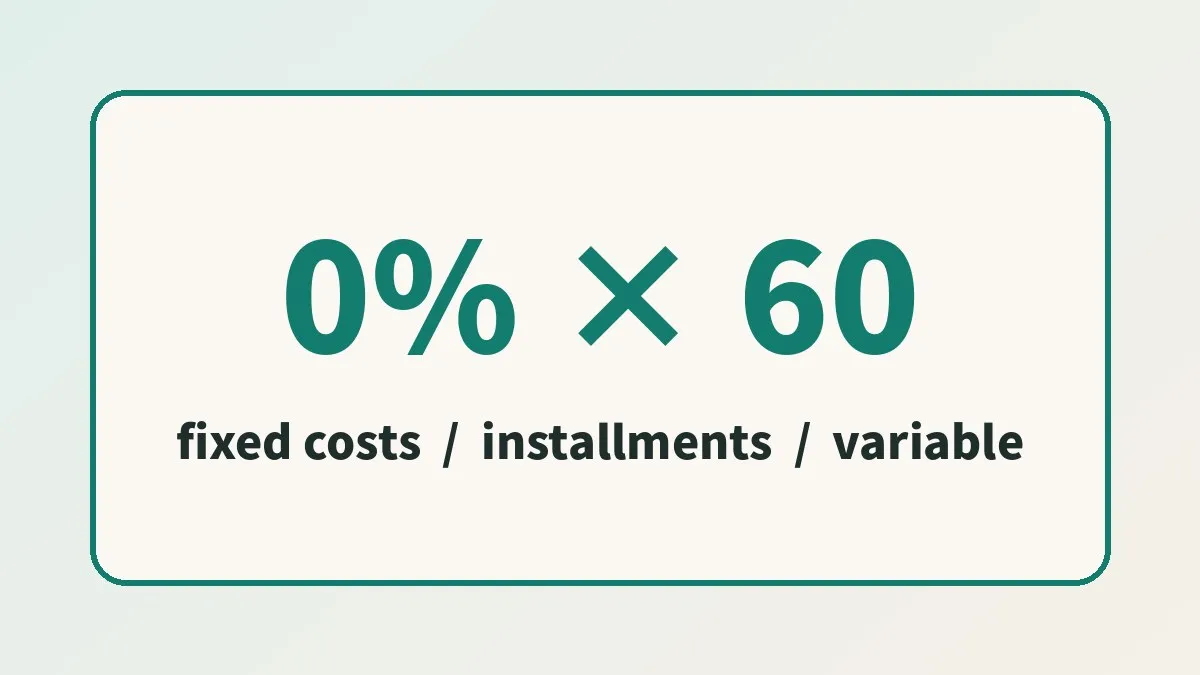
It was actually a zero-interest plan of 60 installments
When I looked into it, it was not a lease. It was an installment sale: I am paying for our home fuel cell system in 60 installments. That is the unit that uses gas to generate electricity and heat water.
On top of that, it was zero interest. It is an installment plan with no interest or fees added. If I had only looked at the label on the statement, I might have gone on believing it was “a monthly gas-related fixed cost.”
So the label and the substance can differ. A single line on a statement did not tell me what kind of contract it was.
It cannot be cancelled or reduced
In my weekly review, I choose from three decisions. But neither “lower” nor “stop” applies to this installment plan.
That is because it is the price of equipment already installed and in use. There is no plan to downgrade, and the idea of cancelling does not exist. All that remains is “finish paying.”
This left me a little stuck. It did not fit neatly anywhere in my decision table.
Early repayment reduces future fees
The next thing I considered was paying it off early. If a payment in the 20,000 yen range disappears, the monthly budget gets lighter.
But when I checked what early repayment actually does in official explanations, the picture changed. The Shiruporuto guide to home loans says this. Early repayment applies funds to repaying principal. The explanation was that it lightens the interest you would otherwise have paid in the future.
The thinking seems similar for installment payments on credit. The Japan Consumer Credit Association Q&A calls paying the remaining balance in a lump sum before the due date “early payoff.” It says that if you meet the conditions, you can receive a “fee rebate.”
In other words, what you gain from paying early is the fee or interest portion. The principal itself does not shrink just because you pay it sooner.
With zero interest, paying early gains nothing
Now back to zero interest. If the fees are 0 yen, there are no fees to reduce by paying early.
Even if you pay sooner, the total you pay is the same. The only thing that changes is “when the money leaves your hands.”
Here is the gain and loss of early repayment, side by side for interest-bearing and zero-interest plans.
| Point of comparison | Interest-bearing installment | Zero-interest installment |
|---|---|---|
| What early repayment reduces | Future fees (interest) | Nothing |
| Total paid | May go down if you pay early | The same even if you pay early |
| Cash on hand | Drops by the amount you pay early | Drops by the amount you pay early |
| Administrative fee | May apply | Needs checking with the contract provider |
| Rule of thumb | Compare the rebated fees with the administrative fee | Do not pay early |
The Japan Consumer Credit Association Q&A also had a caution. It says early payoff may come with a separate administrative fee. The method for calculating the fee rebate is also said to differ from one credit company to another.
So even with an interest-bearing installment plan, paying early is not always a gain. I think asking the contract provider for the actual amounts is the sure way.
How installment fees are determined
As a small detour, I also checked how the fees work.
The Japan Consumer Credit Association page “Knowledge about fees” says credit fees are to be shown as an effective annual rate. The explanation is that it is not a simple ratio of fees to principal.
The Shiruporuto teaching material had an example at an effective annual rate of 15%. The more installments there are, the larger the fees become.
| Number of installments | Fee ratio (example at a 15% effective annual rate) |
|---|---|
| 3 | 2.51% |
| 5 | 3.78% |
| 10 | 7.00% |
| 12 | 8.31% |
This is one example from the teaching material. Actual rates differ by card company and contract, so please check the official information.
With an interest-bearing installment plan, these fees are what early repayment targets. A zero-interest installment plan does not have this column in the first place.
The definition of the word “installment sale”
I also looked up the official definition of an installment sale. It is on the Installment Sales Act page of the Kansai Bureau of Economy, Trade and Industry.
An installment sale is explained as a transaction in which the price is received in installments over 2 months or more and in 3 or more payments. It covers designated goods, services, and rights.
The form in which a credit company pays on your behalf, on the other hand, was a separate category. It is called credit purchase intermediation, and is described as a transaction in which the consumer pays over a period exceeding 2 months.
I have not yet checked which category my installment plan falls under. The application form should tell me, so I am leaving that for the next check.
Even with zero interest, someone bears the cost
Zero interest feels a little strange. The question is where the installment fees went.
According to the Japan Consumer Credit Association, a credit company has two kinds of fees. There are fees received from consumers and fees received from merchants. It said the latter are set within the merchant agreement.
Who bears the fees in a zero-interest installment plan, and how? I could not confirm this in official explanations. It is said that the selling side often bears them, but it may differ by contract.
What matters to me is that the fees I pay are 0 yen. The application form has fields for interest and fees, so I think looking there is the quickest way.
If the early-repayment money sits in a deposit
Let me also consider keeping the money I would have used for early repayment. The idea comes down to one formula.
A rough figure for the interest earned on a deposit is “amount used for early repayment × deposit interest rate × years remaining.” Even at a low rate, it comes out above 0 yen.
Meanwhile, the amount gained by paying off a zero-interest installment plan early is 0 yen. On the numbers, not paying early comes out slightly ahead. Deposit rates differ by financial institution, so please check the official information.
What I weighed more heavily than interest, though, was cash on hand. If I pay a lump sum up front, I have less available for sudden expenses. With zero interest, I could not find a reason to hurry.
I took it off the fixed-cost list and gave it a separate bucket
After looking into all this, I decided three things.
- Keep it
- Do not repay early
- Take it off the fixed-cost list and hold it as an installment in a separate bucket until the payoff month
The third was the biggest change this time. If it stays on the fixed-cost list, I end up wondering “can this be lowered?” on every pass. The answer is the same every time, so spending 15 minutes on it is a waste.
So I decided to hold my spending in three groups.
| Category | What is in it | What to do in the review |
|---|---|---|
| Fixed costs (contracts that continue every month) | Subscriptions, telecom, electricity and gas, insurance, newspapers, and so on | Decide to keep, lower, or stop |
| Time-limited installments (separate bucket) | Payments with a set end, such as equipment installment sales and installment payments | Record the payoff month and look only at whether early repayment pays off |
| Variable costs | Spending that changes month to month, such as food, daily goods, and leisure | Manage with a monthly budget or allowance |
The difference between a fixed cost and an installment is whether it has an end. A fixed cost continues unless I stop it. An installment ends in the payoff month even if I do nothing.
I suspect that putting things of a different nature in the same table makes decisions wobble.
What to record in the separate bucket
In the separate bucket, I decided to write the following 5 items.
| Item | What to write | Where to check |
|---|---|---|
| Payment name | Both the label on the statement and what it actually is | Card statement, application form |
| Monthly amount | The amount paid each month | Card statement |
| Payoff month | The month of the last payment | Application form, information from the contract provider |
| Early repayment | Whether early or lump-sum payment is possible, and whether there is an administrative fee | Inquiry to the contract provider |
| Interest rate | Whether it is zero interest, or what the effective annual rate is | Application form |
I included “the label on the statement” in the payment name because of this experience. If the label stayed as “lease,” my future self a few months from now would probably look it all up again.
I think the payoff month is the most important field in the separate bucket. When that month arrives, monthly spending gets lighter by an amount in the 20,000 yen range.
My own payoff month is still blank, though. The number of remaining payments is only an estimate based on the application form so far. Confirming the remaining count on the application form is my next move.
I feel that tidying up spending works best when you start from the large amounts. Telecom costs are another fairly large item that goes out every single month.
Clicking this opens the Rakuten login page. Once you log in, you’ll see the campaign details.
Steps when you find an unknown charge on your statement
Here is this process, generalized.
- Check the label and the amount on the card statement
- Look for the documents from when you signed up (application form or contract)
- Identify the type of payment (a contract that continues every month, or an installment with a set number of payments)
- If it is an installment, check whether there is interest or fees
- Check the number of remaining payments and the payoff month
- Check with the contract provider whether early repayment is possible and what the administrative fee is
- If there is interest, compare the gain and loss of paying early; if it is zero interest, move it to the separate bucket
- Record the result in one line
Step 1, checking the statement, can be done partway through the month too. I summarized how to track card spending before the bill is finalized in the steps for knowing your Rakuten Card spending before it is finalized.
Step 3 is the fork in the road. If it is an ongoing contract like a subscription, you go back to the usual decision table. To see whether contracts with the same purpose overlap, the viewpoint in my article on finding duplicate subscriptions is useful.
Even a week with zero savings has results
That week, I also reviewed our newspaper subscription. The conclusion there was also to keep it.
So the amount saved that week was zero. Looking only at the numbers, it looks like a week in which nothing happened.
But I think there were results. A charge whose identity I did not know now has a name. Because I decided to “keep it,” I will not repeat the same hesitation on the next pass.
In the one-contract-a-week article, I also wrote that “keep” is a perfectly good conclusion. I think the purpose of a review is to reach a state where you are paying with conviction. This time, that idea applied exactly.
Common mistakes and pitfalls
- Assuming something is “a monthly fixed cost” from the statement label alone, without checking what it is
- Paying off early to lighten monthly spending even though it is zero interest
- Leaving an interest-bearing installment plan alone, treating it the same as a zero-interest one
- Not recording the payoff month and not noticing when the payments have ended
- Keeping installments on the fixed-cost list and agonizing over “can this be lowered?” every time
- Treating a week with zero savings as no result and giving up
The second and third are two sides of the same coin. If you do not check whether there is interest, either mistake can happen. So I think the first thing to look at is the interest field.
Who it suits and who it does not
Holding things in a separate bucket seems to suit people who have payments with a set end. Installments on appliances and equipment, or installment payments for a handset, perhaps.
On the other hand, it is unnecessary for people who have no installments at all. The fixed-cost list alone is enough.
For people with several interest-bearing installment plans, it may be better to look at the gain and loss of early repayment before moving them to a separate bucket. Try checking with the contract provider, starting with the one with the highest effective annual rate.
Things to check before you start
- I have checked the label and monthly amount on the card statement
- I know where the application form or contract is
- I have checked whether it is zero interest or has an effective annual rate
- I have a plan for confirming the remaining payments and payoff month in the documents
- I am ready to ask the contract provider about early repayment and the administrative fee
- I have prepared a table or note for the separate bucket
Frequently asked questions
Q. Is there no point in paying off a zero-interest installment plan early?
In terms of fees, I think there is nothing to gain. What early repayment reduces is future fees and interest. With zero interest, the total you pay does not change. If you have a reason to want the monthly payment gone, a different decision is possible.
Q. With an interest-bearing installment plan, is it better to pay early?
It can be. The Japan Consumer Credit Association Q&A explains the conditions under which early payoff earns a fee rebate. However, it also says an administrative fee may apply. Please check the amounts with the contract provider.
Q. Should installment payments be counted as fixed costs?
I do not think there is a set classification. I split payments with a set end into a separate bucket. My fixed-cost list contains only “contracts that continue unless I stop them.”
Q. How should I separate installment payments in a household budget?
I use a split into three: fixed costs, time-limited installments, and variable costs. In the installment row, I write the payoff month. It is included in the monthly spending total but taken out of the review targets.
Q. What should I do if I find a fixed cost I cannot cancel?
Checking the type of contract first seems like a good start. If it is an installment with a set number of payments, record the payoff month and move it to the separate bucket. If it is an ongoing contract that still cannot be cancelled, check the renewal timing and conditions with the contract provider.
Q. If the statement says “lease,” is it a lease contract?
Apparently not always. In my case, the label was lease and the substance was an installment sale. I think checking the application form or contract is the sure way to know the contract type.
Q. What if I do not know the number of remaining payments?
I think looking at the documents from when you signed up is quickest. If you cannot find them, you will need to ask the contract provider. I am also still at the stage of confirming this on the application form.
Q. Do “installment sale” and “installment payment” mean the same thing?
In everyday use, they mean almost the same thing. Under the Installment Sales Act, there are categories for each form of transaction. An installment sale is explained as payment in installments over 2 months or more and in 3 or more payments.
Official sources I referred to
- I want to pay off credit I contracted in installments in a lump sum (Japan Consumer Credit Association Q&A)
- Knowledge about fees (Japan Consumer Credit Association)
- Features of credit as seen by consumers, merchants, and credit companies (Japan Consumer Credit Association)
- Installment Sales Act (Kansai Bureau of Economy, Trade and Industry)
- Choosing early repayment (Shiruporuto)
- Teaching material on credit cards (Shiruporuto)
Summary
With a zero-interest installment plan, there are no fees to reduce by paying early. So I decided to keep it and pay through to the payoff month. I am taking it off the fixed-cost list and holding it in a separate bucket.
The savings that week were zero. But there is now one fewer charge whose identity I do not know. I consider that no small step forward.
If you see an unfamiliar label on your statement, start by opening the application form. For the contracts that remain on your fixed-cost list, going through them one at a time in the usual order should be enough.
Clicking this opens the Rakuten login page. Once you log in, you’ll see the campaign details.
This article contains affiliate advertising. If you sign up for a product or service through a link on this site, we may receive compensation from the partner company. The site operator is also an employee of Rakuten Group and may receive compensation through an employee referral program. The content and opinions here are based on the operator’s own experience and research regardless of any advertising relationship, but please read with the above in mind. See the Disclaimer & Affiliate Disclosure for details. Disclaimer & Affiliate Disclosure
This article includes machine-translated content. Please check the official Rakuten Mobile multilingual page for exact terms.
If you have concerns about Rakuten Mobile coverage or signal quality, you can consult through the official signal improvement request form .