- 01With an Emergency Fund, “Deciding” and “Counting” Are Separate Jobs
- 02A Quick Recap of Target Guidelines
- 03I Measured Using Four Linked Accounts
- 04At Face Value, It Looked Above Target
- 05The Three-Stage Counting Procedure
- 06Our Three-Stage Results
- 07What Counts as Earmarked Money
- 08Why Pass-Through Accounts Get Subtracted
- 09Accounts I Count and Accounts I Don’t
- 10The Limits of Counting Only Linked Accounts
- 11Three Options for Closing the Gap
- 12General Thinking on Where to Keep It
- 13Don’t Compare With the National Average
- 14Common Mistakes and Pitfalls
- 15Who This Suits and Who It Doesn’t
- 16What to Check Before You Start
- 17Frequently Asked Questions
- 18Official Sources I Referred To
- 19Wrap-Up
Good morning, this is まさきん.
I had already set a target for our emergency fund. What I hadn’t done was count how much is actually on hand right now. I measured it from the statements in our accounting software, so I am writing down how I counted.
This is not an article recommending investment. As a financial planner, I am sorting out how to count the reserves you have on hand. The final call, I think, depends on each household’s situation.
Note: The information here is current as of publication. Please check the official sites for the latest terms.
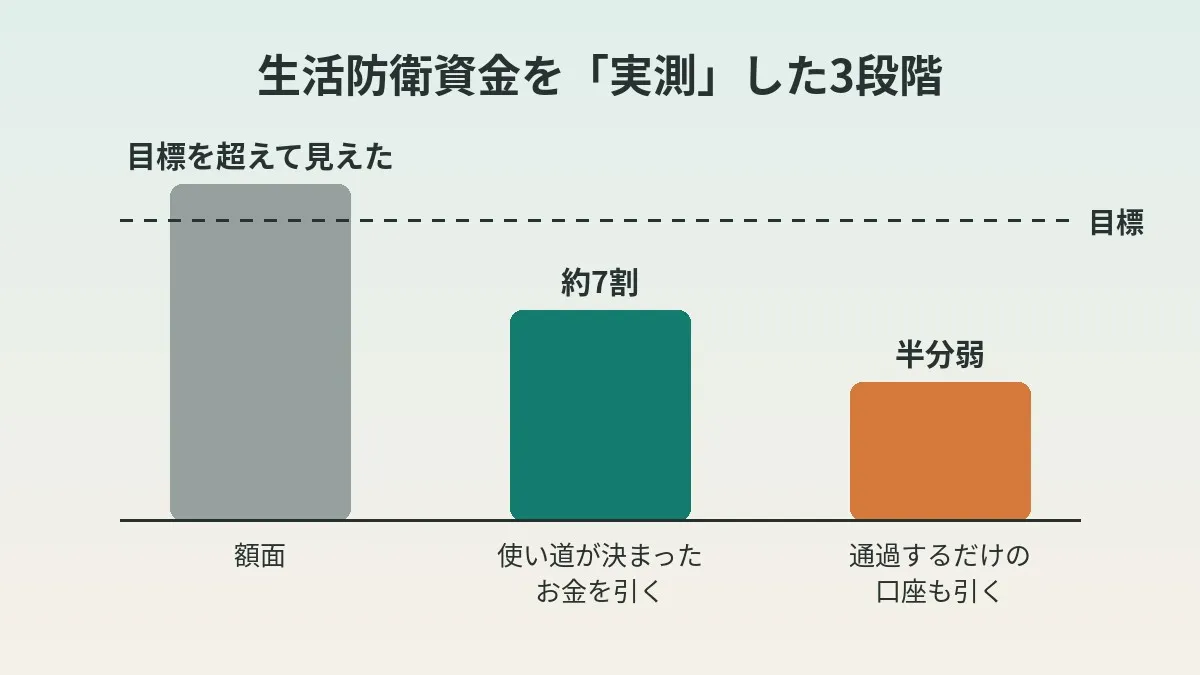
- At face value, adding up the balances of four accounts, it looked above target
- After subtracting money that is already earmarked, it was about 70% of target
- After also subtracting the account that loan payments merely pass through, it was a little under half of target
- Accounts that aren’t linked are not counted, so there is a limit: some money goes uncounted
- For closing the gap, I lined up three options and plan to decide at the month-end fund allocation
With an Emergency Fund, “Deciding” and “Counting” Are Separate Jobs
I think an emergency fund involves two jobs. One is deciding the target amount, and the other is counting what you have on hand now.
I had done only the former and not the latter. Just by setting a target, I may have felt as though I had counted.
How to set the target is covered in my article on working backward from the largest unexpected expense you can foresee. This article deals only with the “actual measurement” against that target.
A Quick Recap of Target Guidelines
First, a brief check of the guideline for the target amount. The Japan Association for Financial Planners page says to “secure 3 months to 1 year of living expenses” as emergency funds. From three months to a year is quite a range.
Where you land in that range depends on the shape of your household, I think. We didn’t set ours by number of months but from the largest unexpected expense we could foresee. I leave the details of that method to the article above.
What matters is that the target is fixed as a single number. Without a number, there is nothing to compare your count against.
I Measured Using Four Linked Accounts
The material for counting is the statements of four accounts linked to our cloud accounting software. They had been imported within the last few days, so the figures are close to current balances.
The reason for using linked accounts is simple. Balances and transactions are visible together in one place. If you open a passbook or app for each account, the dates drift apart. Being able to add up figures from the same point in time is unglamorous but important, I felt.
This method has a weakness from the outset, though. Accounts that aren’t linked simply don’t appear on the screen. I cover that in the “limits” section later on.
At Face Value, It Looked Above Target
First, I simply added up the balances of the four accounts. At face value, it was above target.
I could have ended the work there. If there is enough, nothing needs doing, after all.
But something caught my attention as I looked over the statements. The balance included money scheduled to go out soon for other purposes. Money sitting in an account and money usable as an emergency fund were two different things.
The Three-Stage Counting Procedure
So I recounted by subtracting step by step from face value. As a procedure, it goes like this.
- Confirm the target amount. Fix the single number you will compare against first.
- Check the import dates of the linked accounts. If the statements are stale, the balances will be off.
- As stage 1, get the face value. Add up the linked account balances as they are.
- As stage 2, subtract earmarked money. Remove from face value the funds scheduled to go out soon for other purposes.
- As stage 3, subtract pass-through accounts. Remove entirely any account that money merely passes through for automatic payments.
- Compare the three numbers with the target. Work out what fraction of the target each represents.
- Set the day you will decide how to close the gap. Don’t decide on the spot; move it to the day you think about fund allocation.
The key is to proceed by subtraction, not addition. Start from face value, the biggest number, and trim it down with reasons. That way you can trace afterward where the number shrank.
Our Three-Stage Results
Here are our results as ratios. I won’t give amounts, but I think the ratios alone convey the picture.
| Stage | How it is counted | Ratio to target | Shortfall |
|---|---|---|---|
| Stage 1 (face value) | Simply add the balances of four accounts | Looked above target | Appears to be none |
| Stage 2 | Subtract earmarked money | About 70% | About 30% |
| Stage 3 (conservative reading) | Also subtract the account that loan payments merely pass through | A little under half | A little over half |
What looked sufficient at face value became about 70% at stage 2. Read more conservatively, it is a little under half. The balances are the same, yet the view changes this much with how you count.
Personally, I treat the stage 2 number as the “baseline.” Stage 3 is positioned as the floor if things swing the bad way. Holding it as a range made judgment easier, I felt.
What Counts as Earmarked Money
What I subtracted at stage 2 is money whose destination is already decided. It is in the account, but it will go out soon for another purpose.
J-FLEC’s Survey of Household Finances had a note reflecting a similar idea. Deposits and savings as defined in the survey are said to exclude “the portion kept for everyday deposits, withdrawals, and automatic payments.” It draws the line that an account balance is not the same as savings.
In general, I think the following kinds of money qualify.
- Taxes and insurance premiums with fixed payment dates
- Payment for a large purchase or construction work due soon
- The portion set aside for card payments
- Savings being built up for another purpose
Counting this money toward the emergency fund means relying on it twice. If you spend it on an unexpected expense, the planned payment comes up short.
Why Pass-Through Accounts Get Subtracted
What I subtracted at stage 3 is the account that loan payments merely pass through. Money is deposited and then debited straight out.
The balance of such an account varies widely depending on the day you look. It is high the day before the debit and low the day after. Count on a day when it happens to be high, and your reserves look thicker than they are.
That said, removing it entirely is a strict reading, I think. In practice there may be money left after the debit. So I call stage 3 the “conservative reading” and keep it apart from the baseline.
Accounts I Count and Accounts I Don’t
Here is the sorting of accounts in a table. It combines our own case with the general thinking.
| Type of account or money | How we treat it | Reason |
|---|---|---|
| Linked accounts (freely usable balance) | Count | Can be withdrawn right away and isn’t earmarked |
| Earmarked money in linked accounts | Subtract at stage 2 | Goes out soon for another purpose |
| The account that loan payments merely pass through | Subtract at stage 3 | The balance swings with the day you look |
| Accounts in family members’ names | Not counted | Not linked to the accounting software |
| Cash | Not counted | No statement, so it can’t be measured |
| Brokerage accounts | Not counted | Not linked. Prices also fluctuate |
The bottom three rows are money that is “not counted,” not money that “doesn’t exist.” I used separate wording in the table so as not to confuse the two.
The lighter your fixed costs, the less money merely passes through. And the more easily money stays in the account. Phone bills, for example, may be one of the fixed costs that is easier to tackle.
Clicking this opens the Rakuten login page. Once you log in, you’ll see the campaign details.
The Limits of Counting Only Linked Accounts
The limit of this method is clear. Accounts not linked to the accounting software can’t be counted.
What we don’t count are accounts in family members’ names, cash, and brokerage accounts. So the household’s total reserves may well be larger than this figure. “About 70% of target” refers strictly to what is inside the linked accounts.
- Because unlinked accounts are left out, the measurement tends to come out low
- If an account has stopped importing, its balance stays stale
- Where you draw the line on what is earmarked depends on your own judgment
- The balance of a pass-through account changes a lot depending on the day you look
Even so, coming out low is not a bad thing in itself, I think. When it comes to reserves, overestimating is the more dangerous error. Knowing the limits and using it as a modest figure seems the way to go.
Three Options for Closing the Gap
With the shortfall visible, I lined up three ways to close it. I haven’t decided yet. The plan is to decide at the month-end fund allocation.
| Option | What it involves | Upside | What to watch for |
|---|---|---|---|
| 1. Add only the shortfall | Fill the stage 2 gap (about 30%) | Requires the smallest amount | Still relies on the pass-through account’s balance |
| 2. Add up to the conservative shortfall | Fill the stage 3 gap (a little over half) | Robust against day-to-day swings | Requires a large amount and takes time |
| 3. Place the target amount fresh in a separate account | Open an account just for the emergency fund and put the target amount in it | No more recounting needed | Requires the most. One more account to manage too |
There is a reason I didn’t decide on the spot. The money to fill the gap competes with other uses. Deciding by looking at the emergency fund alone might leave somewhere else short.
So I will judge it all together on the day I consider the overall allocation. Which to choose will vary with monthly slack and the state of repayments, I think. It doesn’t seem to be a matter of one option being correct.
General Thinking on Where to Keep It
Let me also sort out the general thinking on where to keep the money. It is often said that an emergency fund must be withdrawable right away. On that point, an ordinary savings account is the straightforward place.
A time deposit is a product premised on leaving the money until maturity. Even where early cancellation is possible, the terms differ by financial institution. Keeping the portion you are likely to use in an ordinary account may be the common way to split it.
Deposits are covered by a national scheme called the deposit insurance system. I checked the scope of protection on the Deposit Insurance Corporation of Japan page.
| Type of deposit | Scope of protection |
|---|---|
| Deposits for payment and settlement purposes (current deposits, non-interest-bearing ordinary deposits, etc.) | In full |
| General deposits, etc. (ordinary deposits, time deposits, savings deposits, etc.) | Up to 10 million yen (1,000 man-yen) in principal per depositor per financial institution, plus interest and the like up to the date of failure |
| Foreign currency deposits, negotiable certificates of deposit, etc. | Outside the system |
Deposits for payment and settlement purposes are deposits that satisfy three requirements, such as “bearing no interest.” General deposits, etc. are aggregated within a single financial institution. This looks like useful background when considering whether to split accounts.
Don’t Compare With the National Average
For reference, I also looked at one statistic. J-FLEC’s 2025 survey lists the average amount of financial assets held. It was 19.4 million yen (1,940 man-yen) for households of two or more people and 9.19 million yen (919 man-yen) for single-person households.
But I think there is little point comparing these figures with your own emergency fund. Averages are easily pulled up by a few households with large assets. And total financial assets and an emergency fund are money with different purposes to begin with.
What to compare against is the target you set yourself, not the national average. That makes it clearer what to do next.
Common Mistakes and Pitfalls
Having done the measurement, here are the points I felt are easy to fall into.
- Stopping at face value, reassured. Face value is the number that looks biggest.
- Counting on a day when balances are high. Right after payday or before a debit, it looks like more.
- Relying on the same money twice. That is, counting funds with a planned use toward the emergency fund as well.
- Treating uncounted accounts as money you have. It is safer to keep unverified money out of the figure for now.
- Moving money the moment you count. Shifting funds in a hurry can affect other payments.
The third in particular is hard to notice, I think. Account balances don’t come with name tags saying where the money is headed.
Who This Suits and Who It Doesn’t
I don’t think this way of counting fits every household.
| People it may suit | People it may not suit |
|---|---|
| You have accounts linked to accounting software or a budgeting app | You haven’t linked accounts and have no statements at hand |
| Most of your money sits in linked accounts | Cash or accounts in family members’ names are the center of your finances |
| Your target amount is already set | Your target amount isn’t set yet |
| You can make judgments knowing the figure comes out low | You want to know the exact total for the whole household |
If you don’t have a target yet, you need to set one first. If you want the household’s total, you need to add in unlinked accounts by hand.
What to Check Before You Start
- Whether your emergency fund target is fixed as a single number
- Whether the statements of your linked accounts are imported up to the last few days
- Which accounts hold funds due to go out soon for other purposes, and how much
- Which accounts money merely passes through for automatic payments
- Whether you can accept leaving unlinked accounts and cash uncounted this time
- Which day you will decide on if a shortfall appears
Frequently Asked Questions
Q. How much of an emergency fund is enough?
I think it differs by household. The Japan Association for Financial Planners page gives 3 months to 1 year of living expenses as a guideline for emergency funds. I wrote about how we set ours in my article on setting the target amount.
Q. Is it not enough to just add up balances to calculate an emergency fund?
Just adding tends to come out high, I think. That is because earmarked money gets mixed in. In our case, face value was above target, yet after subtracting it was about 70%.
Q. Can I count without accounting software?
You can. Writing down same-day balances from passbooks or apps achieves the same thing. With many accounts, though, lining up the dates looks like it takes some effort.
Q. Do you not include money in brokerage accounts in the emergency fund?
In our measurement this time, it is not counted. The direct reason is that it isn’t linked to the accounting software. Whether to count assets with fluctuating prices as reserves is each household’s call, I think.
Q. Which should I trust, stage 2 or stage 3?
I don’t think you need to settle on one. I use stage 2 as the baseline and view stage 3 as the floor. Holding it as a range is probably closer to reality.
Q. Once I know the shortfall, should I fill it right away?
In many cases there is no need to rush, I think. Moving money in a hurry may leave other payments short. We decided to settle it at the month-end fund allocation.
Q. How often should I recount?
I don’t think there is a fixed right answer. Before and after large payments, or when the assumptions behind your finances change, seem like good cues. Matching it to the day you consider the month-end allocation may also be easy to keep up.
Q. Are deposits over 10 million yen unprotected?
For general deposits, etc., the scope of protection is up to 10 million yen (1,000 man-yen) in principal plus interest and the like up to the date of failure. It is counted per depositor, per financial institution. The portion above that is said to be handled according to the state of the financial institution’s assets.
Official Sources I Referred To
- Guideline costs of major life events (Japan Association for Financial Planners)
- Scope of protection (Deposit Insurance Corporation of Japan)
- Survey of Household Finances (2025): Key Findings (J-FLEC, Japan Financial Literacy and Education Corporation)
Wrap-Up
With an emergency fund, I felt that setting the target is only half of it. You need to actually count how much is on hand now.
Ours looked above target at face value. But after subtracting earmarked money, it is about 70%. After also subtracting the pass-through account, it was a little under half. Unlinked accounts aren’t counted, so this is a modest figure.
On closing the gap, I have stopped at lining up three options. I plan to decide at the month-end fund allocation.
If you want to start with a fixed cost review, how to get started reviewing fixed costs may also be helpful. How about starting by writing down your account balances as of the same date?
Lowering fixed costs like phone bills may also make it a little easier to free up money to add to the fund.
Clicking this opens the Rakuten login page. Once you log in, you’ll see the campaign details.
This article contains affiliate advertising. If you sign up for a product or service through a link on this site, we may receive compensation from the partner company. The site operator is also an employee of Rakuten Group and may receive compensation through an employee referral program. The content and opinions here are based on the operator’s own experience and research regardless of any advertising relationship, but please read with the above in mind. See the Disclaimer & Affiliate Disclosure for details. Disclaimer & Affiliate Disclosure
This article includes machine-translated content. Please check the official Rakuten Mobile multilingual page for exact terms.
If you have concerns about Rakuten Mobile coverage or signal quality, you can consult through the official signal improvement request form .