- 01The difference between switching and an allocation change
- 02Switching fees and the redemption reserve charge
- 03Lining up trust fees in the Rakuten Securities iDeCo
- 04Calculating the trust fee gap on a ¥1,000,000 balance
- 05Between the sale and the purchase, the money waits as cash
- 06All at once or in installments
- 07What to do about domestic equity and global equity
- 08Switching steps at Rakuten Securities
- 09The cutoff is 10:00 a.m. on business days
- 10The December 2026 rule change and allocation changes
- 11Common mistakes and pitfalls
- 12What to check before you start
- 13Frequently asked questions
- 14Official sources I referred to
- 15Summary
Good morning, this is まさきん.
I am in the middle of reviewing the products I hold in my Rakuten Securities iDeCo. The job is to use switching to move out of products with relatively high trust fees and into low-cost ones. I have already finished tidying up the domestic REIT fund. I thought gold was done too, but the order history showed the order had never been placed, so I submitted it again on October 7 (corrected October 9, 2026).
What remains are the US total market and global equity index funds. I have not placed those orders yet. I wrote out what I need to decide before ordering, such as whether to move everything at once or in installments, so I am leaving it here as a memo.
Note: This information is current as of publication. Please check the official sites for the latest conditions.
- iDeCo switching carries no fee for the procedure itself, and there is no limit on the number of times
- The sale and the purchase happen on different days, and in between the money sits as cash (standby funds)
- The fees are the same whether you go all at once or in installments. The only difference is how many separate standby periods you have
- The trust fee gap between index funds is about ¥850 to ¥1,219 per year per ¥1,000,000 of balance
- Switching alone does not change where your monthly contributions go, so look at the allocation change as part of the same job
The difference between switching and an allocation change
iDeCo has two operations that look alike but are different: switching and allocation changes. If you mix them up, you end up thinking you have tidied things up when you have not.
| Operation | What it moves | Future contributions |
|---|---|---|
| Switching | All or part of the products you already hold | Unchanged |
| Allocation change | The proportions of products bought with monthly contributions | Changed |
Switching is an operation where you sell a product you hold and buy another product with the proceeds. The Rakuten Securities procedures page also states that switching does not change the products purchased with future contributions.
So even if you move only the balance, your contributions keep buying the original product. If you want to shift toward low-cost products, you need to look at the allocation change as well. I too decided to check my contribution allocation first, before placing the order.
Switching fees and the redemption reserve charge
There is no fee for the procedure. For the Rakuten Securities iDeCo, the recordkeeping work is handled by JIS&T. The JIS&T FAQ says that no fee applies to the procedure itself.
However, depending on the product, a redemption reserve charge may apply. This is money deducted from the net asset value when you redeem. It is not the asset manager’s take; it stays in the fund’s trust assets.
As far as I saw on the Rakuten Securities fund detail pages, only one fund showed a redemption reserve charge. It was 0.2% on the Mizuho US High Yield Fund (DC Pension). None of the four funds involved in this move showed one.
A word on taxes too. According to the Rakuten Securities explanation, gains during the investment period in iDeCo are tax-free. The wording includes gains from redeeming investment trusts.
Lining up trust fees in the Rakuten Securities iDeCo
Here are the four funds in question. The column to compare is “management costs (including trust fees).” It refers to the real cost, including the trust fees of the underlying investments.
| Product | Management fee (tax included) | Management costs (including trust fees, tax included) |
|---|---|---|
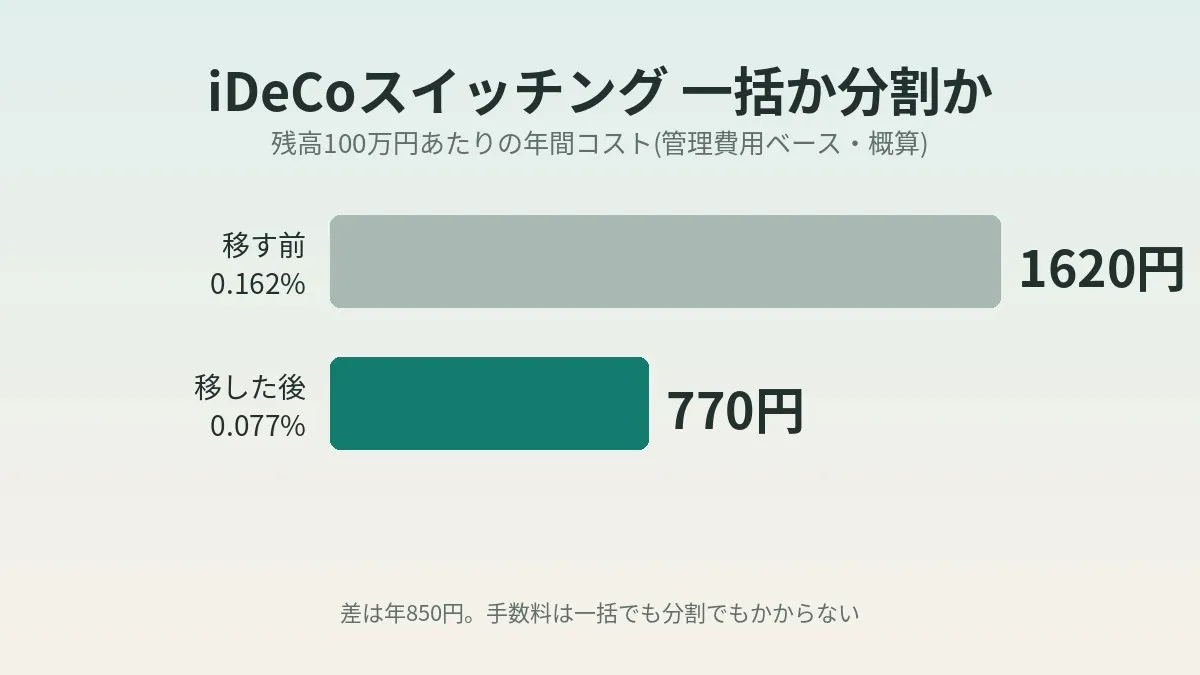
| Rakuten US Total Market Index Fund | 0.132% | 0.162% |
| Rakuten Plus S&P 500 Index Fund | 0.077% | 0.077% |
| Rakuten Global Equity Index Fund | 0.132% | 0.178% |
| Rakuten Plus All Country Equity Index Fund | 0.0561% | 0.0561% |
I checked these figures on October 3, 2026, on each fund’s detail page at Rakuten Securities. Trust fees can change. I plan to look again at the prospectus and the product pages before ordering.
The two Rakuten Plus funds were added to the iDeCo lineup on January 26, 2024. If you have been contributing since before then, your balance tends to still be sitting in the original funds. That was my situation too.
The underlying indexes are not the same
This is a point to be careful about. The names are similar, but the indexes they track are not the same.
The US total market fund tracks an index covering nearly the entire US stock market. Rakuten Plus S&P 500, on the other hand, tracks the S&P 500, which is centered on large caps. The difference is whether you hold small caps too.
The same goes for global equity. The original fund uses an FTSE index, while Rakuten Plus All Country uses the MSCI ACWI.
So this move is not a case of “same contents, lower cost.” It means changing indexes within a similar asset class. I want to be comfortable with that before ordering, rather than deciding on the cost gap alone.
Calculating the trust fee gap on a ¥1,000,000 balance
Next, I calculated how much the gap comes to per year. The formula is simple.
Annual cost difference (approximate) = balance × difference in management costs
Assuming the balance stays constant at ¥1,000,000, it works out as follows.
| Combination | Difference in management costs | Annual difference per ¥1,000,000 of balance |
|---|---|---|
| Rakuten US Total Market 0.162% → Rakuten Plus S&P 500 0.077% | 0.085% | ¥850 |
| Rakuten Global Equity 0.178% → Rakuten Plus All Country 0.0561% | 0.1219% | ¥1,219 |
| Nomura J-REIT 1.045% → Sumitomo Mitsui DC Japan REIT Index 0.275% | 0.77% | ¥7,700 |
| Gold (currency hedged) 0.895% → Gold Open (unhedged) 0.2925% | 0.6025% | ¥6,025 |
Trust fees are not billed to you separately. They are deducted daily from the trust assets for as long as you hold the fund. They are built into the net asset value. As the balance grows, the difference grows in proportion.
The bottom two rows are examples of combinations with a large cost gap. However, these are pairs of products whose contents differ, such as in investment policy and whether there is currency hedging. Please treat them as a comparison of cost only.
The gap between index funds is smaller than I expected
I ran the numbers on my own balance too. The result was a smaller amount than I had imagined. That is because between index funds, the gap is around 0.1% a year.
What about over the long term? I used a simple model to calculate the case of leaving ¥1,000,000 of principal for 20 years with no additional contributions. The assumption is a constant annual return of 5% before costs.
- Comparing 0.162% and 0.077%, the difference after 20 years is about ¥44,000
- Comparing 0.178% and 0.0561%, the difference after 20 years is about ¥63,000
This is an estimate built on assumptions and does not indicate future performance. My feeling was that the gap is not big enough to rush for.
On the other hand, when you are moving out of a product with a trust fee of around 1%, the numbers are in a different league. On the same ¥1,000,000, the difference is around ¥7,000 a year. If you hold high-cost products, those probably come first in the order of priority. That is the order I had in mind when I set out to deal with gold and domestic REITs first.
A small gap can be a reason not to move, and also a reason to move. That is because the price movement during the standby period can be bigger than a year of cost difference. So I decided to look at both the amount of the cost difference and the standby period side by side.
Between the sale and the purchase, the money waits as cash
Before thinking about all at once versus installments, let me cover how switching works. The key point is that the sale and the purchase do not happen on the same day.
The Rakuten Securities procedures page states that because the sale date and the purchase date differ, it takes a prescribed number of days for a switch to complete. I could not find a specific number of business days on the official pages.
According to the JIS&T FAQ, you can check the execution dates on the “select products to purchase by switching” screen when you apply. So the surest way is to check the number of days on your own application screen. The dates shown are not guaranteed either, and can apparently shift depending on market conditions.
Between the sale and the purchase, the money is in cash. On screen it is shown as “standby funds.” During this period you are out of the market. If stock prices rise, you can buy fewer units; if they fall, you can buy more.
All at once or in installments
This is the main topic. For a product with a large balance, do you move it in one go or split it into several? The official information does not say which is more advantageous. So this part is my own way of organizing it.
| Aspect | All at once | Installments |
|---|---|---|
| Procedure fee | None | None, even with more rounds |
| Amount that becomes standby funds | The full amount in one go | A small amount each time |
| Number of standby periods | One | As many as the number of rounds |
| Time to completion | Short | Longer |
| Effort | Little | More applications and checks |
| Time left on the high-cost side | Short | Longer for the later rounds |
There is no limit on the number of times, and no fee. So splitting does not put you at a cost disadvantage. What differs is how you take the price movement during the standby period.
All at once, the full amount is exposed to whatever the market does while you wait. There is no telling which way it will go. Splitting it up spreads that effect over several rounds.
That said, splitting does not make the standby period itself go away. In each round, the money is in cash for the same number of days. When moving from equities to equities, there is both the risk of prices rising and the risk of prices falling. It is worth keeping in mind that installments are not guaranteed to come out ahead.
Personally, I think the deciding question is “am I fine taking the price movement during the wait all in one hit?” For a product with a small balance, all at once may be perfectly adequate. For a product with a large balance, splitting it into several rounds seems easier on the nerves.
Sales are specified in units or as a percentage
One thing to know if you split is how the sale is specified. For investment trusts, you cannot specify an amount of money. You specify units.
The guide for the smartphone version says you can choose between specifying a percentage and specifying units. Percentages are in 1% increments and units in increments of one. If you split, you decide by “what percent each time” or “how many units each time.”
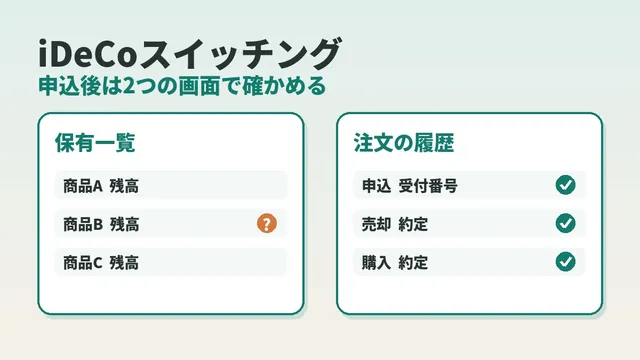
One more thing: the sale and the purchase are always applied for as a set. You cannot specify selling first and then buying on some later day.
What to do about domestic equity and global equity
There are two more issues I lined up before ordering. Should I move the domestic equity product too? And should I also move global equity to the low-cost version?
For domestic equity, looking at cost alone, the case for moving may be weak. The domestic equity index funds in the Rakuten Securities iDeCo are two funds with management costs of 0.143% and 0.176%. The gap is small, and the indexes they track are different. I decided to think about this separately, as a matter of asset allocation.
For global equity, the gap of 0.1219% is on the larger side among the ones here. However, the index changes from FTSE to MSCI.
All of these are issues where cost and asset allocation easily get mixed up. I decided to settle them in the following order.
- Decide the overall asset allocation first (the ratio of domestic, US, and global)
- Within that allocation, choose the lower-cost product that plays the same role
- Look at the size of the balance and decide between all at once and installments
If the allocation itself ends up changing in order to lower costs, the goal has been swapped out. This is something I want to keep separate.
In the sense of being a cost you pay every year, trust fees have the same structure as fixed costs. Review them once and the effect lasts. With communication costs like a phone bill, the difference may be easier to see if you convert them to an annual amount with the same eye.
Clicking this opens the Rakuten login page. Once you log in, you’ll see the campaign details.
Switching steps at Rakuten Securities
I also checked the ordering flow in the official guidance. If you have a Rakuten Securities account, the steps are as follows.
- Log in to Rakuten Securities and open “Order” under “Defined contribution pension”
- Select “Replace held products” (this takes you to the JIS&T screen)
- Select the product you want to sell
- Select the product you want to buy as the replacement
- Check the scheduled execution dates on the screen
- Check the quantity to sell and press “Confirm application”
- Check the details and press “Yes”
- Change the contribution allocation too, if needed, through a separate procedure
If you do not have a Rakuten Securities account, you log in to the JIS&T site and do the same thing.
The cutoff is 10:00 a.m. on business days
Knowing the rules for acceptance and cancellation in advance also saves you from scrambling.
| Item | Details |
|---|---|
| Acceptance hours | 24 hours in principle (online) |
| Cutoff time | 10:00 a.m. on business days. Later applications are treated as received on the next business day |
| Cancellation (applications made by 10:00 a.m.) | Until 10:00 a.m. that day |
| Cancellation (applications made after 10:00 a.m.) | Until 10:00 a.m. on the next business day |
| Changing the product to purchase | Possible even after the cutoff, until the purchase order is placed |
| Limit on number of times | None |
The execution dates and market values shown on screen are for reference only. The actual dates and prices can change depending on market conditions. Before ordering, check the latest display on your own application screen.
The December 2026 rule change and allocation changes
There is one more reason I want to look at my allocation now: the increase in iDeCo contribution limits. Ministry of Health, Labour and Welfare materials say it is scheduled to take effect on December 1, 2026.
For example, for company employees with no corporate pension, the limit rises from ¥23,000 a month to ¥62,000 a month . Those with a corporate pension are also capped at ¥62,000 a month combined with the corporate pension and the like. For Category 1 insured persons, it becomes ¥75,000 a month combined with the National Pension Fund and the like.
It applies from the contribution for December 2026, which is debited in January 2027. Changing your contribution amount is said to require a procedure.
If contributions go up, where they go matters more. If the allocation is still pointed at high-cost products, the increase flows there too. In that sense as well, looking at the allocation change before switching seems to make sense.
The option of doing just the allocation change first
There is also the approach of leaving the balance where it is and doing only the allocation change first. That directs only new contributions to the low-cost product. This way there is no standby period. While the gap is around 0.1% a year and the balance is still small, this may be enough.
Common mistakes and pitfalls
Here are the points where I felt it would be easy to trip up as I researched before ordering.
- Doing only the switch and forgetting to change the contribution allocation
- Assuming the underlying indexes are the same because the names are similar
- Looking only at the management fee column and missing the real cost
- Thinking the sale and purchase finish on the same day and not considering the standby period
- Assuming you can sell by amount and not preparing the unit or percentage calculation
- Not knowing about the 10:00 a.m. cutoff and applying on the assumption that you can cancel
- Meaning to lower costs but ending up changing the asset allocation too
The first one in particular seems easy to do. Once the balance has moved, it feels like the job is finished.
What to check before you start
- I checked the management costs (including trust fees) of the products I hold in a list
- I checked how the index tracked by the destination product differs
- I checked whether a redemption reserve charge applies to the product
- I calculated how much the trust fee gap comes to per year on my own balance
- I decided the overall asset allocation first
- I decided whether to move all at once or in installments, and if in installments, the number of rounds and the percentage
- I am ready to check the scheduled execution dates for the sale and purchase on the application screen
- I understand the 10:00 a.m. business day cutoff and the cancellation conditions
- I will also review the allocation of my monthly contributions
Frequently asked questions
Q. Is there a fee for iDeCo switching?
There is no fee for the procedure itself. That is what the JIS&T FAQ says. However, depending on the product, a redemption reserve charge may apply. It is reassuring to check the detail pages of both the product you sell and the one you buy.
Q. How many times can I switch?
There is no limit on the number of times. The JIS&T FAQ says it can be done any number of times. So splitting it into several rounds is not a problem as far as the count goes.
Q. How many days does it take from sale to purchase?
The official page only says “a prescribed number of days.” You can check the scheduled execution dates on screen when you apply. It varies with the combination of products, so check on your own screen.
Q. Which is more advantageous, all at once or installments?
Officially, neither is said to be more advantageous. That is because nobody knows whether the market will go up or down while you wait. I think of installments less as a way to gain an edge and more as a way to smooth out the effect of price movement.
Q. If I switch, do my monthly contributions change to the new product too?
No. Switching is an operation that moves the balance you hold. To change the products bought with your monthly contributions, you need to do an allocation change separately.
Q. Can I cancel after applying?
You can cancel up to the cutoff time. For applications made by 10:00 a.m. on a business day, that is until 10:00 a.m. that day. For applications made after 10:00 a.m., it is until 10:00 a.m. on the next business day.
Q. Is the gain on the sale taxed?
According to the Rakuten Securities explanation, gains during the investment period in iDeCo are tax-free. The wording included gains from redeeming investment trusts. Tax rules can change, so please check the official sources for the latest treatment.
Official sources I referred to
- Rakuten Securities iDeCo | Change procedures (switching and allocation settings)
- Rakuten Securities iDeCo | Product list
- Rakuten Securities iDeCo | Benefits and points to note
- Rakuten Securities | Two investment trusts added to the iDeCo lineup (January 2024)
- Rakuten Securities | How to use switching (smartphone)
- Rakuten Securities | Rakuten US Total Market Index Fund (iDeCo)
- JIS&T | Frequently asked questions (switching)
- JIS&T | Execution dates for switching sales and purchases
- iDeCo official site | Reviewing your investment products
- Ministry of Health, Labour and Welfare | 2025 system revision
- Ministry of Health, Labour and Welfare | Increase in iDeCo contribution limits (PDF)
Summary
iDeCo switching has no fee and no limit on the number of times. So the cost does not change whether you go all at once or in installments. What differs is how you take the price movement during the period the money waits as cash.
The trust fee gap between index funds is around ¥1,000 a year per ¥1,000,000 of balance. Running the numbers showed me this is not something to rush. That frees up time to settle the index differences and the asset allocation first.
From here, I plan to decide my allocation and then check the execution dates on the application screen. The order comes after that. What I have written here is my own way of organizing things. It is not a recommendation of any particular product. For the final decision, please also check official information and consult a professional.
I wrote about the days when I was switching every month in my corporate DC plan in my look back at switching in a corporate DC plan. The lesson from moving things too much is also feeding into the plan this time. I summarized my Rakuten Securities settings in a checkup of points investing and SPU. For coming up with money to invest, how I reviewed my phone bill and put the savings into NISA is close in content.
Why not start by looking over the management costs of the products you hold in a list?
When it comes to lowering costs you pay every year, communication costs are the same. As a way to make room for regular investing, take a look at your phone bill too.
Clicking this opens the Rakuten login page. Once you log in, you’ll see the campaign details.
This article contains affiliate advertising. If you sign up for a product or service through a link on this site, we may receive compensation from the partner company. The site operator is also an employee of Rakuten Group and may receive compensation through an employee referral program. The content and opinions here are based on the operator’s own experience and research regardless of any advertising relationship, but please read with the above in mind. See the Disclaimer & Affiliate Disclosure for details. Disclaimer & Affiliate Disclosure
This article includes machine-translated content. Please check the official Rakuten Mobile multilingual page for exact terms.
If you have concerns about Rakuten Mobile coverage or signal quality, you can consult through the official signal improvement request form .