- 01What Kodomo NISA is, and when it starts
- 02Kodomo NISA conditions
- 03Withdrawal rules
- 04Differences from Junior NISA
- 05What Zerokan is
- 06What the 0% trust fee actually covers
- 07Trust fees of All Country funds
- 08How each company is handling Kodomo NISA
- 09Points I could not confirm from official sources
- 10Steps up to opening an account
- 11Common mistakes and pitfalls
- 12What to check before you start
- 13Frequently asked questions
- 14Official sources I referred to
- 15Summary
Good morning, this is まさきん.
Kodomo NISA (the children’s NISA) starts in January 2027. Then, on October 1, 2026, SBI Securities announced a dedicated fund with a 0% trust fee, nicknamed “Zerokan.” As a father of four, I read the release and wanted to get the conditions straight.
Let me say up front that I have neither opened an account nor bought the fund. This article is a memo listing the conditions I could confirm in official materials. Also, I work for the Rakuten Group. Since this is another company’s product, I am not going to rate it and will only lay out the facts.
Note: This information is current as of publication. Please check the official sites for the latest conditions.
- Kodomo NISA is a nickname. In substance it is a revision that lowers the eligible age for the Tsumitate (installment) investment quota down to age 0. It starts in January 2027
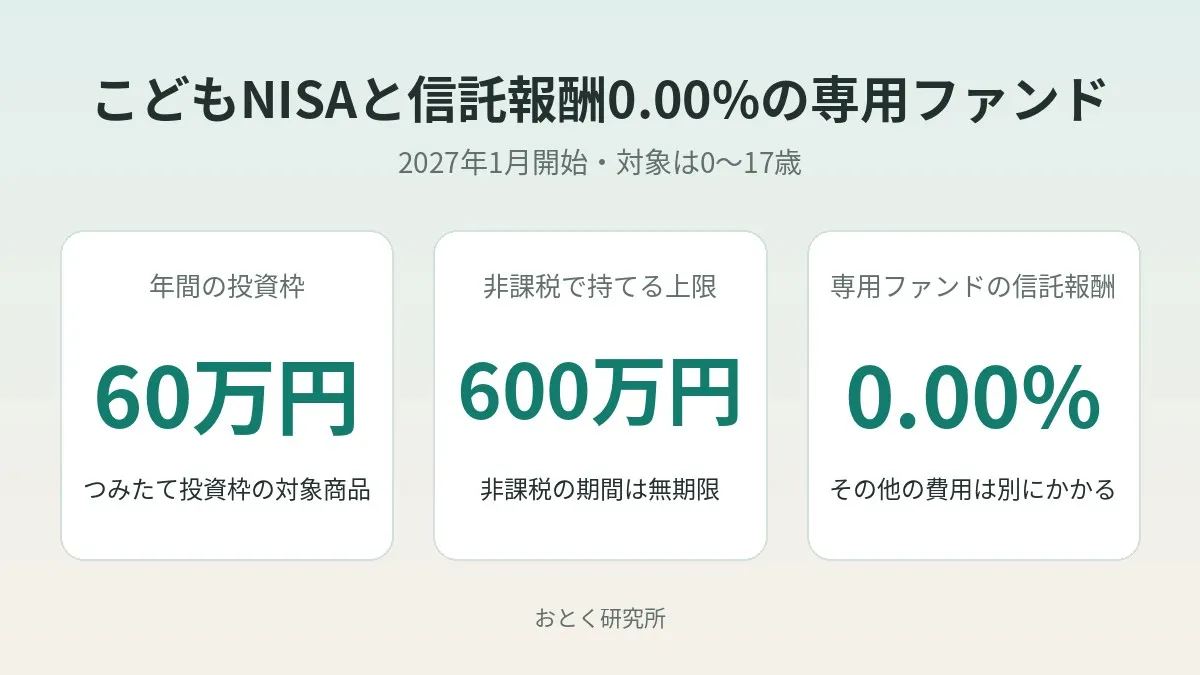
- It covers ages 0 to 17. The annual investment quota is ¥600,000 , and the tax-free holding limit is ¥6,000,000
- Withdrawals are not allowed in principle. From age 12, they are possible under certain requirements, such as the money being used for the child and the child consenting
- Zerokan is exclusive to Kodomo NISA, with a trust fee of 0.00% per year (tax included). The fund launch date is November 17, 2026
- I could not confirm from official sources how long the 0% will last, or what the real total cost figure is
What Kodomo NISA is, and when it starts
Kodomo NISA starts in January 2027. I confirmed the start date in the Japan Securities Dealers Association (JSDA) leaflet and in Ministry of Finance materials.
That said, “Kodomo NISA” is a nickname. Ministry of Finance and Financial Services Agency documents do not use the term. They describe it along the lines of “a review of the eligible age for the Tsumitate investment quota.”
In other words, it does not look like a brand-new system is being created. My understanding is that it is a revision that lets the Tsumitate investment quota of the current NISA be used from age 0. In this article I will call it “Kodomo NISA” for the sake of clarity.
According to the Ministry of Finance’s public relations magazine, the amended law was passed on March 31, 2026. So this is not at the tax reform outline stage; it is an enacted system.
Kodomo NISA conditions
Here are the conditions in a table. The sources are materials from the JSDA, the Ministry of Finance, and the Financial Services Agency.
| Item | Details |
|---|---|
| Start | January 2027 |
| Eligible age | 0 to 17 |
| Annual investment quota | ¥600,000 |
| Tax-free holding limit | ¥6,000,000 |
| Tax-free period | Indefinite (no rollover procedure needed) |
| Eligible products | Only products eligible for the Tsumitate investment quota |
| Money that can be used for purchases | Limited to funds belonging to the child |
| Changing financial institutions | Not possible |
| After age 18 | Automatically moves to the NISA for ages 18 and over |
The eligible products are certain investment trusts suited to long-term, regular, diversified investing. Listed stocks cannot be bought. The leaflet also says the Growth investment quota cannot be used.
What caught my attention personally is that you cannot change financial institutions. Where you open the account first will keep mattering for a long time. This may be a choice worth making without rushing.
Withdrawal rules
Kodomo NISA has withdrawal restrictions. I think this is the biggest difference from the adult NISA.
The JSDA leaflet explains that withdrawals are restricted in principle. From age 12, withdrawals are possible under certain requirements. The requirements include the money being used for the child.
The Ministry of Finance materials also described the procedure. Withdrawals are possible from age 12 when the child consents. A person with parental authority submits a request form to the financial institution. Documents showing the intended use and the child’s consent are also required.
If you make a withdrawal that does not meet the requirements, the gains and unrealized gains you had received tax-free up to then are taxed. The leaflet also says the NISA account is closed. It may be safer not to put in money you plan to use in the near future.
Until age 12, this is basically money you cannot move. If you want to use it for junior high school entrance exam costs, for example, the timing may not line up. I wrote about when the peaks in education costs arrive in How to find the “cliff year” of education costs with a timeline. Looking at it alongside the withdrawal timing should make the decision easier.
Differences from Junior NISA
Let me also line up how it differs from Junior NISA, which ended at the end of 2023. This is based on the comparison in an explainer article by SBI Securities.
| Item | Junior NISA (ended at the end of 2023) | Kodomo NISA |
|---|---|---|
| Eligible age | Under 20 (under 18 in 2023) | Under 18 |
| Annual investment limit | ¥800,000 | ¥600,000 |
| Tax-free holding limit | ¥4,000,000 | ¥6,000,000 |
| Tax-free period | Up to 5 years | Indefinite |
| Eligible products | Stocks and investment trusts | Products eligible for the Tsumitate investment quota |
| Withdrawals | Not allowed in principle until age 18 | Allowed with conditions from age 12 |
The annual quota got smaller. On the other hand, the holding limit and the tax-free period have expanded. The Financial Services Agency’s newsletter also explained that the tax-free period is indefinite.
What Zerokan is
This is the main topic of the release. Zerokan is a nickname; the official name is the “SBI Zero All Country Index Fund.” SBI Securities announced it on October 1, 2026.
| Item | Details |
|---|---|
| Official name | SBI Zero All Country Index Fund (nickname: Zerokan) |
| Asset manager | SBI Asset Management |
| Product category | Open-ended investment trust / Domestic and overseas / Equity / Index type |
| Target index | MSCI All Country World Index (including dividends, yen-converted basis) |
| Trust fee | 0.00% per year (tax included) |
| Fund launch date | November 17, 2026 |
| Sales start date | In line with the start date of Kodomo NISA handling |
| Eligible account | Kodomo NISA only |
It is an investment trust that aims to track the same index as the so-called “Orukan” (All Country). It is structured to invest through a mother fund. The release explains that it will be handled exclusively for Kodomo NISA. Regular installment purchases are also limited to Kodomo NISA.
A sister fund was announced on the same day. It is nicknamed “SBI All Country,” and its mother fund is the same as Zerokan’s. Its trust fee is 0.055% per year (tax included). This one can be bought in the adult NISA and in taxable accounts as well.
What the 0% trust fee actually covers
The 0% trust fee figure is one where you want to read all the way through the footnotes. What is zero is strictly the trust fee portion.
The footnote in the release defines what 0.00% means. It means that the compensation to the asset manager, the trustee, and the distributor, which is deducted daily from the trust assets, is zero.
On the other hand, other costs apply separately. These include audit fees and brokerage commissions on trades. The footnote said these are borne indirectly from the trust assets. The details are to be checked in the summary prospectus.
“A 0% trust fee” and “completely zero cost” are not the same thing. The full picture of costs while you hold the fund needs to be checked in the prospectus and the management report. And as with any other investment trust, there is a risk of losses from price fluctuations.
What happens after age 18
The release also covered what happens after the child turns 18. The balance held in Kodomo NISA is carried over into the regular NISA. That portion can reportedly continue to be held at a 0.00% trust fee.
However, installment purchases of Zerokan are limited to Kodomo NISA. If you want to keep investing regularly in the same target after age 18, you set up a separate installment plan. SBI All Country was presented as the vehicle for that.
Trust fees of All Country funds
Let me line up funds that aim to track the same index by trust fee. The figures are as of when I was able to confirm them on each official page.
| Fund | Trust fee (tax included, annual) | Source and date |
|---|---|---|
| Zerokan | 0.00% | SBI Securities release (October 1, 2026) |
| SBI All Country | 0.055% | SBI Securities release (October 1, 2026) |
| Rakuten Plus All Country | 0.0561% | Rakuten Securities official page |
| eMAXIS Slim All Country Equity | 0.05775% or less | Asset manager’s official page (as displayed in September 2025) |
The three funds other than Zerokan are not exclusive to Kodomo NISA. The eMAXIS Slim figure is what was displayed a year ago. I have not been able to confirm the latest rate as of October 2026.
Rakuten Plus All Country has a points rebate based on the balance you hold. The Rakuten Securities page listed it at 0.017% per year. That is a part you cannot fully compare from the trust fee figure alone.
What struck me looking at the numbers is how small the differences are. The gap between 0.055% and 0.00% is about ¥550 a year on a balance of ¥1,000,000. So it may be a little hasty to pick an account based on the trust fee alone. The fact that you cannot change financial institutions seems likely to matter more.
How each company is handling Kodomo NISA
Here is where each company stands, as far as I could confirm from official sources.
- SBI Securities: Its own article says account opening applications are scheduled to begin in October 2026. A minor’s account in the child’s name is required, and one of the persons with parental authority must hold an SBI Securities account
- Rakuten Securities: It has published a special Kodomo NISA page. It describes a planned start in January 2027, ages 0 to 17, and ¥600,000 per year with a ¥6,000,000 total. In July 2026 it held a school for parents and children at the Tokyo Stock Exchange
- Matsui Securities: In a September 3 release, it announced plans to start taking account opening reservations from October 1, 2026
- MUFG (MUFG Bank, Mitsubishi UFJ eSmart Securities, and others): In an August 14 release, it announced it would start accepting account opening applications in October 2026
On the Rakuten Securities special page, I could not find a stated date for when applications open. I also have not found any announcement from the Rakuten Group side about a dedicated fund with a 0% trust fee. This is strictly as of when I looked.
Points I could not confirm from official sources
I will be honest here. Even after reading the release, there were several things I could not figure out.
- How long the 0.00% trust fee will last. The release states neither a time limit nor conditions for revision
- The real cost figure (total expense ratio). Since the fund has not started operating, there should be no actual figure yet
- The purchase fee, the redemption reserve charge, the minimum purchase amount, the trust period, and the distribution policy
- Whether one-off spot purchases, rather than installments, are possible
- Whether it can be bought anywhere other than SBI Securities
- The specific sales start date (it only says “in line with the start date of Kodomo NISA handling”)
- Any official explanation of how gift tax applies when parents or grandparents provide the money
- Whether the financial institution can be changed after age 18
How long the 0% lasts is especially important. There was no clear statement that it is permanent, nor that it is for a limited time. So it seems best not to assume it will “always be 0%.”
The prospectus is not yet available. Once it is published, I plan to read the sections on the trust fee and on changes to the trust deed.
Steps up to opening an account
I have not applied yet, but here is the sequence I have in mind. This is the order of preparation, not a result.
- Read the conditions of the system in the JSDA leaflet
- Decide when the money will be used, given the withdrawal restrictions
- Sort out whether the money belongs to the child
- Compare candidate institutions on the assumption that you cannot change later
- If considering Zerokan, wait for the prospectus to be published and check the full cost picture
- Check each company’s conditions on its official page, such as whether a parent’s account is required
- Check the documents needed for the application in each company’s guidance
Where the money comes from is a point where it is easy to get lost. The leaflet says it is limited to funds belonging to the child. I could not find an explanation of the gift tax implications in official materials. If the amounts get large, it is safest to check with the tax office or a tax accountant.
There is also the question of how to come up with the money to invest. In my case, I have been putting what I saved by lowering fixed costs into regular investing. I wrote about how that went in How I cut my phone bill by ¥8,000 a month and put it into the new NISA. Communication costs go out every month, so once you lower them the effect tends to keep going.
Clicking this opens the Rakuten login page. Once you log in, you’ll see the campaign details.
Common mistakes and pitfalls
Here are the points where I felt it would be easy to trip up while sorting out the conditions.
- Taking “0% trust fee” to mean “completely zero cost”
- Assuming the 0% also continues for new installment purchases after age 18
- Putting in money you plan to use before age 12
- Choosing where to open the account based on a single product, without knowing you cannot change institutions
- Using money for purchases without separating the parents’ money from the child’s
- Thinking “Kodomo NISA” is the official name and failing to find the official materials
The Ministry of Finance and Financial Services Agency materials are easier to find if you search with the term “Tsumitate investment quota” (つみたて投資枠). The order of priority relative to your own adult NISA is also something to think about. I have also written about my own regular investing in my record of points investing at Rakuten Securities.
What to check before you start
- I confirmed that the system starts in January 2027 and covers ages 0 to 17
- I confirmed that the annual investment quota is ¥600,000 and the tax-free holding limit is ¥6,000,000
- I understand that withdrawals are not allowed in principle until age 12
- I understand that a withdrawal that does not meet the requirements is taxed and the account is closed
- I sorted out whether the money for purchases belongs to the child
- I compared where to open the account on the assumption that the institution cannot be changed
- I made a plan to check the costs of Zerokan other than the trust fee in the prospectus
- I am aware that no time limit for the 0.00% is officially stated
Frequently asked questions
Q. When does Kodomo NISA start?
In January 2027. I confirmed this in the JSDA leaflet and the Ministry of Finance materials. Some companies are starting to accept account opening applications from October 2026.
Q. Is Kodomo NISA the official name of the system?
It is a nickname. Ministry of Finance and Financial Services Agency materials explain it as a review of the eligible age for the Tsumitate investment quota. I think it is easiest to understand as a revision extending the current NISA down to age 0, rather than as a new system.
Q. When can I buy Zerokan?
The fund launch date is November 17, 2026. The sales start date is described as “in line with the start date of Kodomo NISA handling.” I could not confirm a specific date from the release.
Q. If the trust fee is 0%, are there no costs at all?
There are costs. Audit fees, brokerage commissions on trades, and the like are borne indirectly from the trust assets. It looks like the real cost figure will have to be checked in the management report and similar documents after the fund starts operating.
Q. How long will the 0% trust fee last?
The release stated neither a time limit nor conditions for revision. It does explain that holdings can continue to be held at 0.00% after age 18. However, there is no clear statement on whether it is permanent. It needs to be checked in the prospectus.
Q. What happens when the child turns 18?
As a system, the account moves automatically to the NISA for ages 18 and over. No special procedure is said to be needed. Zerokan can continue to be held, but the explanation indicated that new installment purchases are not possible.
Q. Can money be taken out partway through?
Withdrawals are restricted in principle. From age 12, they are possible in cases such as when the money is used for the child and the child consents. If the requirements are not met, the gains are taxed and the account is closed.
Official sources I referred to
- SBI Holdings | News release (October 1, 2026)
- SBI Securities | Release on handling Zerokan (PR TIMES)
- SBI Securities | Explainer article on Kodomo NISA (September 10, 2026)
- SBI Securities | Article comparing Kodomo NISA and Junior NISA
- Japan Securities Dealers Association | Leaflet on NISA for those under 18
- Ministry of Finance | Materials on expanding the NISA Tsumitate investment quota
- Ministry of Finance | PR magazine “Finance,” FY2026 tax reform
- Financial Services Agency | Access FSA, February 2026 issue
- Financial Services Agency | FY2026 tax reform materials
- Rakuten Securities | Kodomo NISA special page
- Rakuten Securities | Rakuten Plus series
- Rakuten Investment Management | Rakuten Plus All Country Equity Index Fund
- Rakuten Securities | Release on the parent-child asset building school
- Mitsubishi UFJ Asset Management | eMAXIS Slim All Country Equity
- Matsui Securities | Press release (September 3, 2026)
- Mitsubishi UFJ eSmart Securities | Press release (August 14, 2026)
Summary
Kodomo NISA starts in January 2027. It covers ages 0 to 17, with up to ¥600,000 per year and ¥6,000,000 in total. Until age 12, withdrawals are not allowed in principle, and the financial institution cannot be changed.
Zerokan is a fund exclusive to Kodomo NISA with a trust fee of 0.00% per year. However, I could not yet confirm from official sources how long the 0% lasts or what the real cost is. It seems best to reread things once the prospectus is out.
This was a memo that goes only as far as lining up the conditions. If you are interested, take a look at the official materials.
If you are thinking about investing regularly for your children, it may make things easier to look over the fixed costs that fund it at the same time. Your phone bill is one of the easier items to review.
Clicking this opens the Rakuten login page. Once you log in, you’ll see the campaign details.
This article contains affiliate advertising. If you sign up for a product or service through a link on this site, we may receive compensation from the partner company. The site operator is also an employee of Rakuten Group and may receive compensation through an employee referral program. The content and opinions here are based on the operator’s own experience and research regardless of any advertising relationship, but please read with the above in mind. See the Disclaimer & Affiliate Disclosure for details. Disclaimer & Affiliate Disclosure
This article includes machine-translated content. Please check the official Rakuten Mobile multilingual page for exact terms.
If you have concerns about Rakuten Mobile coverage or signal quality, you can consult through the official signal improvement request form .